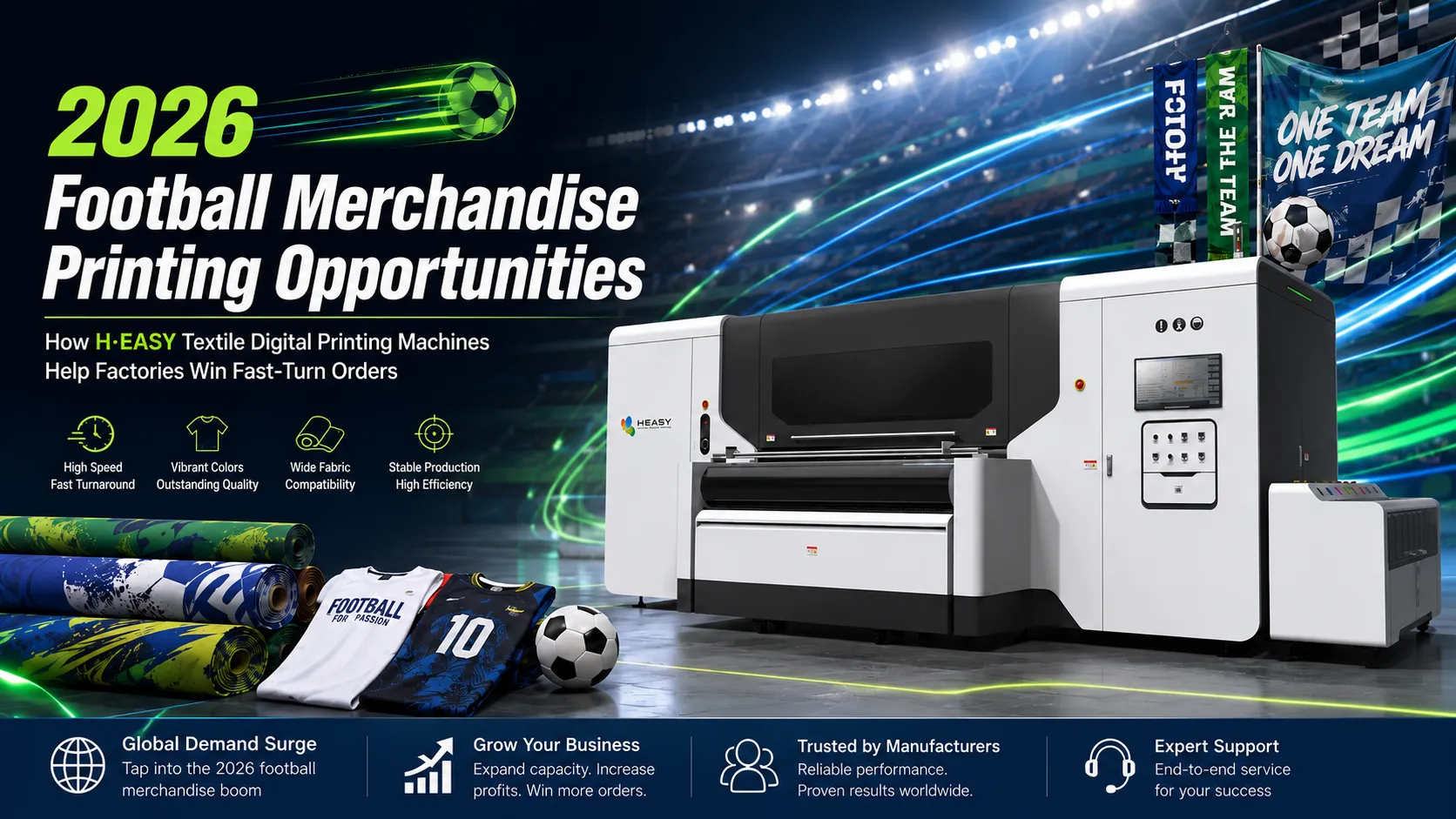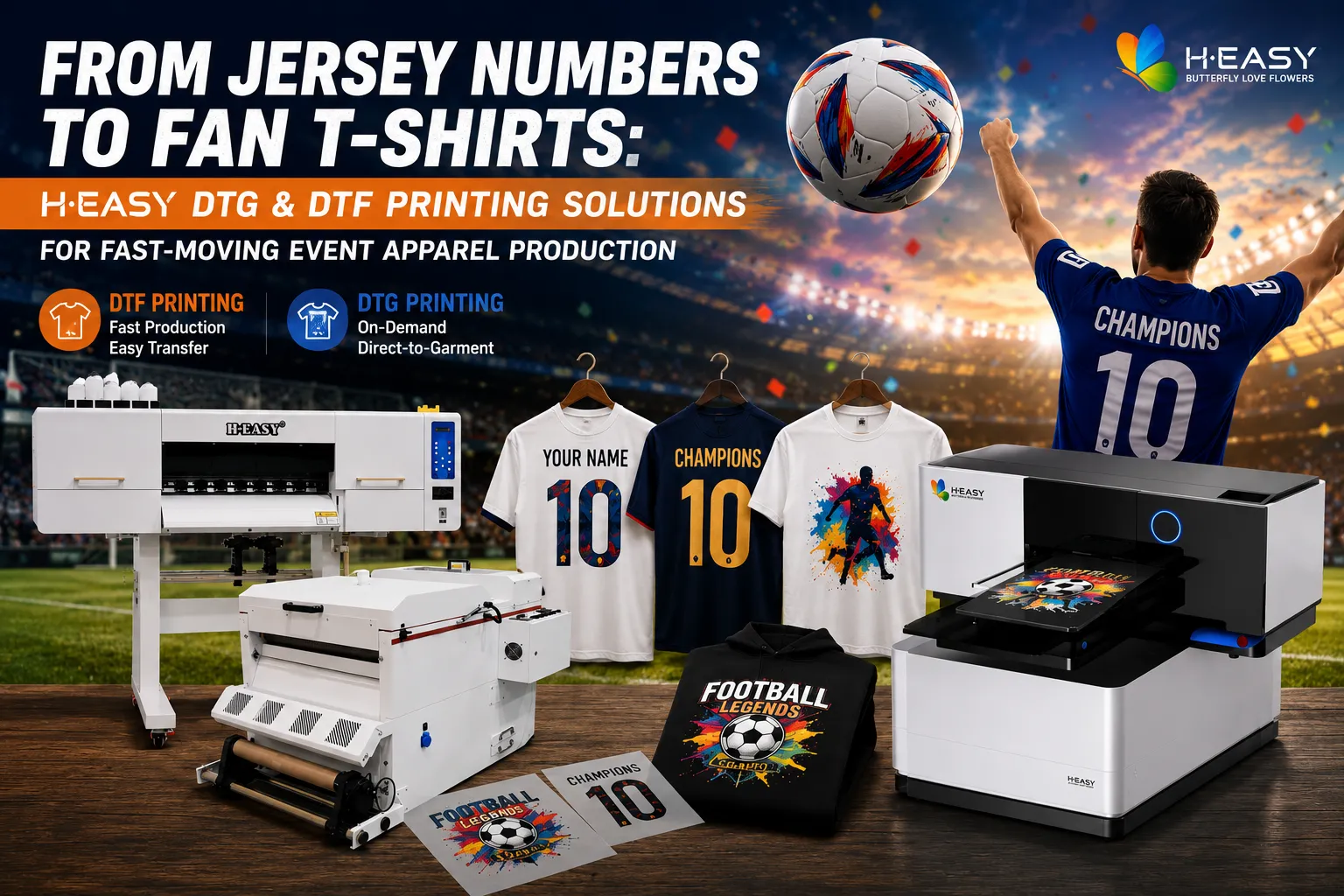
The FIFA World Cup 2026™ is more than a football tournament. It is also a global consumption event that drives demand across apparel, sportswear, fan merchandise and printed textile products.
The 2026 tournament is hosted across Canada, Mexico and the United States, with an expanded format of 48 teams and 104 matches. FIFA’s official schedule runs from 11 June to 19 July 2026, covering 16 host cities across the three countries.
For textile printing factories, this larger event scale means one clear opportunity:
more teams, more fans, more markets, more designs, and more printed textile orders.
Jerseys, fan T-shirts, scarves, team flags, training wear, sportswear, banners and event fabrics all depend on one key production step: textile printing.
But World Cup-related orders often come with pressure. Styles change quickly. Team elements vary by country. Fan demand may rise suddenly after matches. Delivery time is short. For printing factories, the real question is not only whether they can print these products, but whether they can produce them fast, stably and profitably.
Why World Cup Merchandise Is a Production Opportunity
During every major sports event, the demand for printed textile products increases across several categories:
| Product Category | Common Materials | Printing Requirement |
|---|---|---|
| Football jerseys | Polyester, polyester-spandex, quick-dry fabrics | Bright color, wash fastness, high output |
| Fan T-shirts | Cotton, blends, polyester | Small-batch designs, fast turnaround |
| Team scarves | Polyester, acrylic blends, knitted or woven fabrics | Double-sided design, color consistency |
| Team flags | Polyester, knitted flag fabric, pongee | Large-area graphics, color penetration |
| Training wear | Polyester, nylon, sports fabric | Breathability, fastness, bulk production |
| Event banners | Polyester, canvas, decorative fabric | Wide format, quick delivery |
| Home-viewing products | Cushions, decorative cloth, table covers | Flexible design and small batches |
These orders are not limited to official team products. Local brands, fan clubs, sports retailers, e-commerce sellers, event organizers and small apparel brands may all need short-run or bulk printed fabrics during the tournament cycle.
This creates two major production opportunities for printing factories:
- bulk export-style orders for jerseys, sportswear, flags and scarves;
- flexible small-batch orders for custom fan products, sample testing and fast fashion-style event products.
The Challenge: Fast Orders Need More Than a Basic Printer
World Cup merchandise printing is different from normal fabric printing.
Factories may face:
- many countries and team-related designs;
- frequent artwork changes;
- small orders mixed with bulk orders;
- tight delivery windows;
- high requirements for washing and rubbing fastness;
- pressure to reduce cost and waste;
- peak-season overtime production;
- quality consistency across repeated orders.
Traditional screen printing can be efficient for very large repeated orders, but it requires screen-making and longer preparation. Low-quality digital machines may look attractive at first, but during peak season, nozzle clogging, unstable feeding, color difference or downtime can quickly turn orders into losses.
This is why choosing the right textile digital printing machine matters.
A stable digital textile printer allows factories to respond faster, print more designs, reduce setup burden and improve production flexibility.
Bulk Orders: Jerseys, Sportswear and Team Flags
For bulk World Cup-related textile orders, production capacity becomes the first challenge.
Many jerseys, training shirts, sportswear fabrics and team flags are made from polyester or synthetic materials. These fabrics are commonly matched with disperse direct printing or sublimation-related processes, depending on product requirements.
For direct printing on polyester and chemical fiber fabrics, disperse direct printing can provide good color depth, fabric penetration and washing performance. In your provided technical materials, disperse direct printing is described as having better color fastness and penetration compared with transfer printing in relevant applications.
For factories producing sportswear and team flags, this matters because products may need:
- repeated washing;
- bright team colors;
- breathable fabric feel;
- no heavy surface film;
- stable color during bulk production;
- high output during peak season.
H·EASY textile digital printing machines can be configured for different ink solutions, including disperse, reactive, acid and pigment processes according to fabric type and production needs. This gives factories more flexibility beyond one single event season.
Small-Batch Orders: Fan Shirts, Custom Jerseys and Event Products
World Cup-related demand is not only bulk production.
A large part of the market is small-batch and fast-turn:
- custom fan T-shirts;
- city-specific event products;
- limited-edition patterns;
- match-day designs;
- fan club apparel;
- small brand collections;
- sample orders before bulk confirmation.
For these orders, digital textile printing has a major advantage: no screen-making.
Factories can switch designs directly from digital files. This helps reduce setup time and makes small-batch orders more profitable.
For cotton, linen, rayon and blended fabrics, pigment printing can be a practical solution. The provided H·EASY pigment printing materials describe pigment ink as suitable for many fabric types, including cotton, silk, polyester, nylon, rayon, blended fabric, wool and linen.
Pigment printing is also summarized as a simpler workflow of sizing → printing → fixation, while reactive, disperse and acid printing usually require sizing, printing, steaming, washing and finishing.
This simpler workflow is valuable for fast-turn event orders because it can reduce process complexity and shorten production planning.
Why H·EASY Machines Fit World Cup Merchandise Printing
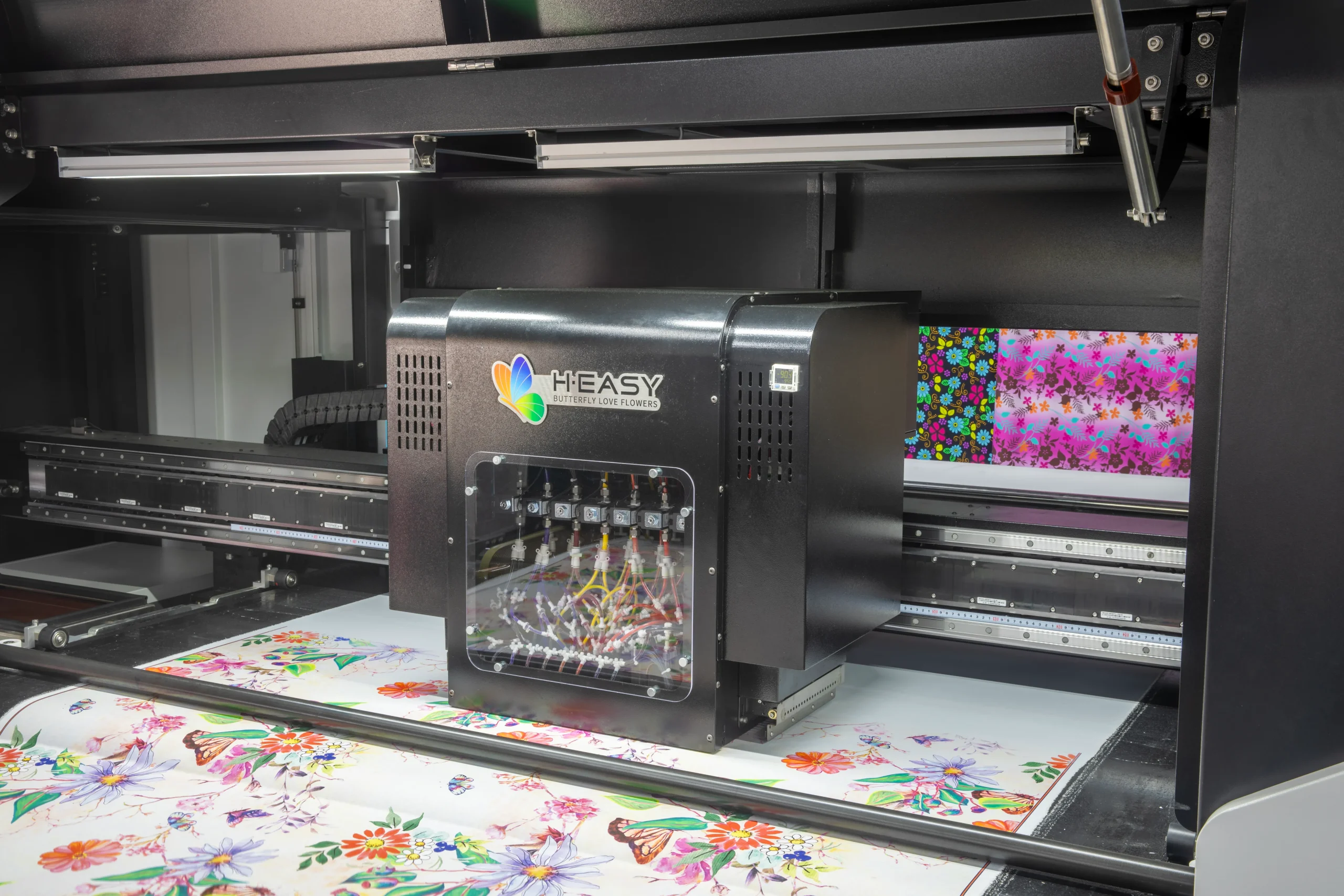
H·EASY textile digital printing machines are designed for industrial direct-to-fabric production. For World Cup-related textile orders, the key advantages are not only speed, but also stability, fabric compatibility and process flexibility.
1. High Productivity for Peak-Season Orders
During tournament seasons, order volume can rise quickly. A machine that performs well during normal production periods may become a bottleneck when facing peak demand.
Different printer configurations provide different levels of production capacity. For example, Ricoh G6-based configurations such as the 1808, 1816, and 1832 models show significant differences in output capability under 1-pass and 2-pass production modes.
2. Flexible Production for Different Fabrics
World Cup merchandise is not made from only one fabric.
Different products may require different textile materials:
| Product | Possible Fabric | Suitable Direction |
|---|---|---|
| Jerseys | Polyester, quick-dry fabric | Disperse direct printing |
| Training wear | Polyester, nylon blends | Disperse or acid depending on fiber |
| Fan T-shirts | Cotton, cotton blends, polyester | Pigment, reactive or disperse depending on fabric |
| Team flags | Polyester flag fabric | Disperse direct printing |
| Scarves | Polyester, acrylic blends, knitted fabrics | Test according to fabric |
| Event banners | Polyester, canvas, decorative cloth | Pigment or disperse depending on material |
| Home-viewing products | Cotton, linen, blends | Pigment or reactive depending on requirements |
H·EASY machines can support multiple ink process directions based on production configuration, helping factories avoid being limited to only one product category.
3. No-Screen Digital Workflow for Fast Design Changes
World Cup designs change quickly.
A team wins a match. A new slogan appears. A local market suddenly demands a certain colorway. A customer wants 50 pieces first, then confirms 5,000 pieces later.
Digital textile printing is well suited to this type of order structure.
With a digital workflow, factories can:
- import artwork directly;
- change patterns quickly;
- produce samples faster;
- reduce screen-making cost;
- handle small and large orders together;
- serve e-commerce and fast fashion customers.
For factories handling both bulk export orders and small domestic or online orders, this flexibility can increase machine utilization throughout the season.
4. Stable Fabric Feeding for Long Production Runs
For jerseys, flags, scarves and sportswear fabrics, stable feeding is essential.
If fabric shifts, wrinkles, arches or skews during printing, the result may include:
- pattern deformation;
- color misalignment;
- wasted fabric;
- lower speed;
- reprinting;
- delivery delay.
H·EASY machines can use a dedicated fabric feeding device, movable feeding pressure roller and constant-tension unwinding and winding system to help keep fabric rolls smooth during feeding.
This is especially important for long-roll event orders where stable continuous production directly affects profit.
5. Drying and Fixation Matching for Better Fastness
World Cup merchandise is not only for display. Jerseys, T-shirts, scarves and flags may be washed, rubbed, folded, packed and shipped internationally.
This means fastness matters.
In pigment printing, fixation references such as 130–150°C for 4–6 minutes in one process, and 170°C for 4 minutes in another pigment ink reference. The latter can achieve dry rubbing fastness level 3 and wet rubbing fastness level 2.5, with about 0.5 level improvement after adding fixing agent.
For disperse direct printing, fixation and color development should also be matched with the fabric and ink process.
The key point is simple:
Fast printing must be matched with proper drying and fixation.
A high-speed textile printing machine without matched drying capacity may cause unstable color, poor fastness or floating color.
6. Industrial Structure for Long-Term Production
Event orders create short-term peaks, but equipment is a long-term asset.
A good textile printing machine should not only help during the World Cup season. It should continue to support apparel, home textile, sportswear, fabric sampling and daily custom orders after the tournament.
H·EASY machines use an integrated frame structure, high-precision head bottom plate and independently developed driver boards. The head bottom plate uses wire-cutting processing technology, with minimum cutting size reaching about 0.01mm to help ensure printing accuracy.
The company materials also state that Han Leading has developed Ricoh printhead driving boards since 2014 and has experience with Gen5, Gen5e and Gen6 printheads.
For factories choosing equipment for 3–5 years of production, this type of mechanical and electronic stability is more important than simply comparing purchase price.
Recommended H·EASY Solutions for World Cup-Related Orders
| Factory Situation | Recommended Direction |
|---|---|
| New factory entering digital textile printing | H·EASY H1808 |
| Small-batch fan apparel and custom products | H·EASY H1808 / H1816 |
| Regular jersey and sportswear fabric production | H·EASY H1816 |
| Mixed small-batch and bulk orders | H·EASY H1816 |
| High-output textile production | H·EASY H1832 |
| Long-roll flag or event fabric production | H·EASY H1816 / H1832 |
| Wider home textile or banner fabrics | Customized wider solutions |
Beyond the World Cup: A Long-Term Digital Printing Opportunity
The World Cup is a strong demand trigger, but it should not be treated as the only reason to invest in digital textile printing equipment.
After the tournament, the same machine can continue producing:
- sportswear fabrics;
- fashion fabrics;
- fan merchandise for local events;
- home textiles;
- custom apparel;
- promotional textile products;
- small-batch e-commerce orders;
- seasonal collections;
- fabric sampling for brands.
This is why H·EASY textile digital printing machines are not only for one sports event. They are suitable for factories that want to move toward flexible, digital and environmentally conscious textile production.
Final Checklist Before Buying a Machine for Event Merchandise Printing
Before adding a new machine, factories should confirm:
- What products will be printed most often: jerseys, flags, T-shirts, scarves or banners?
- What fabrics are used: polyester, cotton, blends, nylon or decorative fabrics?
- Which ink process is most suitable: disperse, pigment, reactive or acid?
- What is the target daily output?
- Is the factory focused on bulk orders, small-batch orders or both?
- Can drying and fixation match the printing speed?
- Is the fabric feeding system stable for long-roll production?
- Does the supplier provide process support and machine training?
- Are spare parts, ink and after-sales service available?
- Can the machine continue producing after the World Cup season?
Conclusion
The FIFA World Cup 2026™ creates a major opportunity for textile printing factories. As the tournament expands to 48 teams and 104 matches across Canada, Mexico and the United States, the demand for jerseys, fan T-shirts, scarves, flags, sportswear and event fabrics becomes more diverse and time-sensitive.
For factories, the winner is not always the one with the lowest machine cost. It is the one with stable production, flexible design switching, matched fabric processes and reliable delivery capacity.
H·EASY textile digital printing machines help factories handle both bulk production and flexible small-batch orders. With different model options, stable machine structure, Ricoh printhead application experience, tested ink-process support and matched drying/fixation solutions, H·EASY can help textile printing factories capture World Cup-related demand and build long-term digital printing capability beyond the tournament season.
Frequently Asked Questions
Major football tournaments increase demand for jerseys, fan T-shirts, scarves, flags, sportswear, event banners and other printed textile products.
Most football jerseys are made from polyester or quick-dry synthetic fabrics, so disperse direct printing or sublimation-related processes are commonly used. The best choice depends on fabric type, color requirement and fastness standard.
Yes. H·EASY textile digital printing machines are suitable for both bulk production and flexible digital design switching, depending on model and ink process configuration.
H1808 is suitable for small-batch and flexible orders, H1816 is suitable for balanced industrial production, and H1832 is suitable for high-output bulk production.
Yes. Pigment printing can be suitable for cotton, blended fabrics and some custom fan products, especially when small-batch production and fast design changes are required.
Yes. The same textile digital printing machine can continue producing sportswear fabrics, fashion fabrics, home textiles, custom apparel, promotional products and small-batch e-commerce orders.