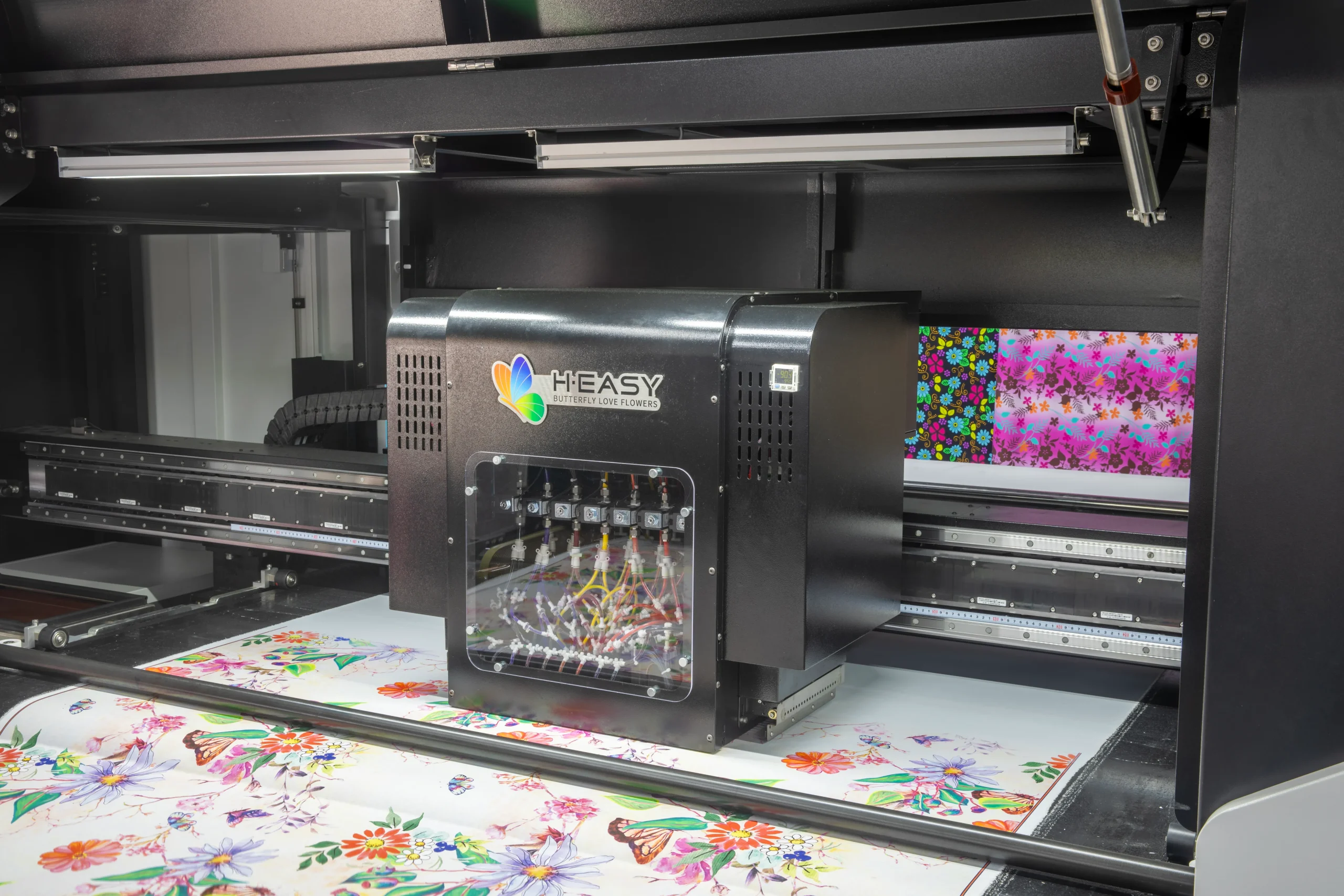
When choosing a pigment ink textile printer, the printhead is one of the most important decisions. For industrial fabric production, Ricoh Gen5 and Ricoh Gen6 are two common options, but they are designed for different production priorities.
So, which one is better?
Ricoh Gen5 is usually the better choice when penetration, application maturity, and stable long-term production are the main priorities. Ricoh Gen6 is better when higher productivity, finer droplets, and faster industrial output are more important.
The choice is not simply about which printhead is newer. A factory should consider:
- fabric type;
- pattern requirements;
- target production capacity;
- print mode;
- maintenance capability;
- ink and printhead compatibility;
- machine structure;
- long-term production cost.
This guide compares Ricoh Gen5 and Gen6 specifically for pigment printing in textile production and explains how to choose the right configuration for an industrial pigment inkjet printer.
Quick Answer: Ricoh Gen5 or Gen6?
| Comparison | Ricoh Gen5 | Ricoh Gen6 |
|---|---|---|
| Minimum droplet | 7 pl | 5 pl |
| Reference firing frequency | 20 kHz | 50 kHz |
| Main strength | Penetration and mature application | Speed and finer output |
| Print fineness | Good | Better than Gen5 |
| Production efficiency | Lower | Higher |
| Pigment application maturity | Very mature | Mature and increasingly adopted |
| Best for | Stability-focused production | Productivity-focused production |
| Typical factory priority | Mature process and penetration | Higher output and finer patterns |
Ricoh Gen5 is a durable printhead with good penetration and a mature application solution. Ricoh Gen6 uses smaller droplets, offers higher efficiency, and provides better fineness than Gen5.
Why Printhead Choice Matters in Pigment Printing
A printhead used for textile pigment printing does more than place color on fabric.
Pigment ink contains solid color particles and requires good compatibility between:
Ink → Ink Supply System → Printhead → Driver Board → Waveform → Machine Structure → Fabric → Pretreatment → Drying → Fixation
This is why choosing a printhead based only on droplet size is a mistake.
A smaller droplet does not automatically guarantee better production. A faster printhead does not automatically guarantee lower cost. And a wider digital textile printer does not automatically produce better fabric.
For a factory that wants to pigment print fabric continuously, the complete printing system determines whether the machine can deliver stable output.
1. Ricoh Gen5 vs Gen6: Droplet Size and Print Fineness
The most obvious difference is droplet size.
Ricoh Gen5
The provided technical materials list Ricoh Gen5 with:
- 7 pl minimum droplet;
- 7 / 14 / 21 pl droplet levels;
- 20 kHz reference firing frequency.
Its larger droplets provide strong ink delivery and good penetration. This can be valuable for fabrics where sufficient ink penetration is more important than extremely fine image detail.
Ricoh Gen6
Ricoh Gen6 is listed with:
- 5 pl minimum droplet;
- 5 / 10 / 15 pl droplet levels;
- 50 kHz reference firing frequency.
The smaller minimum droplet allows Gen6 to produce finer dots than Gen5. This can improve detail, transitions, and overall image fineness.
Which Is Better?
Choose Gen5 when:
- penetration is important;
- designs do not require extremely fine details;
- a mature pigment process is the priority.
Choose Gen6 when:
- finer details are required;
- higher production efficiency is important;
- the factory needs more output from its Pigment Ink Textile Printer.
The company pigment solution materials describe Gen5 as having stronger penetration but thicker dots, while Gen6 provides better fineness and higher efficiency.
2. Ricoh Gen5 vs Gen6: Production Speed
For industrial textile factories, speed is often one of the main reasons to choose Gen6.
Ricoh Gen5 has a lower firing frequency, while Gen6 is designed for higher-frequency operation. In the provided application materials, Gen5 is referenced at 20 kHz and Gen6 at 50 kHz.
This difference gives Gen6 a stronger advantage in high-output configurations.
However, printhead frequency alone does not determine actual printer speed.
Real production capacity also depends on:
- number of printheads;
- carriage speed;
- pass mode;
- feathering;
- fabric width;
- pattern coverage;
- machine mechanical accuracy;
- data processing;
- drying capacity.
This is important when comparing any textile printing machine. Two machines using the same Ricoh Gen6 printhead may still have very different real production performance.
3. Ricoh Gen5 vs Gen6: Penetration
Penetration is one of the major strengths of Ricoh Gen5.
The larger minimum droplet can deliver more ink in each dot, which is useful for fabrics that need stronger penetration. In some applications, this can help reduce surface-only color and improve coverage.
Ricoh printheads in general are also described in the provided technical materials as having strong jetting force, which is useful for textile applications.
Gen5 Is Better Suited to:
- fabrics requiring stronger penetration;
- patterns where coverage is more important than ultra-fine detail;
- factories with an established Gen5 pigment process;
- production environments that prioritize mature application stability.
Gen6 Is Better Suited to:
- patterns requiring finer detail;
- smoother transitions;
- higher output;
- factories that need a better balance between quality and production efficiency.
For pigment printing in textile, penetration is not determined by the printhead alone. Pretreatment, ink volume, fabric absorbency, printing mode, and fixation also affect the final result.
4. Does Gen6 Always Produce Better Print Quality?
No.
Gen6 has a smaller minimum droplet, so it has a technical advantage in fineness. But final print quality depends on much more than droplet size.
A high-quality digital fabric printer also requires:
- precise printhead alignment;
- stable carriage movement;
- accurate fabric feeding;
- suitable waveform settings;
- stable ink supply;
- proper RIP software;
- optimized ICC profiles;
- correct pretreatment.
A poorly aligned Gen6 machine may produce worse output than a well-designed Gen5 machine.
This is especially important in multi-head industrial printing. When more printheads are installed, the mechanical accuracy of the fabric printing equipment becomes increasingly important.
5. Ricoh Gen5 vs Gen6: Application Maturity
Application maturity is one of the strongest reasons to consider Gen5.
The provided pigment solution materials describe Ricoh Gen5 pigment applications as mature in both domestic and overseas markets. Gen5 has been used for a longer period, so many common problems related to ink, board adaptation, maintenance, and production have already been encountered and solved.
Gen6, by comparison, provides higher efficiency and better fineness. Its pigment application base has also continued to grow.
Therefore:
Gen5 = mature and conservative choice
Gen6 = higher-performance and productivity-focused choice
For a factory entering industrial pigment printing for the first time, maturity can sometimes be more valuable than maximum speed.
For an experienced factory with stable orders and stronger technical capability, Gen6 may create better long-term productivity.
6. Ricoh Gen5 vs Gen6: Durability and Maintenance
Both Gen5 and Gen6 are described in the supplied materials as durable industrial printheads.
An average reference service life of approximately three to four years for Ricoh printheads, although actual service life depends heavily on:
- operating hours;
- ink quality;
- maintenance;
- workshop environment;
- fabric surface;
- printhead height;
- accidental head strikes.
The more important point is that both printheads require a well-controlled printing environment.
The supplied H·EASY process data recommends approximately:
Temperature: 20–30°C
Humidity: 50–65%
Excessively high or low humidity can affect printhead condition and increase clogging risk.
A reliable pigment ink printer should therefore be installed in a controlled environment.
Regular maintenance should include:
- checking nozzle condition before production;
- using compatible pigment ink;
- cleaning ink lines and tanks;
- maintaining stable negative pressure;
- preventing fabric from rubbing against the printhead;
- keeping the workshop clean;
- controlling temperature and humidity.
7. Which Printhead Is Better for Different Production Goals?
Choose Ricoh Gen5 If You Need:
A mature pigment solution
For factories entering industrial pigment printing, Gen5 offers a well-established application base.
Good penetration
The larger droplets are useful when penetration and ink coverage are important.
Stable long-term production
Gen5 is suitable for factories that prioritize process maturity over maximum output.
Lower technical risk for a new project
For a new overseas pigment project, a mature Gen5 configuration may be easier to introduce and manage.
Choose Ricoh Gen6 If You Need:
Higher productivity
Gen6’s higher reference firing frequency supports faster industrial production.
Better fineness
The 5 pl minimum droplet provides finer output than Gen5.
Higher-capacity machine configurations
Gen6 is better suited to production-focused 16-head and 32-head systems.
A balance of speed and print quality
For factories that already have stable orders, Gen6 can increase daily output.
8. Which Is Better for Different Fabrics?
| Fabric / Application | Recommended Direction |
|---|---|
| Cotton | Gen5 or Gen6 |
| Linen | Gen5 or Gen6 |
| Rayon / Viscose | Gen5 when penetration is important |
| Blended fabrics | Gen5 or Gen6 |
| Detailed fashion patterns | Gen6 |
| High-output garment fabric | Gen6 |
| General industrial pigment production | Gen5 or Gen6 |
| Mature, conservative setup | Gen5 |
| Productivity-focused factory | Gen6 |
Pigment ink can be used on a broad range of textile materials. The H·EASY pigment solution includes applications for cotton, silk, polyester, nylon, rayon, blended fabrics, wool, and linen, although each fabric still needs appropriate testing and process control.
For smooth and very thin synthetic fabrics, the choice of printhead alone will not solve the challenge of balancing color fastness and hand feel. The pretreatment and fixation process remain critical.
9. Which Is Better for an 8-Head, 16-Head, or 32-Head Printer?
The right printhead also depends on machine configuration.
8-Head Pigment Ink Textile Printer
For medium-volume production, Gen5 can provide a mature and stable solution. Gen6 can be selected when the factory wants more efficiency from an 8-head configuration.
16-Head Pigment Ink Textile Printer
A 16-head system often needs to balance investment and industrial output.
Gen5 is suitable for factories prioritizing mature pigment production.
Gen6 is suitable for factories prioritizing productivity, finer output, and faster order delivery.
32-Head Pigment Ink Textile Printer
For high-output production, Gen6 is generally the more logical choice because its higher efficiency better matches the purpose of a 32-head system.
A high-capacity printing textile machine also needs sufficient:
- data processing capacity;
- driver board stability;
- fabric feeding accuracy;
- drying capacity;
- fixation capacity.
A fast printhead cannot solve a production bottleneck in the dryer.
10. Why the Driver Board Matters
One important but often overlooked factor is the driver board.
The printhead and driver board must work together correctly. Waveform, firing control, ink characteristics, and machine software all affect jetting stability.
Han Leading began developing Ricoh printhead driver boards in 2014 and continued working with Gen5, Gen5e, and Gen6 configurations. The current H1808, H1816, and H1832 product platforms support G5/G6 configurations with board compatibility.
For a Pigment Ink Textile Printer, this printhead-board compatibility is especially important because pigment ink requires stable jetting and consistent ink supply.
11. Can a Gen5 Printer Be Changed Directly to Gen6?
No. It should not be considered a simple plug-and-play replacement.
Although a machine platform may be available in both G5 and G6 configurations, converting a Gen5 machine to Gen6 requires changes to:
- printheads;
- main board;
- driver boards;
- control system.
Therefore, factories should choose the printhead configuration based on long-term production plans before purchasing the machine.
A buyer should ask:
- What fabrics will we mainly print?
- What is our target daily output?
- Do we prioritize penetration or fineness?
- Will our order volume grow quickly?
- Can our drying system match higher speed?
- Do our operators have experience with high-output digital production?
12. H·EASY Pigment Ink Textile Printer Recommendations
H·EASY offers different industrial direct-to-fabric platforms for different production scales.
H·EASY H1808
Recommended for: flexible and medium-volume production.
Choose a mature G5-based direction when stability and pigment process maturity are the priority. Consider G6 when higher productivity is required.
H·EASY H1816
Recommended for: balanced industrial production.
For many garment fabric factories, H1816 is a practical digital textile printer because it offers a balance between productivity, investment, and production flexibility.
A Gen5 configuration can suit maturity-focused production, while Gen6 is more suitable for factories prioritizing higher efficiency.
H·EASY H1832
Recommended for: high-output bulk production.
H1832 production at up to 700 m²/h in 2-pass mode, depending on configuration and production conditions.
For this type of high-capacity textile fabric printing machine, Gen6 is the stronger direction when output is the main goal.
Why H·EASY for Ricoh Pigment Printing?
A printhead alone does not make a good Pigment Ink Textile Printer.
H·EASY pigment printing solutions combine:
- Ricoh printhead application experience;
- independently developed driver boards;
- integrated machine frame;
- high-precision printhead bottom plate;
- tested pigment ink compatibility;
- fabric feeding system;
- RIP software;
- pretreatment and post-treatment support.
The H·EASY head bottom plate uses wire-cutting technology with a minimum cutting size of about 0.01 mm, helping support printhead alignment and printing accuracy.
This matters because as the number of printheads increases, mechanical precision becomes more important.
For factories comparing fabric printing equipment, the correct question should therefore not be:
Which printhead is better?
A better question is:
Which combination of printhead, machine, ink, board, software, pretreatment, drying, and fixation is better for my production?
Ricoh Gen5 vs Gen6: Final Decision Table
| Your Priority | Better Choice |
|---|---|
| Mature pigment application | Ricoh Gen5 |
| Strong penetration | Ricoh Gen5 |
| Conservative new project | Ricoh Gen5 |
| Higher productivity | Ricoh Gen6 |
| Finer droplets | Ricoh Gen6 |
| Faster industrial output | Ricoh Gen6 |
| High-output 32-head production | Ricoh Gen6 |
| Stable general pigment printing | Gen5 or Gen6 |
| Best overall choice | Depends on fabric and production target |
Conclusion
There is no single winner in the Ricoh Gen5 vs Gen6 comparison.
For a Pigment Ink Textile Printer, Ricoh Gen5 is a strong choice when penetration, maturity, and stable long-term application are the main priorities. Ricoh Gen6 is the better choice when higher productivity, finer droplets, and faster bulk production are more important.
The simplest selection rule is:
Choose Ricoh Gen5 for maturity and penetration.
Choose Ricoh Gen6 for productivity and fineness.
However, the final performance of a pigment inkjet printer depends on the complete system. Machine structure, driver board, ink compatibility, printhead alignment, fabric feeding, pretreatment, drying, and fixation are all critical.
For factories developing industrial textile pigment printing, H·EASY H1808, H1816, and H1832 provide different production directions. By matching the right Ricoh configuration with the right machine and process, factories can build a more stable and efficient pigment printing workflow.