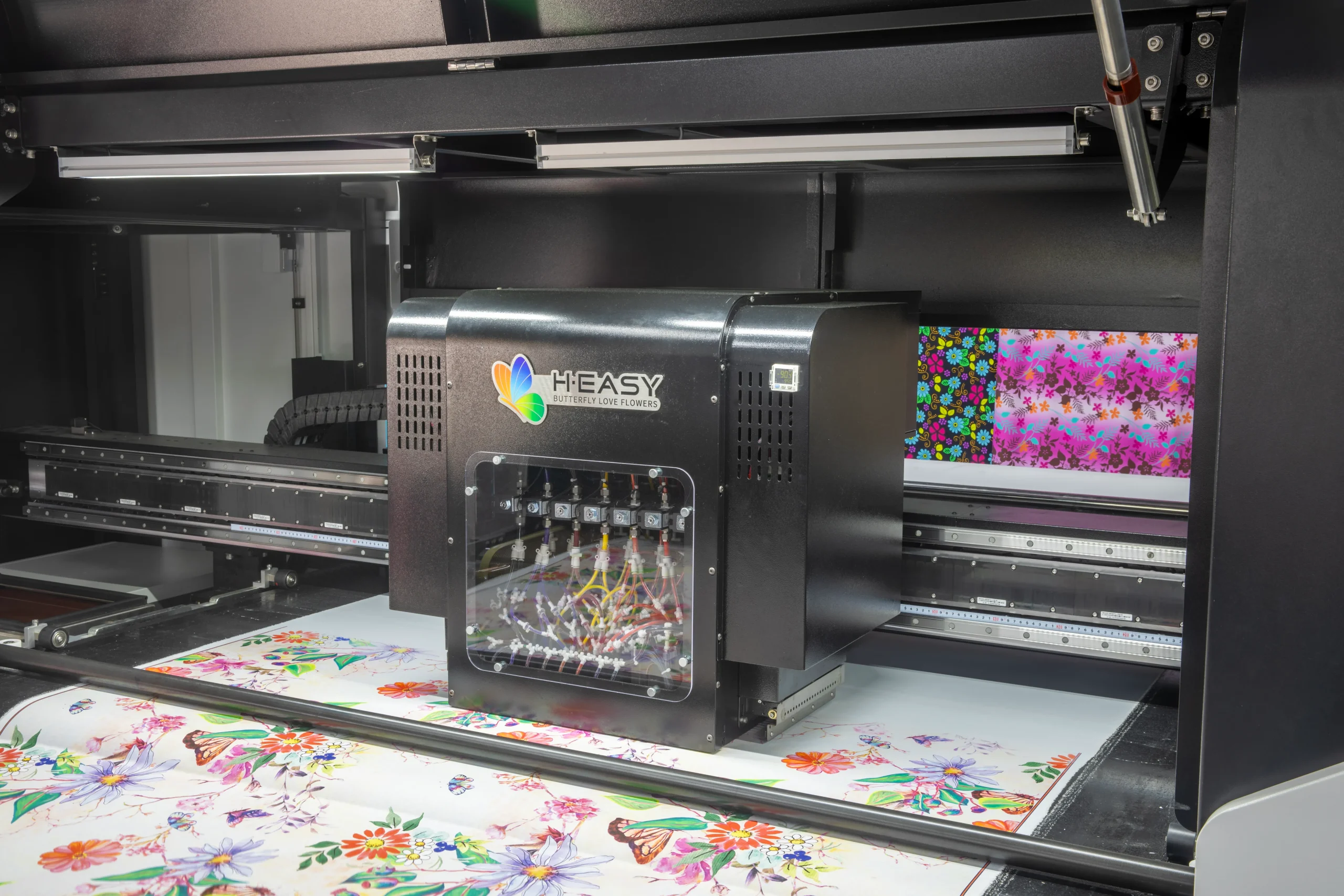
When choosing an industrial pigment inkjet printer, one of the most common questions from textile factories is:
Should I choose an 8-head, 16-head, or 32-head machine?
For factories entering pigment printing in textile production, printhead quantity directly affects production capacity, investment cost, drying requirements, maintenance workload, and future order flexibility. However, more printheads do not always mean better print quality. In industrial textile printing, more printheads mainly increase production speed, while print quality still depends on machine structure, printhead alignment, ink system, RIP software, fabric feeding, pretreatment, and fixation.
This guide compares 8-head, 16-head, and 32-head pigment ink printers and explains how to choose the right H·EASY solution for your fabric printing business.
Quick Answer
| Printer Type | Best For | Main Advantage |
|---|---|---|
| 8-Head Pigment Inkjet Printer | Small to medium production, sampling, flexible orders | Lower investment and easier operation |
| 16-Head Pigment Inkjet Printer | Industrial garment fabric production | Balanced speed, cost, and production flexibility |
| 32-Head Pigment Inkjet Printer | High-output textile factories | Higher capacity for bulk production |
For most factories starting industrial textile pigment printing, a 16-head pigment inkjet printer is often the most balanced choice. For factories with high daily output requirements, a 32-head pigment ink printer is more suitable. For factories entering pigment digital printing or handling medium-volume orders, an 8-head digital fabric printer can be a practical starting point.
What Does “8-Head, 16-Head, 32-Head” Mean?
In a digital textile printer, “head” refers to the number of printheads installed on the machine. More printheads allow the machine to print more ink channels or cover a larger printing area in less time.
However, printhead quantity should not be confused with print resolution. The Q&A materials clearly state that more printheads do not mean higher precision; under certain conditions, more printheads mainly increase production capacity.
In other words:
More printheads = higher potential production capacity
Better precision = machine accuracy + printhead alignment + ink control + software + process
This is why a stable machine structure is critical when choosing a printing on fabric machine for pigment production.
8-Head Pigment Inkjet Printer: Flexible Entry-Level Industrial Production
An 8-head pigment inkjet printer is suitable for factories that need a lower investment, flexible operation, and stable small-to-medium production.
Best For
- New factories entering pigment digital printing;
- sampling and product development;
- small to medium fabric orders;
- fashion fabrics and customized patterns;
- factories with limited production space;
- customers who want to test pigment printing before scaling up.
Main Advantages
An 8-head pigment ink printer is easier to manage and usually requires lower initial investment than 16-head or 32-head systems. It is suitable for factories that need flexibility rather than maximum speed.
For H·EASY H1808, the Q&A materials list reference theoretical speeds under Ricoh G6 configuration as 1-pass 330 m²/h, 2-pass 170 m²/h, and 3-pass 120 m²/h. Actual production speed may be lower depending on feathering, fabric type, pattern coverage, pass mode, and quality requirements.
8-Head Daily Capacity Reference
According to the production capacity table, an 1808 model can reach about 2,500 meters in 20 hours under 2-pass mode and about 5,000 meters in 20 hours under 1-pass mode, based on 1-meter fabric roll calculation.
This makes an 8-head machine suitable for factories that need stable production but do not yet require high-volume bulk output.
16-Head Pigment Inkjet Printer: Balanced Choice for Industrial Production
A 16-head pigment inkjet printer is often the most practical choice for garment fabric factories and medium-to-large textile printing businesses.
Best For
- Industrial garment fabric production;
- cotton and blended fabric printing;
- regular bulk orders;
- factories upgrading from sampling to production;
- customers who need a balance between investment and output;
- factories that want room for future growth.
Main Advantages
Compared with an 8-head machine, a 16-head digital textile printer can significantly increase production capacity at the same pass mode. The Q&A materials also mention that a 16-head machine can nearly double the capacity of an 8-head machine under the same pass setting.
For H·EASY H1816, the reference theoretical speeds are 1-pass 660 m²/h, 2-pass 330 m²/h, and 3-pass 200 m²/h under Ricoh G6 configuration.
16-Head Daily Capacity Reference
According to the capacity table, an 1816 model can reach about 5,000 meters in 20 hours under 2-pass mode and about 10,000 meters in 20 hours under 1-pass mode, based on 1-meter fabric roll calculation.
Why H·EASY H1816 Is Often Recommended
For many textile factories, H·EASY H1816 provides a strong balance between production capacity, investment control, and fabric flexibility. It is suitable for cotton, linen, rayon, blended fabrics, garment fabrics, and many regular industrial orders.
For factories that need a reliable textile printing machine without moving directly into high-cost, high-output production, H1816 is often the most practical model.
32-Head Pigment Inkjet Printer: High-Output Bulk Production
A 32-head pigment inkjet printer is designed for factories with high order volume and strict delivery requirements.
Best For
- Large textile printing factories;
- high-volume bulk production;
- continuous industrial fabric printing;
- factories with stable order flow;
- customers requiring faster delivery;
- large garment fabric or home textile production.
Main Advantages
A 32-head machine provides much higher production capacity than 8-head and 16-head models. It is suitable for factories that already have stable orders, skilled operators, matched pre-treatment and post-treatment equipment, and enough drying or fixation capacity.
For H·EASY H1832, the Q&A materials list reference theoretical speeds as 1-pass 1300 m²/h, 2-pass 700 m²/h, and 3-pass 450 m²/h under Ricoh G6 configuration.
32-Head Daily Capacity Reference
According to the production capacity table, an 1832 model can reach about 10,000 meters in 20 hours under 2-pass mode and about 20,000 meters in 20 hours under 1-pass mode, based on 1-meter fabric roll calculation.
This makes H1832 suitable for factories where production capacity is the key requirement.
Comparison: 8-Head vs 16-Head vs 32-Head
| Item | 8-Head | 16-Head | 32-Head |
|---|---|---|---|
| H·EASY Model | H1808 | H1816 | H1832 |
| Production Level | Small to medium | Industrial balanced production | High-output bulk production |
| Investment | Lower | Medium | Higher |
| Operation Difficulty | Easier | Moderate | Higher |
| Maintenance Load | Lower | Medium | Higher |
| Output Capacity | Lower | Medium-high | High |
| Best Use Case | Sampling, flexible orders | Garment fabric production | Large-scale bulk orders |
| Recommended Factory Type | New or growing factory | Industrial textile factory | High-volume production factory |
Does More Printheads Mean Better Print Quality?
No. More printheads mainly increase production capacity, not print quality.
Print quality depends on:
- mechanical structure;
- printhead bottom plate accuracy;
- printhead alignment;
- ink stability;
- RIP software;
- ICC profile;
- fabric feeding;
- pretreatment;
- drying and fixation.
This is why machine precision matters. H·EASY pigment printing solutions use an integrated frame structure, high-precision head bottom plate, and independently developed driver boards. The H·EASY materials mention that the head bottom plate adopts wire-cutting processing technology, with minimum cutting size around 0.01mm, helping ensure printing accuracy.
For long-term industrial production, this kind of mechanical stability is more important than simply increasing printhead quantity.
Printhead Quantity and Cost
When printhead quantity increases, machine cost also increases.
A 16-head or 32-head fabric printing equipment system requires more printheads, more driver boards, stronger drying capacity, a larger guide belt system, more ink system components, and more maintenance planning.
The Q&A materials explain that a 16-head machine costs much more than an 8-head machine because capacity increases, but the cost of printheads, drying room, belt cleaning system, bottom plate, and degassing components also increases.
So the right question is not:
“Which machine is the biggest?”
The right question is:
“Which machine matches my order volume, fabric type, production cost, and delivery requirements?”
Choose Based on Fabric Type and Application
A textile fabric printing machine should be selected according to the fabrics you print most often.
Pigment ink can be used on many fabric types, including cotton, silk, polyester, nylon, rayon, blended fabric, wool, and linen.
8-Head Is Suitable For
- sample development;
- small-batch cotton fabric;
- customized fashion fabrics;
- medium-volume orders;
- factories testing pigment printing.
16-Head Is Suitable For
- cotton garment fabric;
- blended fabrics;
- regular fabric production;
- fast fashion orders;
- flexible industrial printing.
32-Head Is Suitable For
- high-volume cotton or blended fabric production;
- large garment fabric orders;
- bulk home textile production;
- continuous production lines;
- factories with stable daily orders.
For pigment printing in textile, blended fabrics are one of the important application areas because pigment ink is less dependent on one specific fiber reaction. However, smooth and thin polyester or nylon fabrics should be tested carefully, because fastness and hand feel may be harder to balance.
Do Not Ignore Pretreatment, Drying and Fixation
A pigment inkjet printer alone does not guarantee a good result. Pigment printing requires a matched process.
The typical pigment process includes:
Fabric inspection → Pretreatment / sizing → Digital printing → Drying → Fixation → Softening if needed
H·EASY materials describe the pigment process as fabric inspection, pretreatment, digital printing, and color fixation. Some factories may combine drying and fixation into one process.
For color fastness, fixation is especially important. One H·EASY pigment process reference lists fixation at 130–150°C for 4–6 minutes, while another reference mentions 170°C for 4 minutes for DuPont pigment ink, reaching dry rubbing fastness level 3 and wet rubbing fastness level 2.5, with about 0.5 level improvement after adding fixing agent.
When choosing between 8-head, 16-head, and 32-head systems, make sure the drying and fixation capacity can match printer speed. A high-speed printer without matched drying capacity may cause unstable fixation, floating color, or poor rubbing fastness.
Why H·EASY Pigment Inkjet Printers?
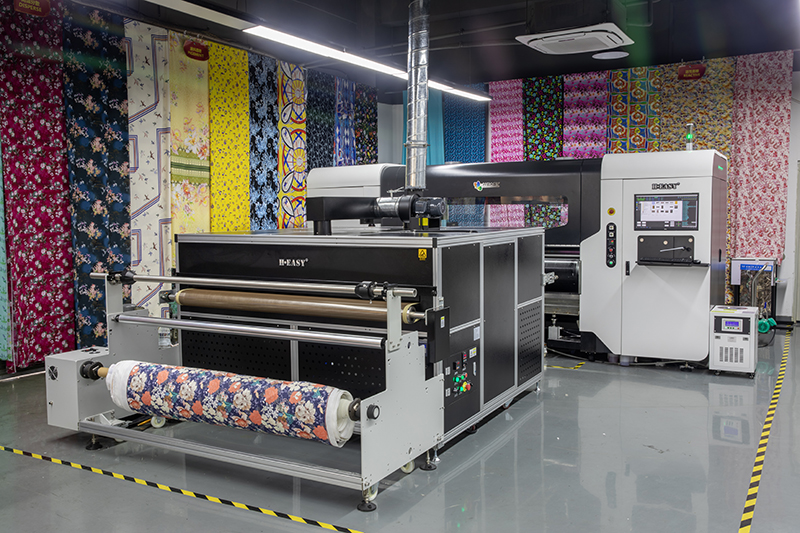
H·EASY provides industrial direct-to-fabric pigment printing solutions for different production scales.
H·EASY H1808: Flexible Entry Choice
H1808 is suitable for factories entering industrial pigment printing or handling medium-volume orders. It is a practical digital fabric printer for customers who need flexibility and controlled investment.
H·EASY H1816: Balanced Industrial Choice
H1816 is recommended for garment fabric factories that need a balance of productivity, stability, and investment. It is suitable for cotton, linen, rayon, blended fabrics, and regular industrial fabric production.
H·EASY H1832: High-Output Production Choice
H1832 is designed for factories that need stronger output and faster bulk delivery. It is suitable for high-volume textile pigment printing and continuous production.
H·EASY also has experience in Ricoh printhead applications and independently developed driver boards. The provided materials state that Han Leading has developed Ricoh printhead driving boards since 2014 and has experience with Gen5, Gen5e, and Gen6 printheads.
How to Choose the Right Model
| Your Situation | Recommended Model |
|---|---|
| You are new to pigment digital printing | H·EASY H1808 |
| You need sampling and small-batch production | H·EASY H1808 |
| You need stable garment fabric production | H·EASY H1816 |
| You want balanced investment and output | H·EASY H1816 |
| You have large daily order volume | H·EASY H1832 |
| You need faster bulk delivery | H·EASY H1832 |
| You print mostly home textiles | Consider wider customized solutions |
Final Checklist Before Buying
Before choosing an 8-head, 16-head, or 32-head printing textile machine, confirm:
- What is your daily output target?
- What fabrics do you mainly print?
- Do you need sampling, bulk production, or both?
- What printing width do you need?
- Can your drying and fixation equipment match printer speed?
- Do you have stable order volume for a 32-head machine?
- What is your budget for printheads and maintenance?
- Does the supplier provide ink, pretreatment, and process support?
- Is the machine structure stable enough for long-term production?
- Is after-sales support available for industrial operation?
Conclusion
Choosing between an 8-head, 16-head, and 32-head pigment inkjet printer depends on your production volume, fabric type, investment budget, delivery requirement, and process capability.
An 8-head pigment ink printer is suitable for flexible entry-level industrial production. A 16-head machine is often the best balanced solution for garment fabric factories. A 32-head machine is ideal for high-output factories with stable bulk orders.
For industrial textile pigment printing, machine stability, printhead alignment, ink compatibility, drying, and fixation are just as important as printhead quantity. H·EASY H1808, H1816, and H1832 provide practical choices for different production scales, helping textile factories build a more efficient and stable pigment printing workflow.