If you are aiming for smooth hand feel, vivid colors, and long-lasting DTF prints that will not crack, peel, or fade after repeated washing, there is one truth you need to know first:
Over 80% of DTF printing problems are not caused by printers or ink — they come from choosing the wrong DTF film.
The wrong film leads to wasted time, ruined T-shirts, misregistration, and unhappy customers.
The right film delivers soft touch, strong adhesion, accurate color alignment, and durability beyond 50 wash cycles.
This 2026 guide combines technical explanations, real production logic, and manufacturing-level process details to help you understand what truly makes a high-quality DTF film — and why film structure matters more than most people realize.
1. What Is DTF Film and Why Is It So Critical?
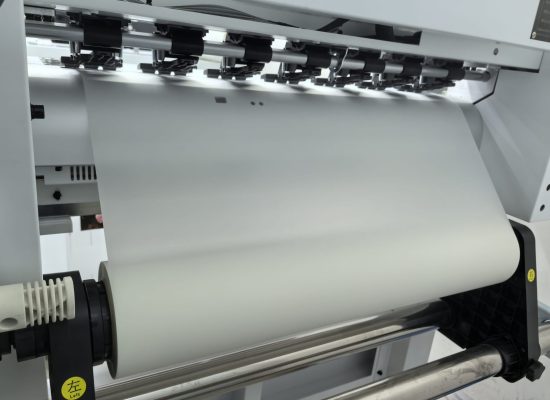
DTF film (Direct-To-Film Transfer Film) is a specialized functional PET film used in the DTF printing process.
Designs are printed onto the film, coated with adhesive powder, cured, and then heat-pressed onto fabric or other substrates.
DTF film directly affects:
- Ink absorption and dot control
- White & CMYK color alignment accuracy
- Peeling consistency and release performance
- Wash durability and stretch resistance
DTF film is not a simple PET sheet — it is a multi-layer engineered material.
2. DTF Film Structure: More Than Just “PET + Coating”
PET Base Film Thickness
Common PET thickness options include 70 / 75 / 80 / 100 μm.
Among them, 75 μm offers the best balance of flexibility, feeding stability, and heat-press compatibility.
Our standard production uses 75 μm PET base film, proven reliable for both fine detail printing and long-run production.
Single-Sided vs Double-Sided DTF Film (A Real Difference)
Feature | Single-Sided Film | Double-Sided Film (Our Standard) |
|---|---|---|
| Functional coating | Front side only | Both front & back |
| Feeding stability | Can slip or shift | Anti-slip, stable feeding |
| White/color registration | Inconsistent | Highly accurate |
| Roll back-stick | Common issue | Effectively prevented |
| Color density | Uneven | Fuller & more consistent |
Conclusion:
Double-sided film is not an upgrade — it is a production-grade necessity.
3. Why Many Market Films Are Unstable
Most low-cost DTF transfer films on the market use simplified coating processes, leading to common issues:
Unstable Release Layer
- Single release coating only
- Results in inconsistent peeling (some areas release, others don’t)
Weak Ink Absorption Control
- Single ink-receptive layer
- Causes ink bleeding, uneven fixing, or blurry edges
No Back-Side Protection
- No anti-static or anti-slip treatment
- Leads to film shifting, poor white/color alignment, and roll blocking
4. Our Core Advantage: Double-Sided Film with 8-Layer Process
We use a double-sided DTF film structure with an 8-layer coating process, where each coating layer is fully cured over 48 hours using environmentally controlled production.
8-Layer Process Breakdown
Back Side (3 Layers)
- Anti-static layer (imported raw materials)
- Triple-protection layer: anti-stick, anti-slip, moisture-resistant (oil-based, cured)
- PET polyester base film
Front Side (5 Layers)
- Matte control layer (reduces glare, improves detail visibility)
- Release base layer (oil-based, high-stability silicone release)
- Release top layer (ensures consistent peeling)
- Ink-receptive base layer (water-based, imported materials)
- Ink-receptive top layer (enhances ink fixation & color saturation)
This structure is designed to solve production consistency, not just appearance.
5. Peel Type & Recommended Heat-Press Parameters
Universal Peel (Hot / Warm / Cold)
Recommended Settings:
- Pressure: 5–6 KP
- Temperature: 150–160°C (standard: 150°C)
- Time: 6 seconds (adjustable from 3–8 seconds)
- Peeling: Peel freely about 3 seconds after pressing
One film, multiple workflows — less trial-and-error.
6. Film Formats & Customization Options
- Roll widths: 30 cm / 60 cm
- Roll lengths: 100 m / 200 m
- Sheets: A3 / A4
- Customization: Available for large volumes
- Branding: Outer cartons support logo printing (film & core do not)
7. Compatibility & Environmental Conditions
- Compatible with all major DTF printers
- Compatible with all common printheads
- Compatible with all DTF inks
- Compatible with all adhesive powders
Environment:
- Temperature: No special requirements
- Humidity: High humidity may affect powder performance (dehumidification recommended)
8. Quality Control & Factory Testing
- Inspection at every coating stage
- Full batch testing before shipment
- Complete test records retained for traceability
This is why our DTF transfer film remains stable across long-term, large-volume supply.
Conclusion: DTF Film Is Not a Secondary Material — It’s the Foundation
Consistent, professional DTF printing does not come from endlessly adjusting settings.
It comes from choosing the right film from the start.
If you are looking for DTF film that delivers:
- No slipping, no back-stick
- Accurate white & color registration
- Universal peel performance
- Wash durability beyond 50 cycles
- Reliable batch-to-batch consistency
Contact us for samples and technical support. Let stability become your standard.