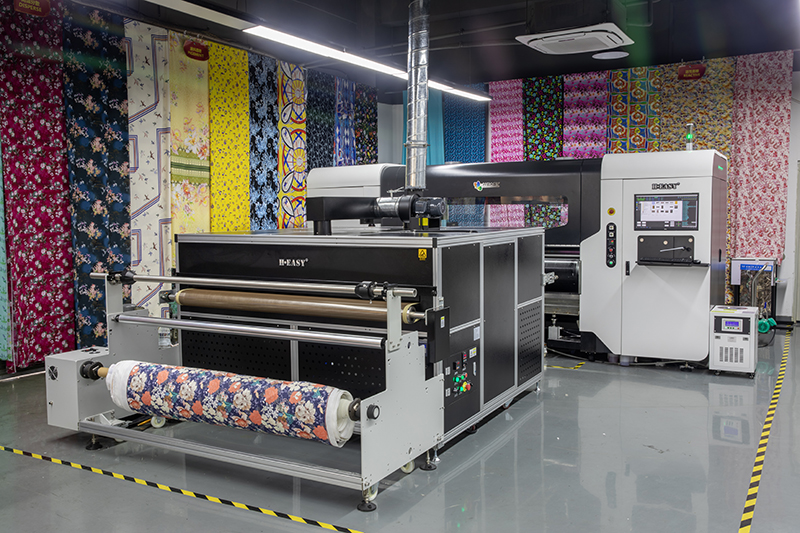
Pigment ink printing is rapidly becoming the preferred choice for modern textile production, thanks to its lower cost, simpler process, and eco-friendly advantages.
While reactive printing still dominates in high-end applications requiring superior softness and color vibrancy, the overall industry trend is clear:
Pigment printing is gaining momentum as the more scalable and future-ready solution.
So how do these two technologies really compare? Let’s break it down.
1. Fundamental Differences Between Pigment and Reactive Printing
Pigment Printing: Surface Coating Technology
Pigment printing is a surface coloration process, where ink is fixed onto the fabric using a binder rather than reacting with the fiber.
Key advantages:
- No steaming required
- No washing process
- Compatible with cotton, polyester, and blended fabrics
Typical workflow:
Fabric inspection → (Pretreatment) → Printing → Drying → Fixation
Reactive Printing: Chemical Bonding Process
Reactive printing works by forming covalent bonds between dye molecules and fibers, resulting in deep penetration and strong fixation.
Key advantages:
- Excellent color vibrancy
- Soft hand feel
- High wash fastness
However, it involves a more complex production process.
2. Production Efficiency: Speed vs Complexity
Pigment Printing
- Fewer production steps
- Faster turnaround time
- Ideal for small-batch and on-demand production
Reactive Printing
- Requires steaming and washing
- Longer production cycle
- Higher operational complexity
Conclusion:
Pigment printing is better suited for fast and flexible production environments
3. Cost Comparison: A Critical Business Factor
Pigment Printing
- Lower water and energy consumption
- Reduced labor requirements
- Stable ink usage (~20g/m²)
Reactive Printing
- Higher utility consumption (water, steam)
- Additional post-processing costs
- Higher total production cost
Result: Pigment printing offers a clear advantage in cost control
4. Sustainability & Environmental Impact
Pigment Printing
- Minimal wastewater discharge
- Easier environmental compliance
- Lower overall environmental footprint
Reactive Printing
- Requires extensive washing
- Higher wastewater treatment costs
Industry direction:
Eco-friendly technologies are becoming the standard
5. Application Scenarios
Pigment Printing
- Home textiles
- Fast fashion
- General-purpose fabric printing
Reactive Printing
- High-end garments
- Premium fabrics
- Applications requiring superior softness
6. Limitations & Improvements
Pigment Printing Challenges
- Slightly stiffer hand feel
- Less depth in dark colors
Solutions:
- Softening treatments
- Multi-pass printing
- Improved ink formulations
Reactive Printing Challenges
- Complex workflow
- High cost
- Environmental pressure
7. Technology & Equipment Advancements
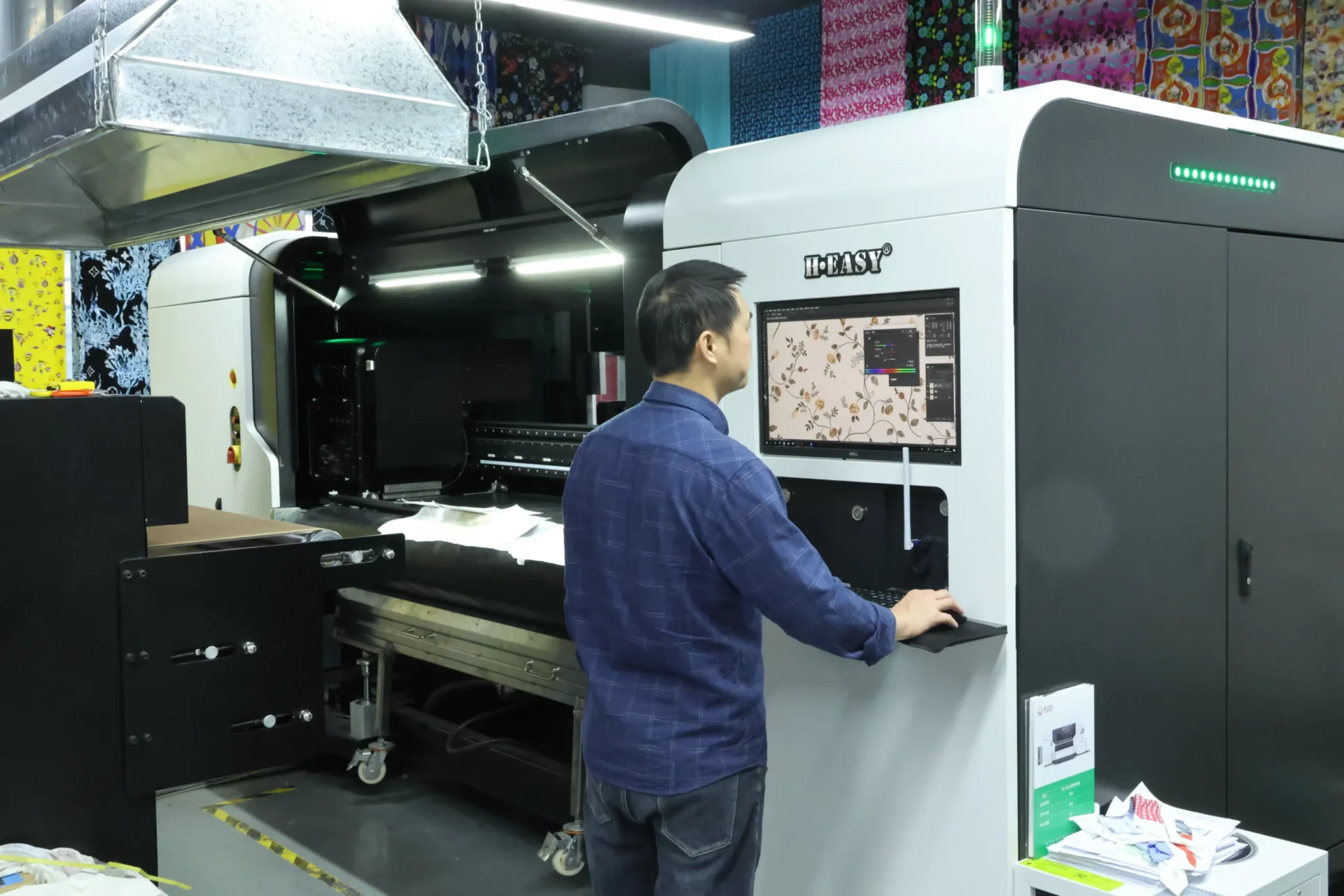
Modern digital printers are accelerating pigment printing adoption:
- High-precision structure (up to 0.01mm accuracy)
- Stable integrated frame design
- Advanced control systems for better performance
These innovations enable consistent, large-scale production
8. Recommended Machine Solutions for Pigment Printing
As pigment printing continues to grow, choosing the right equipment is critical to achieving stable output, high efficiency, and consistent quality.
Based on different production needs, here are two proven configurations:
H-1816 – The Most Balanced Production Solution
Best for:
- Medium-sized factories
- Stable daily production
- Businesses transitioning from traditional printing
Key advantages:
- Balanced speed and print quality
- Flexible width options (1.8m / 2.2m / 2.6m)
- Compatible with various fabrics and pigment ink solutions
Production capacity:
- Approximately 5,000–10,000 meters per day, depending on configuration
This model is ideal if you are looking for a reliable, cost-effective entry into pigment digital printing
H-1832 – High-Speed Industrial Production
Best for:
- Large-scale textile factories
- High-volume continuous production
- Fast delivery business models
Key advantages:
- Supports up to 32 printheads
- High-speed printing (optimized for industrial output)
- Designed for long-hour, stable operation
Production capacity:
- Up to 10,000–20,000 meters per day
This model is ideal for businesses focused on maximum productivity and scalability
9. Future Outlook
Pigment Printing
- Rapid growth
- Cost-efficient
- Suitable for mass adoption
Reactive Printing
- Remains strong in premium markets
Conclusion
The future of textile printing is not about replacing one technology with another—but about choosing the right solution for the right application:
- Efficiency & cost → Pigment printing
- Quality & softness → Reactive printing
However, from a broader industry perspective:
Pigment ink printing is becoming the most scalable and future-oriented solution