As textile manufacturers continue to diversify their product lines, the demand for a reliable pigment inkjet printer has grown rapidly. Modern pigment based inkjet printers allow factories to print on multiple fabric types without changing ink chemistry, making them an ideal solution for blended textile production.
Blended fabrics are becoming more popular in apparel, home textiles, and functional textile products.
Common blended fabrics include:
- Cotton-polyester
- Polyester-viscose
- Cotton-linen
- Nylon-spandex
- Polyester-spandex
- Wool-polyester
These fabrics combine the advantages of different fibers. They can offer better comfort, strength, elasticity, wrinkle resistance, dimensional stability, and cost control.
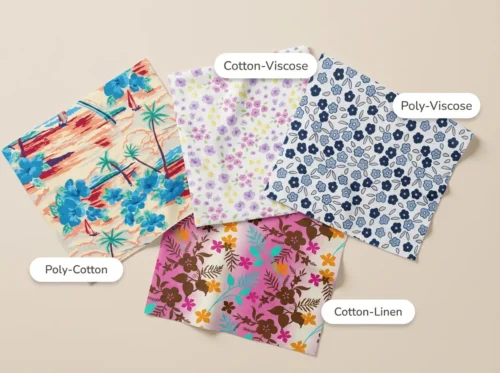
However, blended fabrics also create a challenge for digital textile printing factories.
Different fibers react differently to inks and printing processes. For example, reactive ink is commonly used for cotton, linen, and viscose. Disperse ink is more suitable for polyester. Acid ink is often used for nylon, silk, and wool.
When one fabric contains two or more fiber types, choosing the right printing process becomes more difficult. A single dye-based process may not work equally well on all fibers in the blend.
This is why digital pigment inkjet printer is becoming an attractive solution for blended fabric production.
What Is a Pigment Inkjet Printer?
A pigment inkjet printer uses pigment-based inks, precision printheads, and digital inkjet technology to print directly onto textile fabrics. Unlike traditional dye printing systems, a pigment ink printer applies pigment particles onto the fabric surface before heat fixation secures the image.
Unlike reactive, acid, or disperse inks, pigment ink does not mainly rely on a chemical reaction with one specific fiber type.
Instead, pigment ink works by attaching color particles to the fabric surface through a binder system. After printing, heat fixation helps lock the pigment onto the textile.
This working principle makes pigment ink more flexible for different fabric types, especially blended fabrics.
Why Pigment Inkjet Printers Support More Textile Fabrics
One of the biggest advantages of a pigment based ink printer is its compatibility with cotton, polyester, linen, rayon, wool, nylon, and blended fabrics.
Dye-based inks usually need to match specific fibers. If the fiber type changes, the ink and process may also need to change.
| Ink Type | Commonly Used For |
|---|---|
| Reactive ink | Cotton, linen, viscose |
| Disperse ink | Polyester |
| Acid ink | Nylon, silk, wool |
| Pigment ink | Cotton, polyester, nylon, rayon, wool, linen, blended fabrics, and more |
This is especially important for blended fabrics.
For example, cotton-polyester fabric contains both natural cotton fibers and synthetic polyester fibers. If a factory uses only one dye-based process, one fiber may absorb color well, while the other may not achieve the same result.
Pigment ink offers a more flexible solution.
Because pigment ink attaches to the fabric surface, it does not depend completely on one fiber’s chemical reaction. This helps the printed pattern appear more stable and consistent across different fiber combinations.
According to H·EASY pigment ink printing solutions, H·EASY H1816 / H1808 systems can be used for many materials, including cotton, silk, polyester, nylon, rayon, blended fabric, wool, and linen.
This makes pigment ink printing especially useful for factories that handle many fabric categories.
A Simpler Printing Process for Multi-Fabric Orders
Blended fabric orders are often complex.
A factory may need to print different fabrics, different designs, and different order quantities in the same production cycle. If every fabric requires a different ink system or post-treatment process, production management becomes more difficult.
Modern textile pigment printing systems simplify the production workflow while maintaining excellent print quality across different fabric compositions.
A typical pigment ink printing process includes:
Fabric inspection → Pretreatment / coating → Digital printing → Drying → Heat fixation → Finishing or softening treatment
Compared with reactive, acid, or disperse printing, pigment ink printing usually does not require a traditional washing process after printing.
This brings several practical benefits:
- Easier process switching
- Shorter production workflow
- Less post-treatment complexity
- Faster delivery control
- Lower water consumption
- Less wastewater treatment pressure
- Better flexibility for multi-fabric orders
For factories producing blended fabrics, this simpler process can improve production efficiency and reduce operational pressure.
Ideal for Small-Batch, Fast-Response Textile Production
The textile market is changing.
Many brands no longer rely only on large-volume orders. Instead, they need smaller batches, more designs, faster sampling, and shorter delivery times.
Digital textile printing fits this trend well. It reduces the need for screen making, color separation, and long preparation time.
Pigment ink printing is especially suitable for this production model because it can handle different fabric types with fewer process changes.
For blended fabrics, this flexibility is very valuable.
Pigment ink printing is suitable for:
- Cotton-polyester apparel fabrics
- Polyester-viscose fashion fabrics
- Cotton-linen casual fabrics
- Knitted blended fabrics
- Home textile fabrics
- Decorative fabrics
- Small-batch customized fabrics
- Multi-pattern and multi-SKU orders
For factories that often switch between fabric types and designs, pigment ink printing can make production more flexible and easier to manage.
Suitable for Many Common Blended Fabrics
Blended fabrics are widely used because they combine the strengths of different fibers.
For example, cotton-polyester blends combine cotton’s comfort with polyester’s durability. Cotton-linen blends offer a natural texture and breathable feel. Polyester-viscose blends are often used in women’s wear, shirts, and lightweight garments.
Pigment ink digital printing can be applied to many blended fabric applications.
| Fabric Type | Common Applications |
|---|---|
| Cotton-polyester blends | T-shirts, casualwear, children’s wear, loungewear, home textiles |
| Polyester-viscose blends | Women’s wear, shirts, dresses, lightweight fabrics |
| Cotton-linen blends | Casual fashion, decorative fabrics, home products |
| Viscose blends | Dresses, scarves, fashion fabrics |
| Wool-polyester blends | Coats, suits, autumn and winter garments |
| Knitted blended fabrics | Sportswear, hoodies, loungewear, children’s clothing |
| Home textile blended fabrics | Curtains, bedding, upholstery, decorative textiles |
However, printing results still depend on the actual fabric.
Factories should consider:
- Fabric weight
- Weave or knit structure
- Surface hairiness
- Ink absorbency
- Elasticity
- Hand feel requirements
- Fastness requirements
For very smooth, very thin, or very soft fabrics, sample testing is recommended before mass production. Testing helps confirm color performance, rubbing fastness, washing durability, hand feel, pretreatment formula, ink volume, and curing conditions.
Reduced Washing and Lower Wastewater Treatment Cost
For textile printing factories, cost is not only about ink price.
The total production cost may include:
- Pretreatment
- Drying
- Heat fixation
- Washing
- Labor
- Energy consumption
- Wastewater treatment
- Rework loss
One major advantage of pigment ink printing is that it usually does not require washing after printing.
This can help factories reduce water usage and lower wastewater treatment pressure. It can also shorten the production process.
Compared with reactive printing, which often includes fabric inspection, coating, printing, washing, drying, and finishing, pigment printing offers a more streamlined workflow.
For blended fabric producers, this can help:
- Lower overall production cost
- Improve production efficiency
- Reduce water consumption
- Decrease wastewater discharge
- Shorten delivery time
- Support cleaner textile production
As environmental requirements become stricter, this advantage is becoming more important for textile manufacturers.
Hand Feel, Fastness, and Color Still Need Good Process Control
Pigment ink printing has wide fabric compatibility, but it still needs proper process control.
Because pigment particles mainly stay on the fabric surface, poor process control may lead to issues such as:
- Stiffer hand feel
- Duller color appearance
- Surface ink buildup
- Poor rubbing fastness
- Uneven color performance
- Lower washing durability
To achieve stable results on blended fabrics, factories should control several key factors.
Key process points include:
- Adjust pretreatment according to fabric composition
- Keep the fabric surface clean and flat
- Control ink volume to avoid a thick ink layer
- Maintain stable drying temperature
- Maintain proper heat fixation temperature
- Test dry and wet rubbing fastness
- Add softening treatment when needed
- Reduce floating color on dark patterns
- Optimize curing conditions for different fabric weights
In other words, pigment ink printing is not just about whether a fabric can be printed.
The real goal is to balance color, hand feel, fastness, and production cost.
For products that require a softer hand feel, factories may add softening treatment. In some cases, additional washing may also be used to improve the final fabric touch.
How H·EASY Digital Pigment Ink Printers Support Blended Fabric Printing
A stable printer platform is important for blended fabric production.
Different blended fabrics may have different thickness, tension, absorbency, surface hairiness, and dimensional stability. These factors can affect feeding accuracy, ink absorption, color consistency, and final print quality.
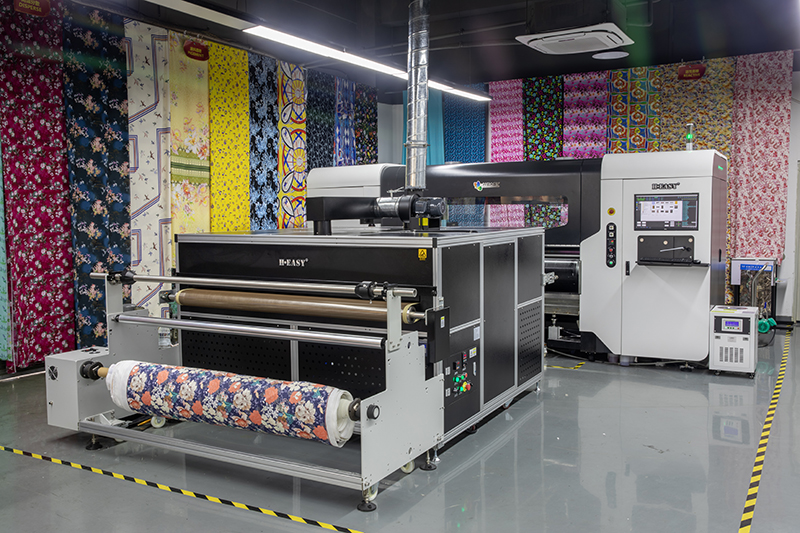
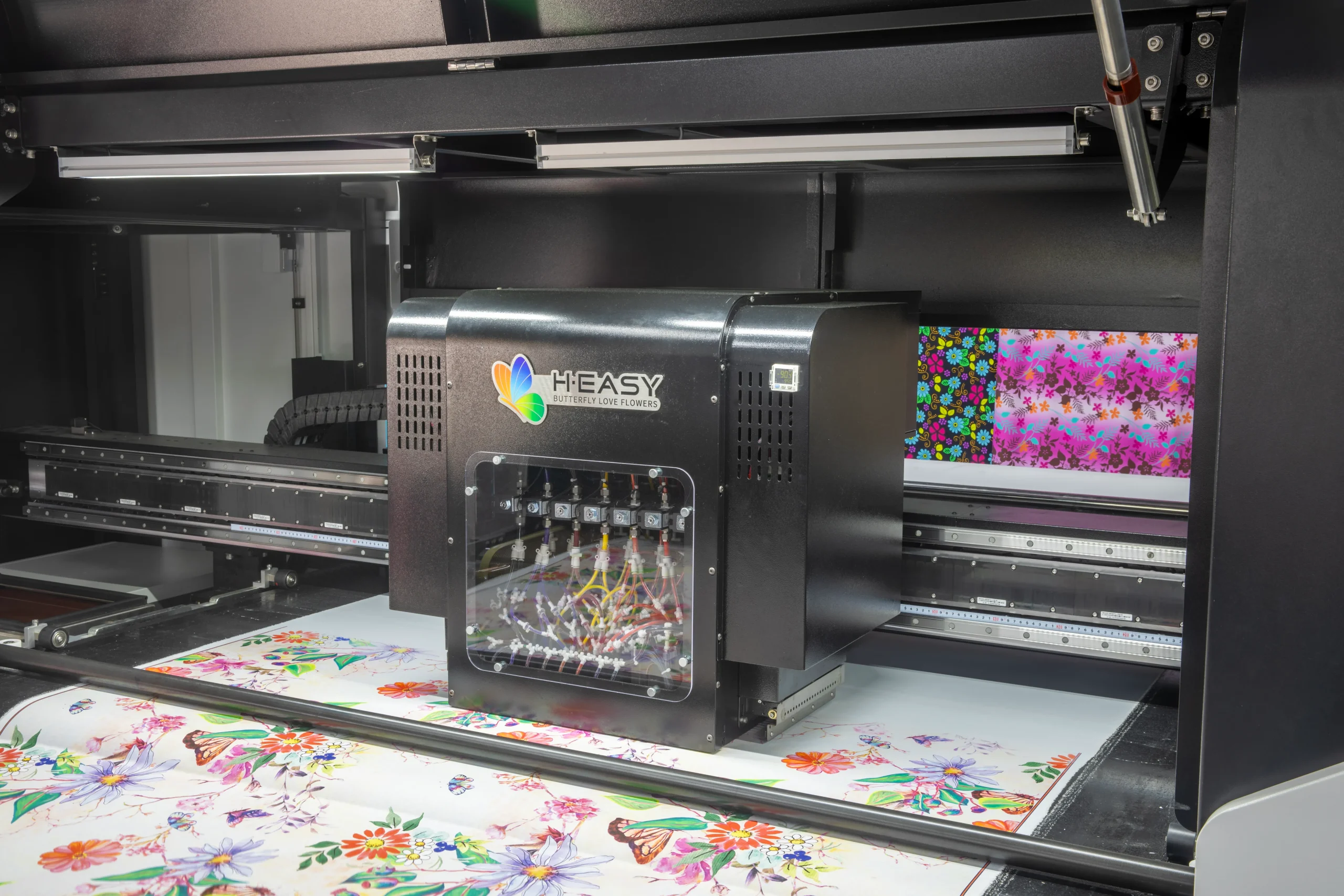
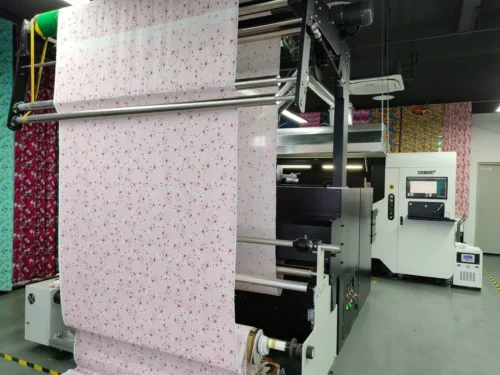
H·EASY manufactures industrial pigment inkjet printers designed for high-volume direct to fabric printing machine applications. They are suitable for apparel fabrics, home textile fabrics, and blended fabric applications.
Integrated Frame for Stable High-Speed Printing
H·EASY machines use an integrated frame structure.
This design helps improve mechanical stability and reduce errors caused by traditional assembly processes.
For continuous blended fabric production, machine stability is very important. Stable belt movement, accurate printhead positioning, and strong mechanical precision can help reduce:
- Fabric deviation
- Ghosting
- Banding
- Misalignment
- Color variation
- Printing instability during long runs
This is especially useful for factories handling long production runs or repeated orders.
High-Precision Printhead Base Plate
For multi-printhead industrial printers, printhead positioning accuracy directly affects print quality.
It influences:
- Image sharpness
- Color registration
- Stitching quality
- Printing consistency
- Long-term production stability
H·EASY machines use a high-precision printhead base plate. According to available technical information, the processing accuracy can reach approximately 0.01 mm.
This precision helps provide a stable foundation for high-quality printing, especially when producing clear patterns and consistent colors on blended fabrics.
Self-Developed Driver Boards for Ricoh Printheads
Han Leading / H·EASY began developing Ricoh printhead driver boards in 2014.
We have continued to optimize compatibility with Ricoh Gen5, Gen5e, and Gen6 printheads.
Ricoh printheads are widely used in industrial pigment ink applications because they offer:
- Stable jetting performance
- Strong ink ejection force
- Good penetration performance
- Slow performance decay
- Easier maintenance
- Good suitability for continuous production
For blended fabrics, different surfaces may respond differently to pigment ink. Stable jetting, mature waveform control, and reliable board compatibility can help reduce nozzle clogging, color inconsistency, ink starvation, and production downtime.
Suitable for Multi-Fabric and Multi-Order Production
H·EASY pigment ink printing solutions can help factories handle different blended fabrics more flexibly.
These include:
- Cotton-polyester blends
- Cotton-linen blends
- Polyester-viscose blends
- Knitted blended fabrics
- Home textile blended fabrics
- Apparel fabrics
- Decorative fabrics
By matching the right pretreatment, ink, printing parameters, curing conditions, and finishing process, factories can build a more efficient production line for multi-fabric and fast-response orders.
Why a Pigment Inkjet Printer Is the Best Investment for Textile Printing
For textile manufacturers looking for the best pigment inkjet printer, selecting the right machine is about more than print quality. The ideal pigment ink printer should deliver stable performance, support multiple fabric types, and reduce production costs.
H·EASY offers industrial pigment based inkjet printers for textile pigment printing, helping manufacturers improve efficiency while supporting high-quality direct to fabric printing.
Pigment ink printing works well for blended fabrics because it does not depend completely on one fiber-specific chemical reaction.
Instead, it uses pigment particles, binder technology, and heat fixation to create printed patterns on the fabric surface.
This makes pigment ink printing more adaptable to fabrics that combine natural and synthetic fibers.
For textile factories, the main benefits include:
- Wider fabric compatibility
- Simpler production workflow
- Usually no need for washing
- Better suitability for small-batch orders
- Faster response to multi-pattern production
- Lower water consumption
- Less wastewater treatment pressure
- More flexibility for blended fabric applications
- Better alignment with cleaner textile production
Combined with H·EASY pigment ink digital textile printers, integrated frame design, high-precision printhead base plate, self-developed driver boards, Ricoh Gen5 / Gen6 printhead compatibility, and industrial production capability, blended fabric manufacturers can achieve a more stable, flexible, and efficient digital printing solution.
For factories producing cotton-polyester, polyester-viscose, cotton-linen, knitted blends, or home textile blended fabrics, pigment ink digital printing is a process worth serious consideration.