The World Cup is more than a global football tournament. It is also a massive test of speed, flexibility, and production capacity for the apparel printing industry.
Before a major match, demand may focus on team-inspired fanwear. After the final whistle, one unexpected result, one standout player, or one viral moment can suddenly trigger thousands of new orders.
A design that did not exist yesterday may become a bestseller today.
For apparel manufacturers, print shops, merchandise suppliers, and customization businesses, the challenge is no longer simply:
Can you print this design?
The real question is:
Can you print it fast enough while the demand still exists?
This is why digital garment printing technologies such as DTG printing and DTF printing have become increasingly important for sports events, fan merchandise, pop-up stores, and on-demand apparel businesses.
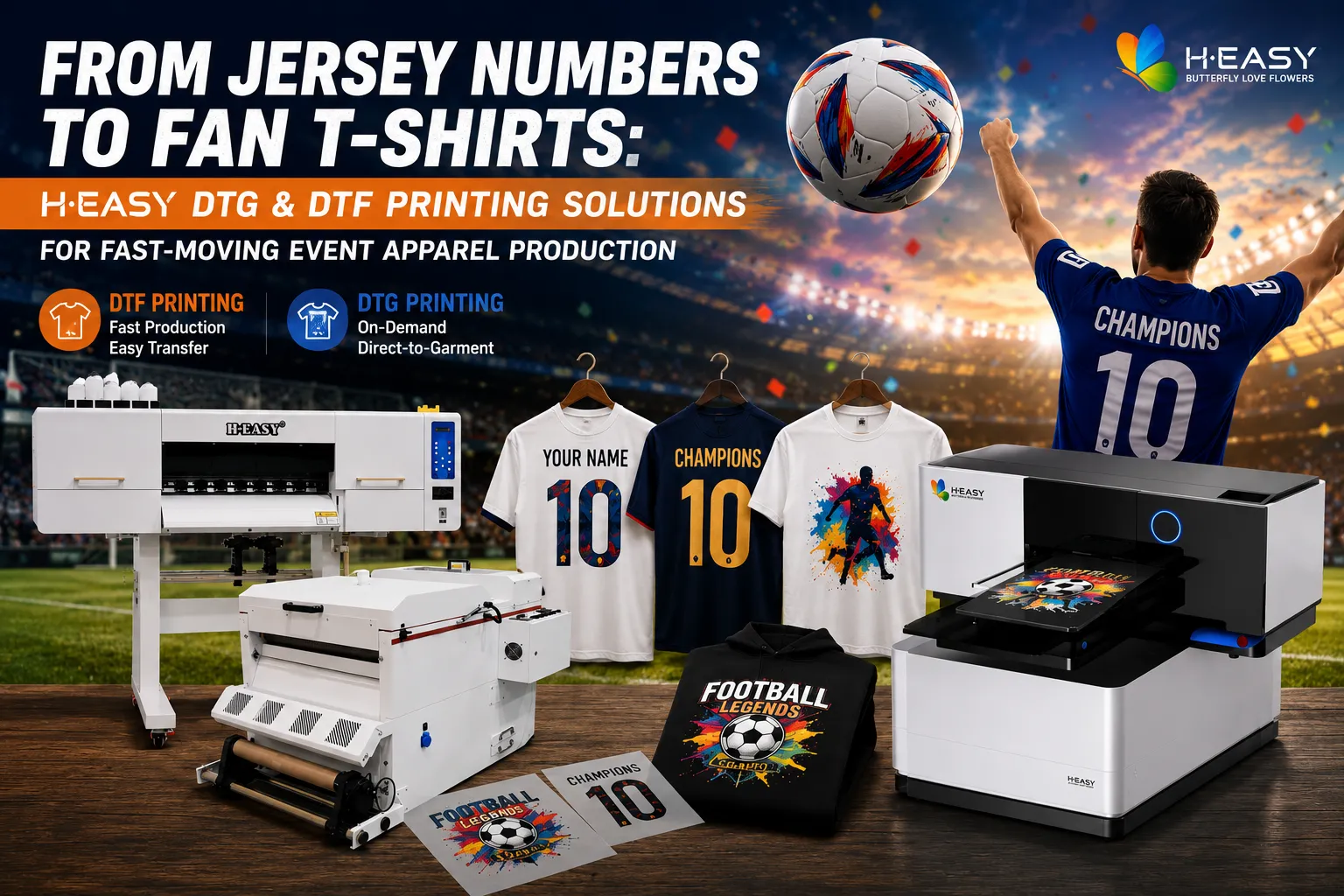
H·EASY combines both technologies into a flexible event apparel printing solution designed for different order volumes, fabrics, production speeds, and personalization requirements.
Why Is Event Apparel Printing So Challenging?
Large sports events create a type of demand that is very different from conventional fashion production.
Traditional apparel orders can often be planned weeks or months in advance. Event-related orders, however, are much less predictable.
A print business may face:
- sudden order spikes after important matches;
- many designs but uncertain quantities;
- very short delivery windows;
- urgent restocking of best-selling designs;
- simultaneous demand for dark and light garments;
- mixed orders involving T-shirts, hoodies, workwear, and other apparel;
- frequent design changes throughout the tournament.
The biggest challenge is simple:
event demand moves faster than traditional production planning.
Conventional screen printing remains highly efficient for stable, high-volume orders. But when a business needs to handle frequent artwork changes, short runs, personalization, or rapid reorders, screen preparation and production setup can become less flexible.
For fast-moving event merchandise, manufacturers need a different workflow.
They need to move directly from:
digital artwork → printing → finished product
with fewer production barriers between each step.
H·EASY Event Apparel Printing Solution: Two Technologies for Two Production Rhythms
The key question is not:
Is DTG better than DTF?
A better question is:
Which technology should handle each type of event order?
H·EASY divides event apparel production into two main scenarios.
DTF Printing: For Rapid Batch Production and Restocking
Best suited for:
- fan T-shirts;
- supporter apparel;
- hoodies;
- souvenir garments;
- jersey names and numbers;
- club merchandise;
- mixed-fabric apparel orders;
- fast repeat orders.
DTG Printing: For Individual Customization and On-Demand Production
Best suited for:
- personalized names;
- custom numbers;
- match-date designs;
- city-exclusive merchandise;
- one-piece fan T-shirts;
- cotton apparel;
- premium short runs;
- event stores and pop-up retail.
The two technologies can work together in one production strategy:
Use DTF to prepare and restock high-demand designs. Use DTG for personalized and on-demand orders.
This combination gives apparel businesses greater flexibility during fast-changing sports events.
H·EASY DTF Printing Solution: Built for Fast-Moving Fan Merchandise
Imagine this situation.
A major match ends.
Within hours, a new fan slogan, celebration concept, or original football-inspired design begins trending online.
A retailer wants to start selling it the next day.
In a conventional production model, the business may still be preparing screens, discussing minimum order quantities, or arranging production.
With a DTF printer, the digital artwork can move much more quickly into production.
There is no need to create a traditional screen for every new design.
This makes DTF printing especially suitable for:
- short product life cycles;
- multiple SKUs;
- frequent artwork changes;
- small-to-medium production batches;
- urgent restocking.
For event merchandise businesses, that flexibility can be more important than simply producing the lowest possible cost per unit.
For Higher-Volume Production: H·EASY HY702 60cm DTF Printer
For garment factories, customization businesses, and event merchandise suppliers that need higher output, the H·EASY HY702 60cm DTF printer is designed for faster continuous production.
Key specifications include:
- 60 cm printing width;
- 2 Epson I3200-A1 printheads;
- one printhead for white ink and one for color ink;
- approximately 9.6 m²/h at 4 Pass;
- approximately 6.4 m²/h at 6 Pass;
- compatibility with an automatic powder shaker and curing workflow.
The machine is designed for garment factories and personalized T-shirt businesses that require a more productive DTF printing setup.
For event apparel, the most important advantage is not only speed.
It is the ability to switch between designs quickly.
A business can print:
- one city-inspired collection in the morning;
- a new fan slogan in the afternoon;
- an urgent limited-edition design later the same day.
There is no need to build physical printing screens for every new artwork file.
This helps reduce the risk of producing too much finished inventory before demand is confirmed.
Why HY702 Fits Event Merchandise Production
During a major tournament, one design may suddenly require hundreds of pieces.
Another may sell only 20.
A third may need an urgent repeat order the next day.
The HY702 allows businesses to respond to these changes with a digital workflow.
The system includes industrial components such as:
- Epson printheads;
- a Hoson control system;
- Leadshine motor drivers;
- HIWIN guide rails;
- RIP software;
- tested ICC color workflows.
It also supports a complete DTF production setup including printing, powder application, curing, and heat transfer.
This makes it suitable for businesses that need to move from:
design approval → transfer production → garment application
as quickly as possible.
For Small Shops and Startups: H·EASY 30cm XP600 DTF Printer
Not every sports merchandise business needs a 60 cm production system.
For:
- small customization shops;
- football fan merchandise studios;
- e-commerce sellers;
- startup apparel brands;
- local print businesses;
- pop-up merchandise operations;
a smaller DTF solution may offer greater flexibility.
The H·EASY 30cm XP600 DTF printer uses a single Epson XP600 printhead and offers approximately:
- 2.25 m²/h at 4 Pass;
- 1.5 m²/h at 6 Pass;
- a 30 cm printing width.
It is designed for garment factories and personalized T-shirt businesses that need a lower-entry DTF production solution.
This creates two clear DTF production options:
30cm XP600 DTF
Better for:
- lower initial investment;
- smaller order volumes;
- startup businesses;
- local customization;
- flexible production.
60cm I3200 DTF
Better for:
- higher output;
- continuous production;
- larger order volumes;
- urgent restocking;
- expanding garment factories.
The correct choice depends on expected order volume, available space, budget, and daily production targets.
H·EASY 4050 DTG: From a Customer Idea to a Finished T-Shirt
DTF is ideal when the question is:
“Can we produce another 500 pieces quickly?”
DTG becomes especially valuable when the question is:
“Can we make one personalized T-shirt right now?”
Sports fans increasingly want products that feel personal.
They may want to add:
- their own name;
- a custom number;
- a match date;
- a city name;
- an original slogan;
- a personalized message.
These orders do not always need hundreds of pieces.
Sometimes the customer wants only one.
That is where a DTG printer becomes particularly useful.
H·EASY 4050 DTG Printer for On-Demand Event Apparel
Based on the H·EASY 4050 DTG configuration, the machine offers:
- maximum 400 × 500 mm print area;
- dual industrial piezo printheads;
- water-based pigment ink;
- CMYK + White ink configuration;
- support for dark and light garments;
- A4 light-garment printing in approximately 50 seconds;
- A4 dark-garment printing in approximately 64 seconds;
- A3 light-garment printing in approximately 88 seconds;
- A3 dark-garment printing in approximately 103 seconds.
The standard production process is:
Pretreat → Cure → Print → Cure
This makes it possible to keep blank garments in stock and print the final design only after the customer has placed an order.
Instead of guessing in advance:
- which design will sell;
- which country-inspired theme will become popular;
- which color will need more stock;
- which size will sell out first;
the business can wait for real demand.
The inventory changes from:
pre-printed finished garments
to:
blank garments ready for customization.
For event-based retail, this can significantly improve flexibility.
A Fan Walks In. A Personalized Shirt Walks Out.
A typical on-demand DTG workflow can be very simple.
Step 1: Choose the Garment
The customer selects:
- a white T-shirt;
- a black T-shirt;
- an oversized T-shirt;
- a hoodie;
- another DTG-compatible garment.
Step 2: Personalize the Design
The customer can add:
- a name;
- a custom number;
- a match date;
- a city;
- an original fan slogan;
- personalized text.
Step 3: Print On Demand
Once the artwork is confirmed, the digital file moves directly into the printing workflow.
No screen making.
No large minimum order quantity.
No need to wait for the next batch production schedule.
Step 4: Cure and Deliver
After printing and curing, the personalized garment is ready for delivery.
For a factory, it may be only one T-shirt.
For a fan, however, it can become a personal reminder of a specific match, city, and moment.
That is the value of on-demand event customization.
DTF vs DTG: Which Technology Fits Each Event Scenario?
| Event Printing Scenario | Recommended Technology | H·EASY Solution |
|---|---|---|
| One-piece name customization | DTG | H·EASY 4050 DTG |
| Cotton fan T-shirts | DTG | H·EASY 4050 DTG |
| Dark and light garment customization | DTG | H·EASY 4050 DTG |
| Fast restocking of fan merchandise | DTF | H·EASY HY702 |
| Mixed-fabric apparel orders | DTF | H·EASY HY702 |
| Names, numbers, and local graphics | DTF | H·EASY HY702 |
| Small fan shops and startups | DTF | 30cm XP600 DTF |
| Full-surface polyester sports jerseys | Sublimation | Professional sublimation solution |
One point is important:
No single printing technology is ideal for every sportswear application.
For full-surface polyester sports jerseys, sublimation is often more suitable.
For localized graphics, names, numbers, mixed fabrics, and fast batch production, DTF offers greater flexibility.
For cotton garments, one-piece personalization, and on-site production, DTG is especially useful.
A professional solution should always consider:
fabric + order quantity + delivery time + artwork + application
before choosing the printing process.
Five Challenges Every Event Apparel Printer Must Solve
1. How Fast Can You React?
Sports events do not wait for a conventional production cycle.
A new design may become relevant overnight.
Digital printing helps reduce the number of steps between artwork creation and production.
For event merchandise:
Every production step removed can mean faster market entry.
The goal is not just to print quickly.
The goal is to react quickly.
2. Can You Produce 10 Pieces First and 500 Later?
Event demand is difficult to predict.
A smarter production model may be:
- print 10 or 20 pieces first;
- test actual market demand;
- produce another 200 when sales grow;
- scale to 1,000 when the design becomes a bestseller.
DTG can support early-stage personalization and low-volume demand.
DTF can support faster scale-up when demand is confirmed.
This reduces the risk of overproduction.
3. Can Different Batches Maintain Consistent Color?
Sports merchandise often requires repeated production.
The first batch may be 100 pieces.
The second may be 300.
The third may be another urgent order several days later.
Stable production requires:
- standardized RIP settings;
- consistent printing parameters;
- appropriate ICC profiles;
- stable ink management;
- controlled curing conditions;
- documented production procedures.
Professional event printing is not about producing one beautiful sample.
It is about maintaining a similar appearance across repeat orders.
4. Can You Handle Both Dark and Light Garments?
Sports fan apparel comes in many colors.
A printer may need to handle:
- white;
- black;
- red;
- blue;
- team-inspired color combinations.
The H·EASY 4050 DTG uses a CMYK + White configuration for dark and light garments.
DTF also combines color and white ink layers to support a wide range of garment colors.
This gives businesses more freedom when handling mixed event merchandise orders.
5. Can Your Equipment Keep Running During Peak Season?
The busiest production period is also the worst time for equipment downtime.
A complete event apparel solution therefore needs more than a printer.
It should also include:
- daily maintenance;
- weekly maintenance;
- monthly maintenance;
- printhead checks;
- white ink management;
- cleaning procedures;
- spare consumables;
- operator training.
For the HY702, H·EASY provides guidance for daily, weekly, and monthly maintenance, together with installation and operation support covering key components such as the printheads, dampers, waste ink system, ink supply system, and nozzle testing.
During event season, the most valuable printer is not always the machine with the highest theoretical speed.
It is the machine that continues to produce reliably when orders are at their highest.
A Practical World Cup Event Apparel Production Model
H·EASY recommends using different printing technologies at different stages of the event cycle.
Before the Match: Prepare High-Frequency Designs with DTF
Before major games, businesses can prepare:
- original football-themed designs;
- general fan slogans;
- city-inspired artwork;
- date templates;
- editable text layouts.
For designs with predictable demand, DTF transfers can be prepared in advance.
This allows faster garment decoration when orders begin to increase.
On Matchday: Personalize with DTG
On the day of the event, customers can add:
- their own names;
- custom numbers;
- dates;
- cities;
- personalized messages.
The final product is produced only after the customer confirms the design.
This reduces finished inventory and increases the value of personalization.
After the Match: Scale with DTF
When a design becomes a confirmed bestseller, production can shift toward a higher-volume DTF workflow.
Instead of producing every order individually, the business can increase output and restock more efficiently.
This creates a practical production model:
DTG discovers and serves individual demand.
DTF helps scale proven demand.
That is the real value of combining the two technologies.
From Forecast-Driven Production to Demand-Driven Production
In the past, event merchandise businesses had to predict:
- what would sell;
- which colors would become popular;
- how many pieces to produce;
- which sizes would move fastest.
If the forecast was wrong, unsold inventory remained after the event.
Digital printing changes this production logic.
Businesses can prepare:
- blank garments;
- digital artwork;
- printing materials;
- production capacity.
They can then decide what to print based on actual customer demand.
The business model shifts from:
Produce first, then find customers.
to:
Receive demand first, then produce.
For fast-changing sports events, this flexibility can be more valuable than simply maximizing output.
Fast Printing Does Not Mean Unrestricted Use of Event Graphics
Large sports events create strong commercial opportunities, but businesses should still pay attention to intellectual property.
Official tournament logos, team marks, player images, and other protected graphics may require authorization.
For commercial production, a safer approach is to work with:
- original artwork;
- licensed graphics;
- legally supplied customer files;
- independently created football-inspired designs.
H·EASY equipment helps businesses print faster and more flexibly.
The artwork itself should still be used legally.
Conclusion: The Real Competition Happens Behind the Printer
From personalized fan T-shirts and supporter hoodies to names, numbers, and limited-edition event merchandise, sports events are creating new opportunities for apparel printing businesses.
But these opportunities also create new production demands.
Orders are more urgent.
SKU numbers are higher.
Trend cycles are shorter.
Restocking is more frequent.
Customers expect greater personalization.
H·EASY addresses these challenges with different solutions for different production needs.
H·EASY 4050 DTG
For:
- one-piece personalization;
- short runs;
- cotton apparel;
- on-demand printing;
- event shops and pop-up stores.
H·EASY HY702 60cm DTF
For:
- medium-to-high-volume production;
- rapid fan merchandise restocking;
- multi-design production;
- mixed apparel applications.
H·EASY 30cm DTF
For:
- startups;
- smaller customization businesses;
- local fan merchandise shops;
- lower-entry DTF production.
The real advantage is not owning one “all-purpose” machine.
It is building a production system that can change as quickly as the market does.
From one personalized fan shirt to the next urgent batch, H·EASY helps apparel businesses respond when event demand moves fastest.