Pigment printing is becoming an increasingly practical solution in digital textile production. Compared with reactive, acid, or disperse printing, pigment printing offers a simpler process, wider fabric compatibility, and usually less washing after printing.
For factories considering a digital textile pigment printer, the key question is not only whether pigment ink can print on a fabric. A more important question is:
How should pigment printing be applied differently in home textiles, apparel, and outdoor products?
These three product categories have different requirements for hand feel, rubbing fastness, washing performance, sunlight fastness, abrasion resistance, fabric width, and finishing. Choosing the right pigment inkjet printer, process parameters, and finishing workflow is essential for stable industrial production.
Key Differences by Application
| Application | Main Requirements | Pigment Printing Advantages | Key Control Points |
|---|---|---|---|
| Home textiles | Color stability, sunlight fastness, batch consistency | Suitable for cotton, linen, blended fabrics, decorative fabrics | Color consistency, fixation, fabric width, continuous production |
| Apparel | Soft hand feel, washing performance, rubbing fastness | Suitable for cotton, rayon, blends, small-batch fashion orders | Hand feel, dry/wet rubbing fastness, pretreatment balance |
| Outdoor products | Sunlight resistance, abrasion resistance, water resistance | Good for flexible graphic printing and some decorative outdoor fabrics | Weather resistance, coating compatibility, long-term testing |
Pigment inks can be used to print on a wide range of fabrics, including cotton, silk, polyester, nylon, rayon, blended fabrics, wool, and linen. They offer several advantages, such as a simple printing process, no post-print washing in many cases, reduced wastewater generation, lower production costs, and excellent light fastness.
What Is Pigment Printing in Textile Production?
Pigment printing in textile production uses pigment particles to create patterns on fabric. Unlike reactive ink, which mainly reacts with cellulose fibers, or disperse ink, which is commonly used for polyester, pigment ink is fixed mainly on the fabric surface through pretreatment, binder, drying, and heat fixation.
A typical pigment printing workflow includes:
Fabric inspection → Pretreatment / sizing → Digital printing → Drying → Fixation → Softening or finishing if needed
P
igment printing is summarized as sizing → printing → fixation, while reactive, disperse, and acid printing usually require sizing, printing, steaming, washing, and finishing.
This shorter workflow is one reason why textile pigment printing is attractive for factories handling multiple fabric types, small-batch orders, or fast-changing designs.
1. Pigment Printing for Home Textiles
Home textile products include curtains, bedding, sofa fabrics, cushions, tablecloths, decorative fabrics, wall coverings, and other interior textile materials.
Compared with apparel, home textiles usually focus more on:
- color stability;
- sunlight fastness;
- batch consistency;
- wide-width production;
- long-roll continuous printing;
- decorative visual effect.
Suitable Home Textile Fabrics
Pigment printing can be used on many home textile fabrics, including:
- cotton;
- linen;
- cotton-linen blends;
- cotton-polyester blends;
- viscose blends;
- canvas;
- decorative woven fabrics;
- selected polyester blended fabrics.
Blended fabrics are especially important. Reactive printing has advantages for natural fibers such as cotton, linen, and modal, while pigment printing has more advantages for blended fabrics as blended materials become more common in the market.
Why Pigment Printing Works for Home Textiles
Home textile products often need stable visual output over larger areas. For curtains, cushions, decorative fabrics, and sofa covers, pigment printing can be a practical solution because it supports many fabric types and provides good design flexibility.
Pigment ink is also useful when factories need to print multiple patterns without screen-making. For home textile brands that update collections frequently, a digital fabric printer or digital textile printer with pigment ink can help reduce setup time and support shorter production runs.
Key Challenges in Home Textile Pigment Printing
For home textiles, the main challenge is not only printing quality. The factory must also control:
- batch-to-batch color consistency;
- sunlight fastness;
- dry and wet rubbing fastness;
- fabric skew;
- long-roll feeding stability;
- drying and fixation matching;
- wide-format production accuracy.
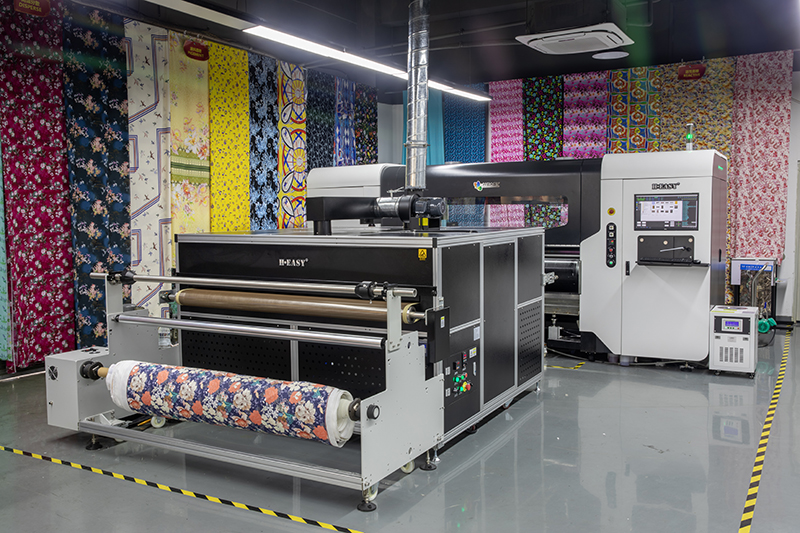
For home textile production, machine width is also important. Our 1.8m and 2.2m widths are commonly used for garment fabrics, while 2.6m and 3.2m widths are more common for home textile fabrics.
Recommended H·EASY Direction for Home Textiles
For home textile factories, H·EASY can recommend solutions based on fabric width and production capacity:
| Production Need | Recommended Direction |
|---|---|
| Medium-volume decorative fabric production | H·EASY H1816 |
| High-output home textile production | H·EASY H1832 |
| Wider home textile fabrics | Customized wider solutions such as 2.6m or 3.2m |
| Small collections or sample rolls | H·EASY H1808 or H1816 |
2. Pigment Printing for Apparel
Apparel includes T-shirts, shirts, dresses, children’s wear, casual wear, fashion fabrics, linings, and small-batch garment materials.
Compared with home textiles, apparel focuses more on:
- hand feel;
- breathability;
- washing performance;
- dry and wet rubbing fastness;
- skin comfort;
- fabric softness;
- design flexibility.
Suitable Apparel Fabrics
Pigment printing can be used for many apparel fabrics, such as:
- cotton;
- cotton-linen blends;
- rayon;
- viscose;
- modal;
- cotton-polyester blends;
- viscose blends;
- cotton-spandex blends;
- selected knitted fabrics.
For apparel factories, pigment printing is especially useful for small-batch production, fast fashion, seasonal patterns, and customized fabric orders. A printing on fabric machine using pigment ink allows the factory to switch artwork digitally without traditional screen-making.
Hand Feel Is the Key Issue
In apparel pigment printing, the biggest question is usually not whether the fabric can be printed. The more important question is:
Can the printed fabric still feel soft enough for clothing?
Compared with some dye-based printing processes, pigment printing may have differences in hand feel, color depth, and fastness performance depending on the fabric type, ink formulation, and printing conditions.
For apparel, factories should carefully balance:
- pretreatment strength;
- ink volume;
- binder amount;
- fixation temperature and time;
- softener usage;
- washing or softening treatment if needed.
If the customer requires a very soft hand feel, a washed finish or softening treatment may be necessary. A washed finish may be required when a softer hand feel is needed.
Rubbing Fastness Is Critical for Apparel
Apparel is frequently rubbed, worn, washed, and exposed to sweat. Therefore, dry and wet rubbing fastness are essential.
One pigment process reference mentions that fixation at 170°C for 4 minutes can achieve dry rubbing fastness level 3 and wet rubbing fastness level 2.5, with about 0.5 level improvement after adding a fixing agent.
For apparel pigment printing, factories should test:
- dry rubbing fastness;
- wet rubbing fastness;
- washing fastness;
- hand feel after fixation;
- shrinkage;
- color change after washing;
- comfort for final garment use.
Recommended H·EASY Direction for Apparel
| Production Need | Recommended Model |
|---|---|
| Sampling, small batches, flexible fashion orders | H·EASY H1808 |
| Regular garment fabric production | H·EASY H1816 |
| High-output garment fabric production | H·EASY H1832 |
| Fast fashion and short-run production | H·EASY H1808 / H1816 |
For many apparel fabric factories, H·EASY H1816 is a balanced choice because it offers industrial productivity while keeping production flexibility.
3. Pigment Printing for Outdoor Products
Outdoor textile products include tent fabrics, awning fabrics, outdoor cushions, camping fabrics, backpack fabrics, leisure chair fabrics, outdoor decorative textiles, and some event fabrics.
Compared with home textiles and apparel, outdoor products focus more on:
- sunlight fastness;
- abrasion resistance;
- water resistance;
- coating compatibility;
- weather resistance;
- long-term outdoor durability.
Why Pigment Printing Can Be Used for Outdoor Products
Pigment ink is known for relatively good sunlight fastness. The H·EASY pigment solution materials list high sunlight fastness as one of the advantages of pigment ink.
This makes pigment printing useful for some outdoor decorative and functional textile applications, especially when the customer needs:
- short-run outdoor graphics;
- multiple designs;
- customized camping textiles;
- decorative outdoor cushions;
- event fabrics;
- flexible product development.
A pigment ink printer can help factories print outdoor textile designs without the setup burden of traditional printing.
Outdoor Products Need More Than Sunlight Fastness
For outdoor applications, sunlight fastness alone is not enough.
Outdoor fabrics may face rain, abrasion, folding, coating, UV exposure, wind, dust, and long-term temperature changes. Pigment printing should be combined with proper finishing and testing, such as:
- water-repellent finishing;
- waterproof coating;
- abrasion testing;
- UV aging testing;
- wet rubbing testing;
- coating adhesion testing;
- long-term outdoor exposure testing.
A textile printing machine is responsible for printing the design, but the final outdoor performance depends on the whole fabric system, including coating and finishing.
Fabric Selection Needs Extra Testing
Outdoor fabrics often include polyester, nylon, Oxford fabric, canvas, coated fabric, and polyester-cotton blends.
Smooth, thin polyester and nylon fabrics can be difficult for pigment printing because it is hard to balance color fastness and softness. More pretreatment may improve fastness, but it can also make the fabric too hard.
For outdoor products, this means every fabric should be tested before bulk production, especially coated or water-repellent fabrics.
Recommended H·EASY Direction for Outdoor Products
| Outdoor Application | Recommended Direction |
|---|---|
| Outdoor decorative fabrics | H·EASY H1816 |
| Sample development and small runs | H·EASY H1808 |
| High-volume outdoor fabric printing | H·EASY H1832 |
| Coated or functional fabrics | Test first before model confirmation |
| Wide outdoor fabric rolls | Consider customized wider solutions |
Comparison: Home Textiles vs Apparel vs Outdoor Products
| Item | Home Textiles | Apparel | Outdoor Products |
|---|---|---|---|
| Main Requirement | Color stability and sunlight fastness | Soft hand feel and washing performance | Sunlight, abrasion, and weather resistance |
| Common Fabrics | Cotton, linen, blended fabrics, decorative fabrics | Cotton, rayon, viscose, knits, blends | Polyester, nylon, Oxford, canvas, coated fabrics |
| Pigment Advantage | Wide fabric compatibility and stable color | Small-batch production and quick design switching | Flexible graphics and good sunlight resistance |
| Main Risk | Color variation and poor fixation | Hard hand feel and poor wet rubbing fastness | Coating compatibility and outdoor durability |
| Key Process Focus | Wide-width stability and fixation | Pretreatment, softening, rubbing fastness | Finishing, coating, UV and abrasion testing |
| Recommended H·EASY Direction | H1816 / H1832 / wider custom models | H1808 / H1816 | Test first, then H1816 / H1832 |
Key Tests Before Bulk Production
Before using a digital textile pigment printer for home textiles, apparel, or outdoor products, factories should test:
- Fabric pH value
- Fabric absorbency
- Weft skew and fabric flatness
- Surface cleanliness
- Dry rubbing fastness
- Wet rubbing fastness
- Washing performance
- Sunlight fastness
- Hand feel after fixation
- Finishing compatibility
- Continuous small-batch production stability
The H·EASY pigment process materials state that fabric inspection should include pH value, absorbency, weft skew, and cleanliness. High or low pH can affect color fixation and cause color difference or spots, while poor fabric condition may lead to rejected fabric.
Why Choose H·EASY Digital Textile Pigment Printer?
Choosing fabric printing equipment is not only about buying a machine. It is about building a complete pigment printing workflow.
H·EASY pigment printing solutions are designed for industrial direct-to-fabric production and can support different application needs in home textiles, apparel, and selected outdoor products.
Integrated Frame for Stable Production
H·EASY machines use an integrated frame structure to improve mechanical accuracy and production stability. The supplied materials state that the integrated frame can reduce traditional assembly steps, improve mechanical accuracy, and support production efficiency.
High-Precision Head Bottom Plate
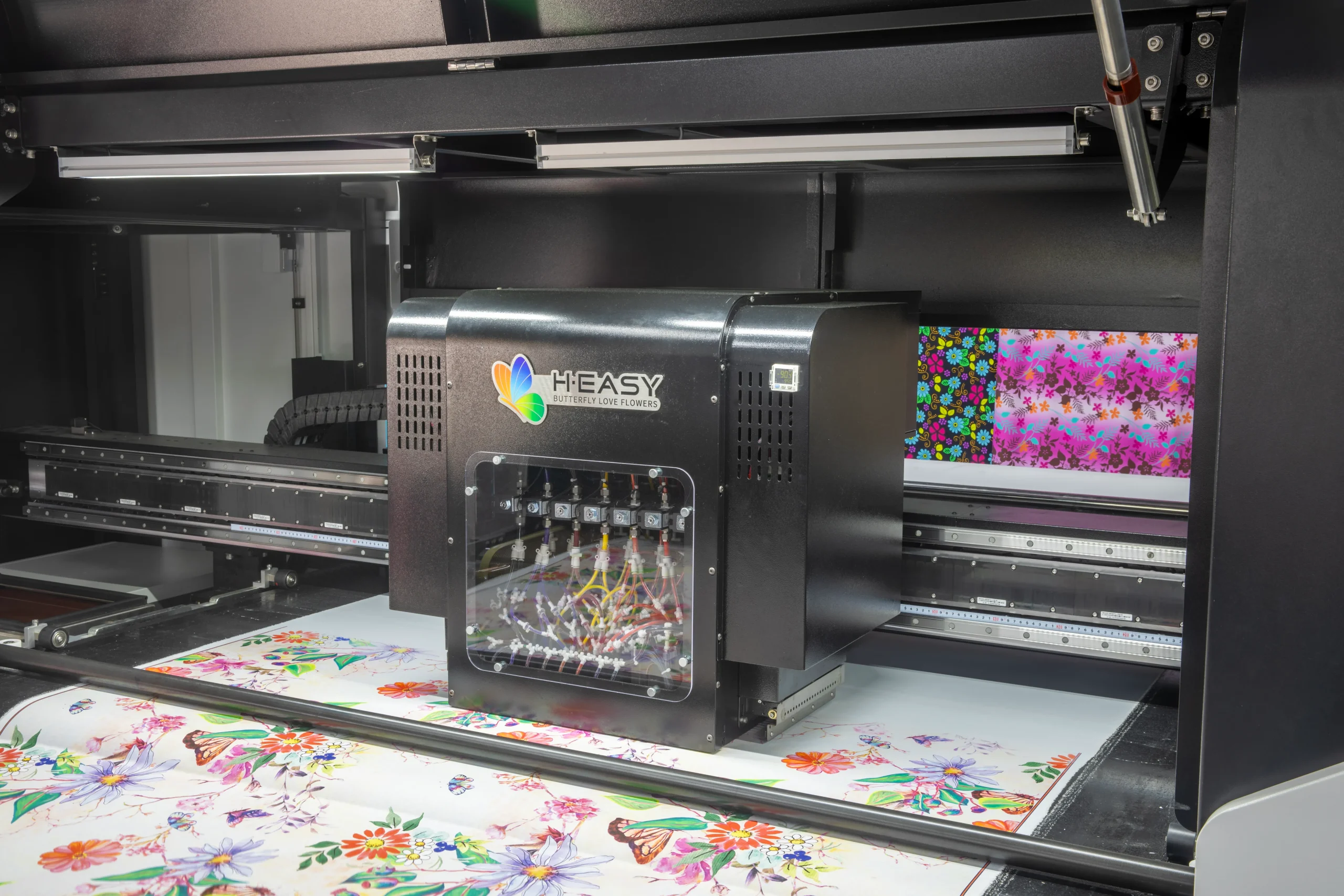
The head bottom plate uses wire-cutting processing technology, with minimum cutting size reaching about 0.01mm, helping ensure printing accuracy.
This is important for industrial multi-head printing, where alignment accuracy affects pattern clarity and color consistency.
Independently Developed Driver Board
H·EASY boards are independently developed and adapted to the printing machine, allowing timely upgrades and adjustments when needed.
For a printing textile machine using pigment ink, stable board-printhead-ink compatibility is important because pigment ink contains particles and requires reliable jetting performance.
Model Recommendations
| Application Direction | Recommended H·EASY Solution |
|---|---|
| Apparel sampling and small batches | H·EASY H1808 |
| Apparel and garment fabric production | H·EASY H1816 |
| Home textile continuous production | H·EASY H1816 / H1832 |
| High-output fabric production | H·EASY H1832 |
| Wide-width home textile fabrics | Customized wider solutions |
| Outdoor product development | Test fabric first, then select H1808 / H1816 / H1832 |
Conclusion
Pigment printing has different values in home textiles, apparel, and outdoor products.
For home textiles, pigment printing is useful because it supports wide fabric compatibility, stable decorative effects, and good sunlight performance. For apparel, it is valuable for small-batch production, fast design switching, and blended fabric printing, but hand feel and rubbing fastness must be carefully controlled. For outdoor products, pigment printing can support flexible graphic production and good sunlight resistance, but weather resistance, abrasion resistance, coating compatibility, and long-term durability require additional testing.
For factories entering pigment printing in textile production, choosing a stable digital textile pigment printer is essential. H·EASY H1808, H1816, and H1832 provide different production options for small-batch orders, garment fabrics, home textiles, and high-output production. With the right machine, pigment ink, pretreatment, drying, fixation, and finishing process, factories can build a more flexible and reliable textile pigment printing workflow.