In pigment digital textile printing, many factories focus first on the printer, printheads, ink, and production speed. However, one important factor is often overlooked: the pretreatment solution.
For pigment printing, pretreatment solution plays a key role in color yield, pattern sharpness, rubbing fastness, hand feel, floating color, fixation performance, and bulk production stability.
In simple terms:
Pretreatment solution helps pigment ink attach more effectively to the fabric surface and supports film formation during drying and heat fixation.
Without proper pretreatment, even a high-quality pigment ink printer or digital fabric printer may produce weak colors, blurred edges, poor rubbing fastness, excessive floating color, or a hard hand feel.
What Does Pretreatment Solution Do?
Function | Impact on Printing Result |
|---|---|
Improves pigment adhesion | Helps increase dry and wet rubbing fastness |
Controls ink spreading | Keeps pattern edges sharper |
Improves color yield | Makes printed colors more stable and fuller |
Supports fixation | Helps reduce floating color and color loss |
Adapts fabric surface | Improves results on cotton, linen, rayon, blends and other fabrics |
Balances fastness and softness | Prevents over-treatment from making fabric too hard |
The typical pigment digital textile printing process follows: Fabric Inspection → Pretreatment → Digital Printing → Color Fixation. Among these steps, pretreatment is a critical stage that helps improve ink adhesion, color performance, and print durability.
What Is Pigment Printing Pretreatment Solution?
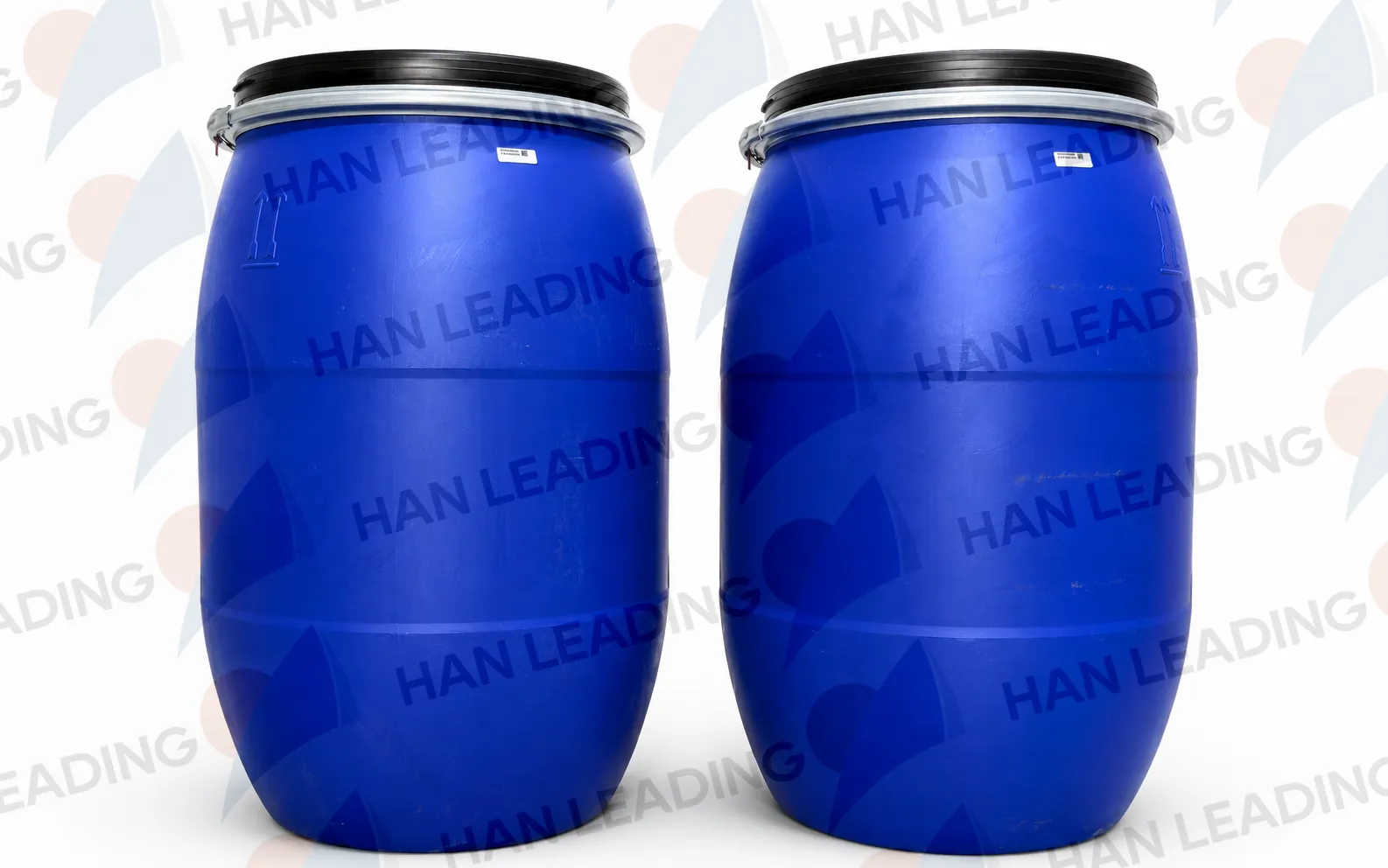
A pigment printing pretreatment solution is a functional chemical applied to fabric before digital printing. It is usually applied through a sizing or pretreatment machine to prepare the fabric surface for pigment ink.
Unlike reactive, acid, or disperse inks, pigment ink does not mainly rely on a chemical reaction with one specific fiber type. Instead, pigment particles are fixed mainly on the fabric surface through pretreatment, binder, drying, and heat fixation.
The principle of pigment printing this way: cationic components are added into the pretreatment liquid, while the pigment ink carries anionic properties. After ionic bonding, the fabric is baked at around 150°C to form a film for better fastness.
This is why pretreatment solution is so important in pigment textile printing.
Basic Workflow of Pigment Digital Textile Printing
A complete pigment digital printing workflow usually includes:
Fabric Inspection → Sizing → Printing → Drying → Fixation → Setting + Softening Treatment + Dry / Wet Rubbing Fastness Test if needed.
Pretreatment is not an isolated step. It must work together with ink, printer, drying, fixation, fixing agent, and softener to achieve stable fabric printing results.
Why Does Pretreatment Affect Color Fastness?
In pigment printing, color fastness depends on how firmly pigment particles stay on the fabric surface.
If pretreatment is insufficient, common problems may include:
- poor pigment adhesion;
- weak dry rubbing fastness;
- poor wet rubbing fastness;
- color fading after washing;
- excessive floating color;
- blurry pattern edges;
- unstable color in bulk production.
If pretreatment is excessive, it may cause:
- hard hand feel;
- reduced breathability;
- sticky or rough surface;
- heavy surface buildup;
- poor comfort for apparel fabrics.
This means pretreatment solution is not “the more, the better.” It must be balanced according to fabric type, pattern coverage, ink volume, fastness requirement, and hand feel requirement.
What Is the Typical Pretreatment Ratio?
The typical pretreatment solution ratio is listed as around 5% when diluted with water.
This can be used as a starting reference for testing, but it should not be treated as a fixed formula for every fabric.
In real production, the pretreatment ratio should be adjusted based on:
| Factor | Why It Matters |
|---|---|
| Fabric type | Cotton, linen, silk, rayon and blends need different formulas |
| Fabric thickness | Thin fabrics may become hard if over-treated |
| Absorbency | Poor absorbency may need process adjustment |
| Pattern coverage | Dark full-coverage prints may need stronger fastness control |
| Hand feel requirement | Apparel fabrics usually need softer finishing |
| Fastness standard | Higher rubbing fastness may require stronger treatment |
| Finishing method | Softening, washing or setting changes the final result |
Different formulas should be used for different fabrics such as cotton, linen, and silk, and that complete recipes can be provided after customers purchase the machine.
Which Fabrics Need Pretreatment Control?
Pigment digital printing can be used on many fabric types, such as cotton, silk, polyester, nylon, rayon, blended fabric, wool, and linen.
However, different fabrics require different pretreatment strategies.
| Fabric Type | Pretreatment Focus |
|---|---|
| Cotton | Improve color yield and rubbing fastness |
| Linen | Balance color depth, vintage effect and hand feel |
| Rayon / Viscose | Control absorbency and ink spreading |
| Cotton-polyester blends | Balance adhesion on different fiber surfaces |
| Polyester | Test fastness and cost carefully; disperse printing may be better for pure polyester |
| Nylon | Test adhesion, wet rubbing fastness and hand feel |
| Silk | Can be tested, but reactive or acid printing is often more common |
| Wool | Control surface fibers, fastness and softness |
Polyester, nylon, and some thin fabrics can be difficult for pigment printing because smooth and thin surfaces make it hard to balance color fastness and softness. More pretreatment may improve fastness, but it may also make the fabric harder.
How Pretreatment Affects Color Performance
Pretreatment solution directly affects color performance in pigment digital printing.
Proper pretreatment can help:
- improve color yield;
- reduce ink spreading;
- sharpen pattern edges;
- improve dark color performance;
- reduce batch color variation;
- reduce floating color.
If fabric absorbency is poor, pH is unstable, or pretreatment is uneven, the result may include light color, color spots, shade variation, and unstable fixation.
Fabric inspection should check pH value, absorbency, weft skew, and cleanliness. High or low pH may affect fixation and cause color difference or spots; poor absorbency may lead to lower color yield and lighter color.
Therefore, pretreatment should always begin with fabric inspection.
Pretreatment, Drying and Fixation: How They Work Together
Pretreatment alone cannot guarantee good fastness. It must work together with drying and heat fixation.
Pigment fixation depends on heat helping the binder system form a stable film on the fabric surface. If the printed fabric is not fully dried or properly fixed, the color may remain unstable.
Some factories combine drying and fixation into one process, with a reference drying time of about 5 minutes and drying temperature around 140°C.
Another process reference lists fixation at 130–150°C for 4–6 minutes.
For DuPont pigment ink, one reference mentions fixation at 170°C for 4 minutes, achieving dry rubbing fastness level 3 and wet rubbing fastness level 2.5; adding a fixing agent can improve each by about 0.5 level.
In bulk production, factories should test:
- drying temperature;
- drying time;
- fixation temperature;
- fixation time;
- fixing agent dosage;
- softener dosage;
- dry rubbing fastness;
- wet rubbing fastness.
Pretreatment Solution vs Fixing Agent vs Softener
Pretreatment solution, fixing agent, and softener are often discussed together, but they are not the same.
| Chemical / Treatment | When It Is Used | Main Function |
|---|---|---|
| Pretreatment solution | Before printing | Improves adhesion, controls spreading and increases color yield |
| Fixing agent | After printing or during fixation | Improves dry and wet rubbing fastness |
| Softener | Finishing stage | Improves hand feel and reduces stiffness |
| Binder system | In ink or treatment system | Helps pigment particles form a film on fabric |
For apparel fabrics, the process must balance fastness and softness. For home textiles, sunlight fastness and batch stability may be more important. For outdoor products, abrasion resistance, water resistance, and coating compatibility may need additional testing.
Common Pretreatment Problems in Pigment Digital Printing
Problem | Possible Cause | Solution Direction |
|---|---|---|
Light color | Poor absorbency, weak pretreatment, low ink volume | Adjust pretreatment ratio and ICC profile |
Blurry pattern edges | Ink spreading or uneven pretreatment | Improve sizing uniformity and drying control |
Poor dry rubbing fastness | Insufficient fixation or excessive ink layer | Optimize ink load and fixation setting |
Poor wet rubbing fastness | Weak film formation or insufficient fixing agent | Test fixing agent and post-treatment |
Hard hand feel | Too much pretreatment or binder | Reduce pickup and add softening treatment |
Floating color | Fabric not fully dried or fixation not enough | Extend drying or fixation time |
Batch color difference | Fabric pH, absorbency or pretreatment instability | Strengthen fabric inspection and process standardization |
How H·EASY Supports Pigment Pretreatment and Digital Printing
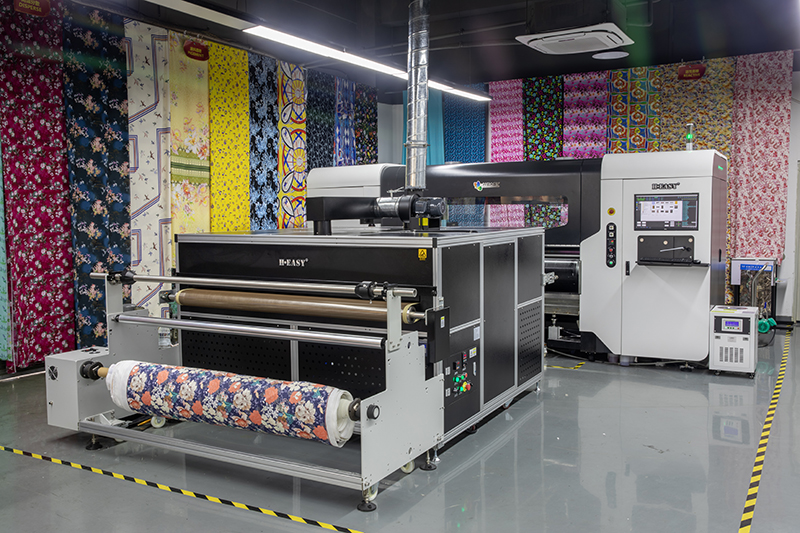
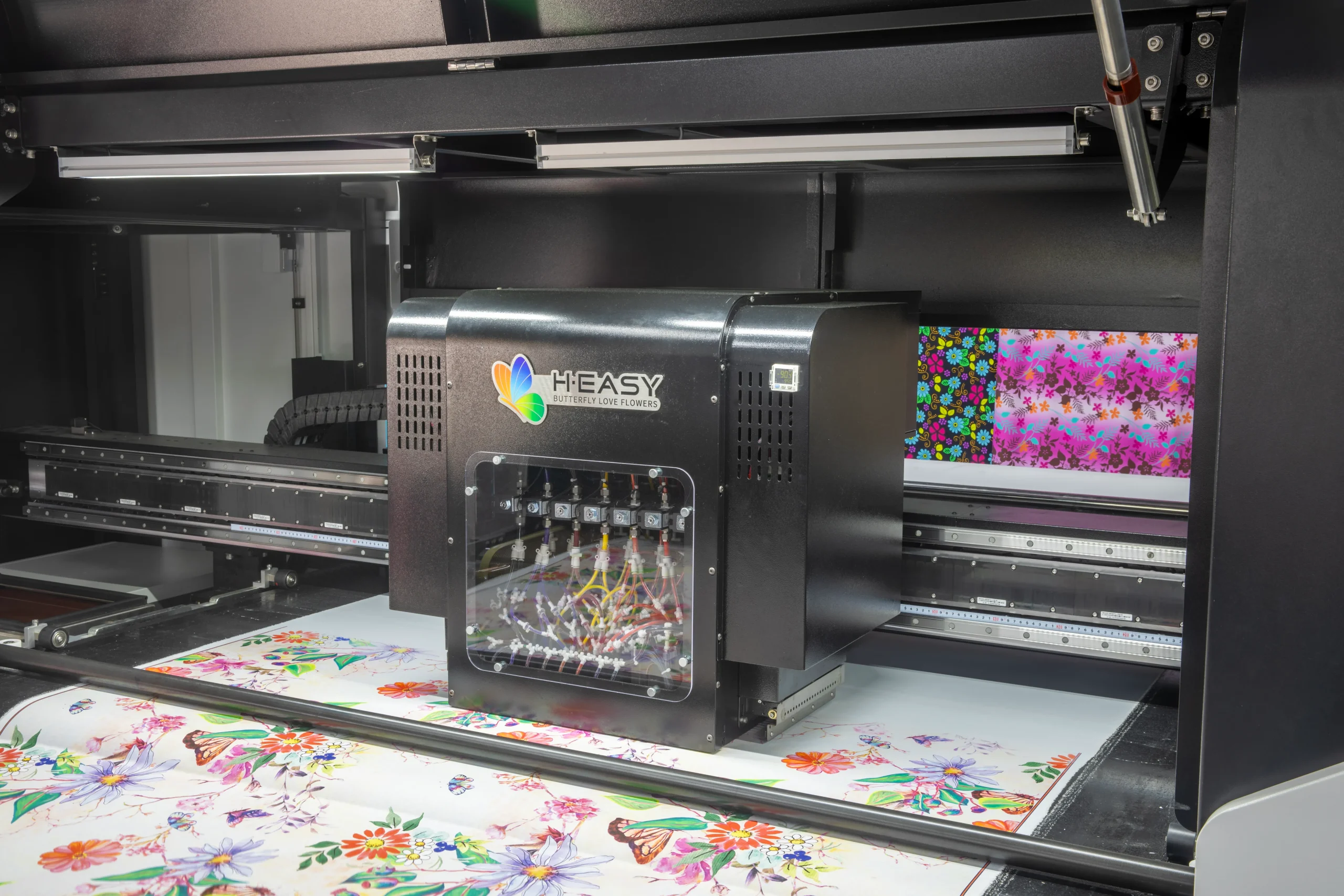
Pigment digital printing is not only about purchasing a textile printing machine. It requires a complete system: printer, printhead, ink, pretreatment solution, drying, fixation, software, and finishing.
H·EASY pigment digital printing solutions support factories in several ways.
1. Pretreatment and Post-Treatment Support
Different fabrics require different pretreatment formulas, and that complete formulas can be provided after machine purchase.
This is important for factories entering pigment textile printing because pretreatment directly affects color, fastness, and hand feel.
2. Tested Ink and Machine Compatibility
The ink has been tested with the machine to achieve good printing results.
For pigment ink, compatibility between ink particles, printhead, ink supply system, waveform, and machine maintenance is critical.
3. Stable Integrated Frame
H·EASY machines use an integrated frame structure to improve mechanical accuracy and production stability.
Stable machine structure helps maintain consistent printing results during bulk production.
4. High-Precision Head Bottom Plate
The head bottom plate uses wire-cutting processing technology, with minimum cutting size reaching about 0.01mm, helping ensure printing accuracy.
For multi-head industrial digital printing equipment, printhead alignment affects pattern clarity, color consistency, and long-term stability.
5. Model Options for Different Production Needs
| H·EASY Model | Recommended Application |
|---|---|
| H·EASY H1808 | Sampling, small-batch production, apparel fabrics, flexible orders |
| H·EASY H1816 | Medium-volume production, garment fabrics, blended fabrics, home textile orders |
| H·EASY H1832 | High-output production, continuous bulk production, home textiles and industrial fabric printing |
For customers building a complete pigment digital textile printing line, H·EASY can also work with pretreatment and post-treatment equipment partners based on the required production speed.
Practical Testing Workflow Before Bulk Production
Before bulk production, factories should follow a structured testing process:
- Check fabric pH value, absorbency, weft skew, and cleanliness.
- Select pretreatment formula according to fabric type.
- Start with a reference pretreatment ratio, such as around 5%.
- Test how different pickup levels affect color and hand feel.
- Print samples with different ink volumes and coverage levels.
- Test drying temperature and time.
- Test fixation temperature and time.
- Test dry rubbing, wet rubbing, and washing performance.
- Decide whether fixing agent or softener is needed.
- Run a small continuous production test before bulk printing.
This helps reduce fabric waste, improve color stability, and create repeatable production standards.
Conclusion
Pretreatment solution is one of the most important factors in pigment digital textile printing. It affects pigment adhesion, color yield, pattern sharpness, rubbing fastness, floating color, and hand feel.
In digital textile production, pretreatment cannot be considered separately. It must work together with fabric inspection, pigment ink, printer stability, drying, fixation, fixing agent, softener, and final finishing.
For factories, a reliable pigment digital printing solution is not only a printer. It is a complete process system. H·EASY pigment printing solutions combine stable machine structure, tested ink compatibility, pretreatment support, drying and fixation guidance, and different machine models to help customers produce cotton, linen, rayon, blended fabrics, apparel fabrics, and home textiles more consistently.
In most industrial pigment digital printing workflows, pretreatment is recommended. It helps improve color yield, pattern sharpness, and rubbing fastness.
One provided process reference mentions a typical pretreatment solution ratio of around 5%, but the final ratio should be adjusted according to fabric type, hand feel, fastness requirement, and pattern coverage.
Not always. Too much pretreatment may improve some fastness results, but it can also make the fabric harder and reduce comfort. The correct process should balance fastness, color, and hand feel.
Heat fixation helps the binder system form a film and lock pigment particles onto the fabric surface, improving rubbing fastness and washing stability.
In most standard pigment printing workflows, washing is not required. The common process is sizing, printing, and fixation. However, softening or washing may be added when a softer hand feel is required.
Yes. According to the provided materials, H·EASY can provide corresponding pretreatment formulas after machine purchase and can also support paste or fabric effect testing.