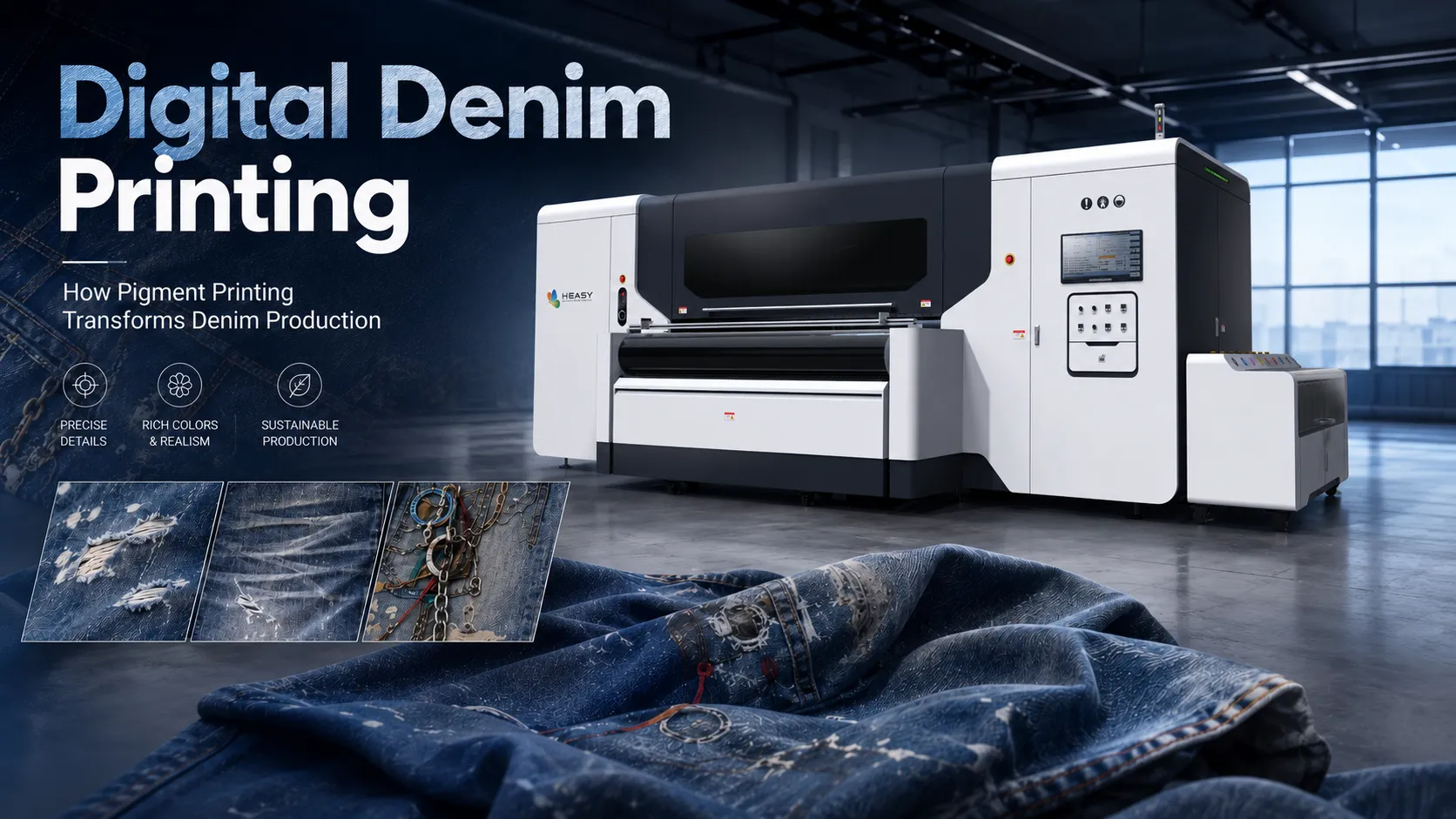
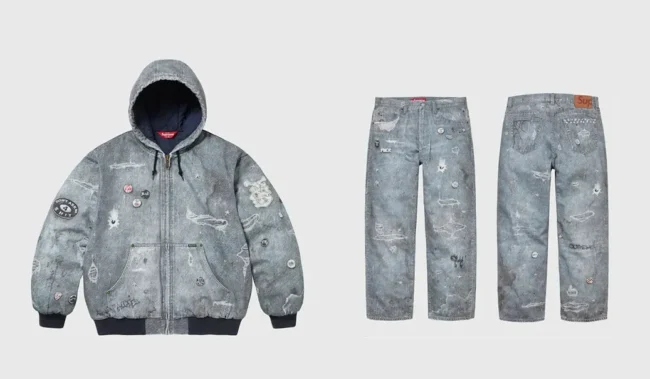
In recent years, more consumers have noticed a new type of denim product: jeans that look heavily washed, distressed, whiskered or worn, but feel relatively smooth and flat to the touch.
These jeans are not created by traditional denim washing alone. Instead, many of the visual effects are produced through digital denim printing, where vintage denim patterns are printed directly onto white or light-colored denim fabric.
From early fashion experiments to broader adoption by designer brands, streetwear labels and e-commerce sellers, digital denim is moving beyond a visual novelty. It is becoming a scalable production method for modern denim manufacturing.
For textile printing factories and denim garment manufacturers, this trend is not only about fashion. It represents a new production opportunity driven by small-batch orders, fast design changes, e-commerce demand and more sustainable manufacturing.
What Is Digital Denim Printing?
Digital denim printing is a textile printing process that uses a digital textile printer to print denim effects, washing textures, whiskers, fading, distress marks, patches, chains, oil stains, badges or other decorative graphics directly onto denim fabric.
Traditional denim finishing creates these effects through physical and chemical processes, such as:
- washing;
- enzyme washing;
- stone washing;
- sanding;
- brushing;
- grinding;
- bleaching;
- whisker pressing;
- distressed finishing.
Digital denim printing changes the logic.
Instead of physically creating every worn effect on the fabric, the visual appearance is converted into a digital artwork file and printed onto the fabric surface.
In simple terms:
Traditional denim finishing creates the effect physically.
Digital denim printing reproduces the effect visually.
This allows factories to turn denim washing effects into repeatable digital patterns.
Why Digital Denim Printing Is Becoming a New Denim Trend
Digital denim printing is not a short-term fashion experiment. It is becoming a new denim production trend because it matches several major changes in the apparel market: faster fashion cycles, customized designs, smaller order quantities and stronger sustainability requirements.
For denim manufacturers and printing factories, the value of denim production is shifting from traditional washing capability to digital design reproduction, flexible manufacturing and fast delivery.
1. Fashion Demand Is Moving Toward Faster Product Cycles
The fashion market is changing faster than ever. Brands no longer rely only on a few seasonal collections. Many apparel brands now need frequent product updates, limited-edition styles, online-exclusive designs and fast response to social media trends.
Traditional denim development usually requires multiple steps, including washing tests, sample adjustment, manual sanding, whisker creation, chemical treatment and repeated approval. This makes the development cycle longer and less flexible.
Digital denim printing simplifies this workflow.
With digital printing, denim effects can be created as image files and printed directly onto white or light-colored denim fabric. Whiskers, fading, vintage textures, patches, chains, oil stains and distressed effects can all be reproduced through digital artwork.
This allows factories to move from:
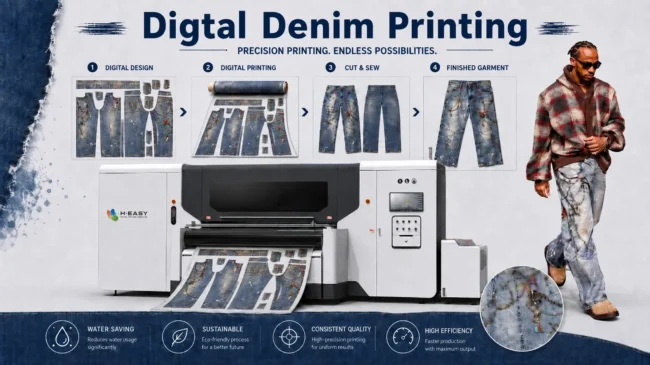
Design idea → Digital file → Printed fabric → Cut and sew → Finished garment
much faster than traditional denim finishing.
For fashion brands, this means faster sampling and quicker product launches. For printing factories, it means the ability to accept more short-cycle orders and respond quickly when a new denim trend appears.
2. Digital Printing Can Reproduce Denim Washing Effects Without Traditional Washing
One of the biggest reasons digital denim printing is gaining attention is that it can reproduce the visual effect of traditional denim washing without relying completely on the full washing process.
Traditional denim effects often require water washing, enzyme washing, sanding, grinding, bleaching, hand brushing or other finishing processes. These methods can create beautiful vintage effects, but they also require water, chemicals, labor, time and process control.
Digital denim printing provides another path.
Instead of physically damaging or washing the denim surface, the factory can print the appearance of washing, fading, whiskers, scratches, holes and used textures directly onto the fabric.
A pair of jeans can look as if it has gone through heavy washing, distressing and manual finishing, while the fabric surface remains relatively flat and consistent.
Digital printing can create:
- heavy washed effects;
- whisker effects;
- vintage fading;
- distressed textures;
- patchwork-style graphics;
- chain or accessory patterns;
- printed pocket and seam details;
- customized decorative denim graphics.
For production, this means fewer process steps and more controllable visual consistency. A digital file can be repeated, adjusted, scaled and printed again with higher flexibility.
3. E-Commerce Drives Small-Batch and Custom Denim Orders
E-commerce has changed how denim products are developed and sold.
In the past, factories often focused on large-volume orders. Today, many online brands and fashion sellers prefer smaller batches, more SKUs, faster testing and quick restocking. A design may first be tested in a small quantity, and only after market feedback will the brand place a larger order.
This order structure is very suitable for digital denim printing.
Traditional denim washing and finishing can be less efficient for small runs because every new style may require process development, sample adjustment and manual work. If the order quantity is small, the setup cost becomes difficult to control.
Digital printing reduces this pressure because new designs can be changed directly through digital files. A factory can print different denim effects without making screens or repeating complex washing development.
This gives factories more flexibility to handle:
- small-batch denim orders;
- fast fashion styles;
- e-commerce test orders;
- customized jeans;
- limited-edition collections;
- streetwear-inspired designs;
- quick repeat orders after online sales increase.
For denim printing factories, digital denim is not only a visual trend. It is also a production model that matches the current e-commerce supply chain.
4. Sustainability Makes Digital Denim More Attractive
Sustainability is another important reason why digital denim printing is becoming more popular.
Traditional denim washing and finishing are often associated with high water use, chemical treatment, wastewater discharge and labor-intensive processing. As brands and consumers pay more attention to environmental impact, denim manufacturers are under pressure to reduce water consumption, chemical use and production waste.
Digital denim printing can help factories reduce dependence on some traditional washing and manual finishing processes.
By printing the visual effect directly, factories can create denim-style designs with fewer washing steps. This can help reduce water use, chemical consumption and wastewater pressure in certain applications.
Digital denim printing also fits broader sustainable fashion trends, such as:
- recycled cotton denim;
- Tencel denim;
- low-water denim production;
- small-batch manufacturing;
- on-demand production;
- reduced inventory waste.
When digital printing is combined with suitable fabrics and responsible finishing, denim production can become more flexible, more creative and more aligned with future market requirements.
Why Digital Pigment Printing Is Suitable for Digital Denim
One important technical route for digital denim is digital pigment printing.
Pigment ink does not mainly rely on a chemical reaction with one specific fiber type. Instead, pigment particles are fixed on the fabric surface through pretreatment, binder, drying and heat fixation.
The pigment process is:
Fabric Inspection → Pretreatment → Digital Printing → Color Fixation, while reactive, disperse and acid printing usually require sizing, printing, steaming, washing and finishing.
This shorter workflow makes digital pigment printing suitable for small-batch, multi-style and fast-turn denim orders.
1. No Screen Making, Better for Multi-Style Orders
Digital denim is rarely a single design produced for a very long time. It is usually driven by trends, e-commerce testing, brand collections and fast style changes.
Pigment digital printing does not require traditional screen making. Once the design file is ready, the pattern can be printed directly.
This makes it suitable for:
- e-commerce product testing;
- fashion denim collections;
- customized denim garments;
- small-batch production;
- multi-style orders;
- fast reorder production.
2. Image-Level Reproduction of Vintage Denim Effects
Digital denim printing is especially suitable for effects that are mainly visual.
These effects include:
- whiskers;
- faded areas;
- distressed marks;
- hole effects;
- washed textures;
- stains;
- chains;
- patches;
- badges;
- graffiti;
- vintage textures.
Since these are visual patterns, they can be reproduced as digital images and printed onto fabric.
3. Better Fit for Fast-Turn E-Commerce Orders
E-commerce denim orders often follow a test-and-repeat model.
A seller may first produce a small batch, test market response, then reorder quickly if the design sells well.
Traditional washing processes are often costly and slow for this type of order. Digital printing makes it easier to produce dozens, hundreds or mixed-style batches with lower setup pressure.
This is one reason digital denim has gained attention in apparel production regions where e-commerce orders are highly active.
Digital Denim Printing vs Traditional Denim Washing
| Comparison | Traditional Denim Washing | Digital Denim Printing |
|---|---|---|
| Production Method | Water washing, chemical treatment, sanding and manual finishing | Digital artwork printed directly on fabric |
| Development Cycle | Longer, requires repeated process testing | Shorter, design can be changed digitally |
| Small-Batch Orders | Higher setup cost | More flexible |
| Visual Consistency | Depends on process and manual control | Digital file can be repeated |
| Water Use | Usually higher | Can reduce dependence on washing |
| Style Change | Slower and more costly | Faster and more flexible |
| Environmental Pressure | Higher water and chemical treatment pressure | Supports lower-water, flexible production |
| Best Application | Traditional denim finishing | Fashion denim, e-commerce orders, customized products, small-batch production |
Digital denim printing does not completely replace all traditional denim processes. Some products still require real fabric damage, true holes, special hand feel or complex finishing.
However, for denim styles where the main value is visual expression, digital printing provides a faster and more flexible alternative.
What Digital Denim Means for Printing Factories
Digital denim gives textile printing factories a new business opportunity.
Many factories are facing challenges such as:
- fewer traditional orders;
- rising labor costs;
- environmental pressure;
- small orders with low margins;
- faster delivery requirements.
Digital denim orders have different characteristics:
- frequent style updates;
- high demand from e-commerce sellers;
- small-batch and repeat orders;
- strong visual differentiation;
- high need for stable output;
- fast delivery requirements.
This makes digital denim highly suitable for factories with digital textile printing capability.
For printing factories, digital denim is not just another product category. It represents a shift in production model:
from large-volume single-style production to flexible, multi-style, small-batch and fast-turn manufacturing.
Equipment Stability Is the Real Key Behind Digital Denim
Digital denim may look like a fashion trend, but in real factory production, it depends heavily on equipment performance.
Denim artwork often contains rich details, including whiskers, faded gradients, distressed edges, stains, chains and vintage textures. If the printer is not stable, factories may face:
- blurry patterns;
- color inconsistency;
- lost details;
- batch color difference;
- fabric skew;
- nozzle clogging;
- poor repeatability;
- delayed delivery.
A professional digital denim printing setup requires:
- stable belt feeding;
- accurate fabric transport;
- high-precision printhead alignment;
- reliable ink supply;
- mature printhead and driver board compatibility;
- proper RIP color management;
- suitable drying and fixation;
- long-time continuous production capability;
- pretreatment and post-treatment support.
How H·EASY Textile Digital Printing Machines Support Digital Denim Production
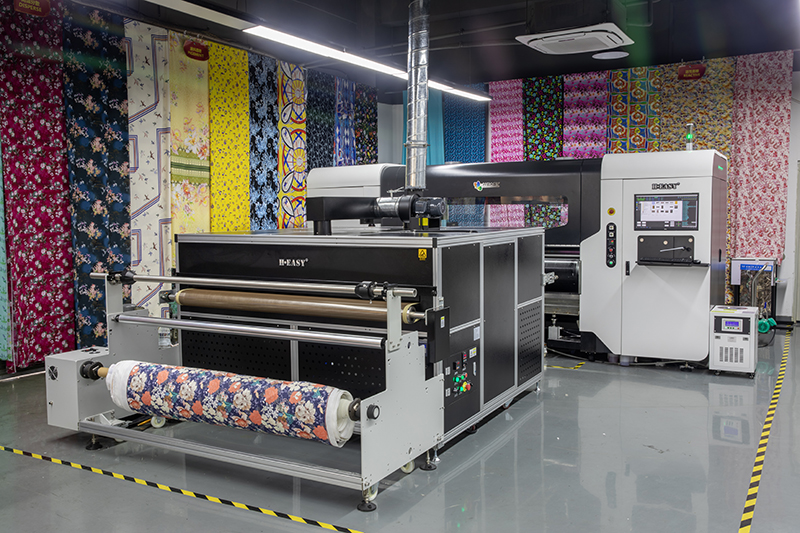
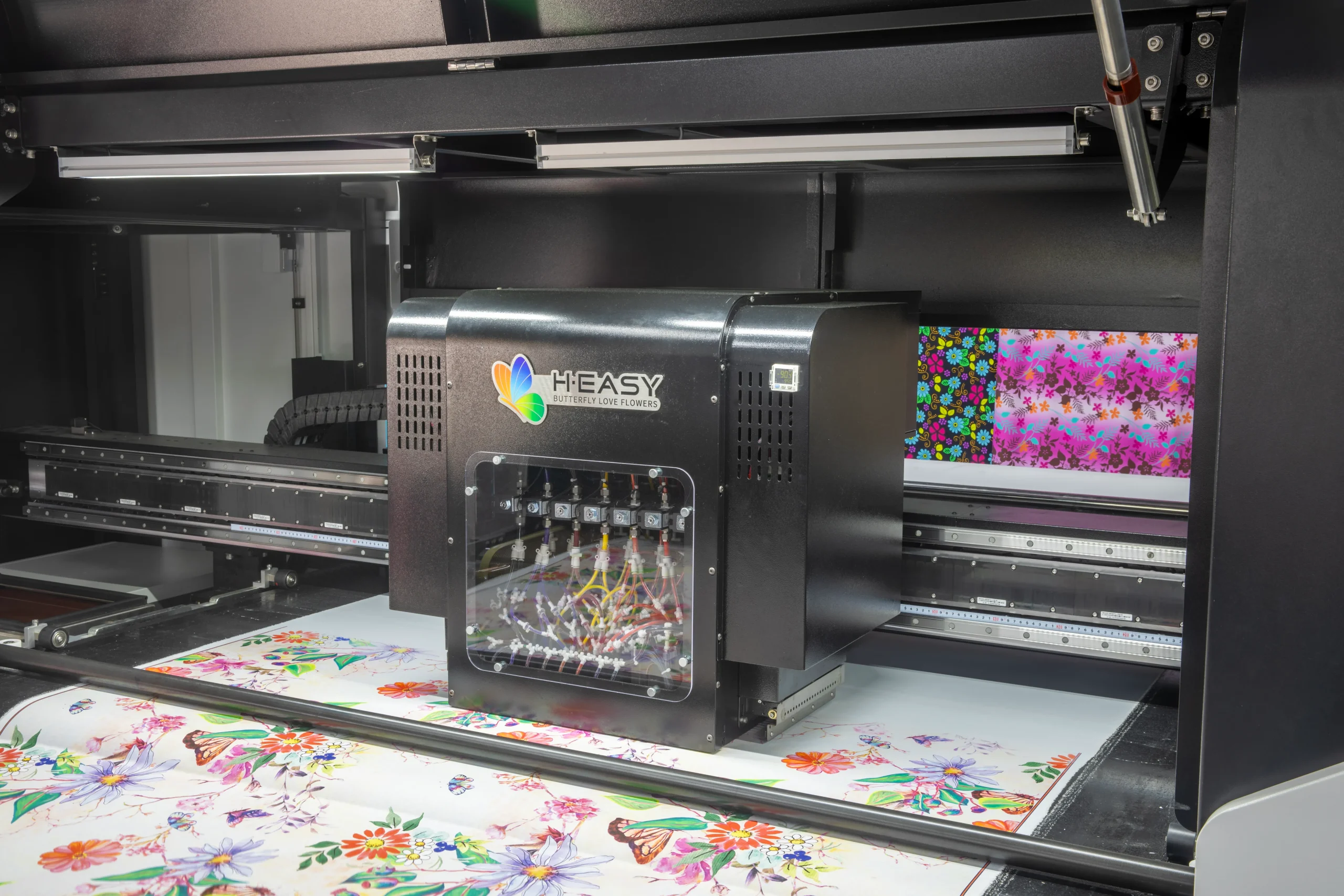
H·EASY textile digital printing machines are designed for industrial fabric printing applications, including apparel fabrics, home textiles, blended fabrics and customized textile products.
For digital denim printing, stability and process support are especially important.
1. Integrated Frame for Long-Term Stability
H·EASY textile digital printing machine uses an integrated frame structure, helping improve mechanical accuracy and reduce precision problems caused by traditional multi-part assembly.
For digital denim printing, machine stability affects pattern positioning, sharpness and repeatability during bulk production.
2. High-Precision Head Bottom Plate for Detailed Images
The H·EASY head bottom plate uses wire-cutting processing technology, with the minimum cutting size reaching about 0.01mm, helping ensure printing accuracy.
Digital denim effects such as whiskers, faded areas, distressed edges and chain details require accurate image reproduction. Printhead alignment and mechanical precision are therefore essential.
3. Independently Developed Driver Board
H·EASY began developing Ricoh printhead driver boards in 2014 and has continued optimizing compatibility for Gen5, Gen5e and Gen6 printheads.
For pigment ink applications, compatibility between ink, printhead, driver board, waveform and ink supply system is critical. Stable jetting helps reduce nozzle issues, color difference and production interruptions.
4. Pretreatment and Post-Treatment Support
Different fabrics require different pretreatment formulas, and complete formulas can be provided after customers purchase the machine.
For digital denim printing, pretreatment affects:
- color performance;
- pattern edge sharpness;
- dry and wet rubbing fastness;
- hand feel;
- bulk production stability.
This means factories need not only a printer, but also a workable production process.
Who Is Digital Denim Printing Suitable For?
Digital denim printing is suitable for:
| Customer Type | Main Need |
|---|---|
| Denim garment factories | Develop new denim styles and speed up product updates |
| E-commerce apparel sellers | Small batches, multiple designs and fast reorders |
| Streetwear brands | Special visual effects and limited collections |
| Textile printing factories | New high-frequency order opportunities |
| OEM / ODM garment manufacturers | Faster sampling and flexible production |
| Fabric development companies | Digital denim fabric sample development |
| Designer brands | Customized patterns with lower minimum order quantity |
Typical Digital Denim Printing Workflow
A typical pigment-based digital denim workflow may include:
- Create denim effect artwork.
- Arrange patterns according to garment panels or fabric layout.
- Select white or light-colored denim fabric.
- Inspect and pretreat the fabric.
- Print the denim effect by pigment digital printing.
- Dry and fix the printed fabric.
- Cut and sew the garment.
- Finish and test the final product.
After printing, the fabric ink should be fully dried before moving to the next process; otherwise, unstable color yield and floating color may occur.
Key Points Before Starting Digital Denim Production
1. Fabric Selection
Digital denim printing is usually more suitable for white or light-colored denim fabric. Dark denim may affect color expression, especially for faded or highlighted areas.
2. Artwork Quality
The realism of digital denim depends on image quality. Low-resolution artwork may make the washing effect look unnatural.
3. Pattern Layout
If printing garment panels, the layout must match the cutting pattern. Otherwise, the effect may not align correctly after sewing.
4. Balance Between Fastness and Hand Feel
Pigment printing requires pretreatment and fixation to improve fastness, but excessive treatment may affect hand feel. Some smooth, thin fabrics are difficult because fastness and softness are not easy to balance.
5. Bulk Production Testing
Before bulk production, factories should test:
- color consistency;
- dry rubbing fastness;
- wet rubbing fastness;
- washing performance;
- hand feel;
- sewing result;
- final garment appearance.
Why Digital Denim Matches ESG and Sustainable Fashion Trends
Digital denim printing is not only about fashion. It also supports the industry’s shift toward cleaner and more flexible manufacturing.
Traditional denim washing often requires significant water use, chemicals and manual processing. Digital printing can reduce dependence on some washing and distressing steps, helping factories lower water use and chemical pressure in certain applications.
It also supports on-demand production and small-batch manufacturing, which can reduce inventory risk and overproduction.
Digital denim aligns with future manufacturing trends:
- lower water use;
- less waste;
- faster response;
- lower minimum order quantity;
- flexible design;
- e-commerce-friendly supply chain;
- more sustainable fashion production.
H·EASY Model Recommendations
Factories can choose different H·EASY solutions based on order type and production capacity:
| Production Need | Recommended Direction |
|---|---|
| Sampling, small batches and e-commerce orders | H·EASY H1808 |
| Medium-volume garment fabric production | H·EASY H1816 |
| High-output continuous production | H·EASY H1832 |
| Wider fabrics or special applications | Customized solution based on requirements |
For digital denim orders with small batches, multiple styles and fast reorders, H1808 and H1816 are practical starting options. If order volume is stable and high output is required, H1832 can be considered.
Conclusion
Digital denim printing is changing the logic of denim production.
It transforms washing, fading, whiskers, distress marks and decorative denim effects into digital images that can be printed, repeated and scaled. This production method is better suited to e-commerce, small-batch orders, fast style changes and more sustainable manufacturing.
For printing factories, digital denim is not just a fashion trend. It is a new growth opportunity.
To capture this opportunity, factories need more than artwork and orders. They need a stable digital textile printing machine and a mature pigment printing process.
H·EASY textile digital printing machines help denim factories, garment manufacturers and textile printing companies enter digital denim production with stable machine structure, high-precision printhead alignment, independently developed driver boards, ink compatibility and process support.