Choosing the right pigment ink printer is an important decision for textile factories that want to produce fabric prints with a simpler workflow, wider fabric compatibility, and lower water consumption.
Pigment printing is becoming more popular in industrial textile production because it can be used on many fabric types, especially cotton, linen, rayon, blended fabrics, and some synthetic materials. Compared with reactive, acid, or disperse printing, pigment printing usually has a shorter process and does not require traditional washing after printing.
However, not every pigment ink printer is suitable for industrial fabric production. Before investing in a machine, factories should evaluate fabric type, printhead configuration, machine structure, printing speed, ink compatibility, fixation process, maintenance cost, and after-sales support.
This guide explains how to choose a suitable pigment inkjet printer for real textile production, not just sample printing.
What Makes a Good Pigment Ink Printer?
A good industrial pigment ink printer should offer:
| Key Factor | Why It Matters |
|---|---|
| Wide fabric compatibility | Supports cotton, linen, blended fabrics, rayon, wool blends, and some synthetic fabrics |
| Mature printhead solution | Affects printing stability, speed, maintenance cost, and print quality |
| Stable machine structure | Reduces vibration, deviation, and long-term accuracy problems |
| Accurate printhead alignment | Improves pattern clarity and color consistency |
| Reliable ink system | Reduces clogging, cleaning waste, and downtime |
| Matched pretreatment and fixation | Improves color yield, rubbing fastness, and hand feel |
| Suitable production speed | Determines daily output and cost per meter |
| Process and after-sales support | Helps factories solve real production issues faster |
The best choice is not simply the cheapest ink pigment printer. For industrial fabric production, the better choice is a complete solution that combines machine, printhead, ink, software, pretreatment, drying, fixation, and technical support.
What Is a Pigment Ink Printer?
A pigment ink printer is a digital textile printing machine that uses pigment ink to print directly onto fabric. Pigment ink contains fine color particles. These particles are fixed mainly on the fabric surface instead of chemically reacting with the fiber.
A typical pigment printing workflow is simple:
Sizing → Printing → Fixation
By comparison, reactive, acid, and disperse printing usually require sizing, printing, steaming, washing, and finishing. Pigment printing provides a shorter process of sizing, printing, and fixation.
This simplified workflow is one of the main reasons why pigment printing in textile production is attractive for factories that want to reduce washing, water consumption, and wastewater treatment pressure.
1. Start with the Fabric You Want to Print
Before choosing a machine, the first question should be:
What fabric do you mainly print?
Pigment ink can be used on many fabrics, including cotton, linen, rayon, viscose, blended fabrics, wool, silk, polyester, and nylon. However, different fabrics need different pretreatment, ink volume, fixation, and finishing settings.
Best Fabric Applications for Pigment Printing
Pigment printing is especially suitable for:
- cotton fabric;
- linen and cotton-linen fabric;
- rayon and viscose;
- cotton-polyester blends;
- polyester-viscose blends;
- home textile fabrics;
- fashion fabrics;
- small-batch and multi-design orders.
Blended fabrics are one of the strongest application areas for textile pigment printing. Reactive printing has more advantages on natural fibers, while pigment printing has more advantages on blended fabrics, especially as blended materials become more common in the textile market.
Fabrics That Need More Testing
Some fabrics can be printed with pigment ink, but they need careful testing before bulk production.
For smooth, thin polyester and nylon fabrics, pigment printing may have difficulty balancing fastness and softness. If more pretreatment or binder is used to improve fastness, the fabric may become harder. For pure polyester, disperse printing may often be more cost-effective.
Toweling fabric is also usually not ideal for pigment printing because it needs repeated washing and rubbing. For this kind of fabric, reactive printing may be more suitable.
2. Choose a Mature Printhead Solution
The printhead is one of the most important parts of any inkjet printer with pigment ink. It affects speed, stability, print quality, maintenance cost, and long-term production reliability.
For pigment applications, Ricoh Gen5 and Ricoh Gen6 printheads are mature and practical choices.
Ricoh Gen5
Ricoh Gen5 is known for good penetration, durability, and mature industrial application. It is suitable for factories that value stability and long-term operation.
Ricoh Gen6
Ricoh Gen6 offers higher efficiency and smaller droplet size compared with Gen5. It is suitable for factories that need higher production capacity while maintaining acceptable image quality.
Ricoh is recommended for pigment printing when customers focus on production efficiency and mature application performance. The materials also mention that Ricoh Gen6 has mature ink, board, and process adaptation for pigment applications.

What About Epson S3200?
Epson S3200 can print pigment ink in some cases, but it is currently more suitable for reactive applications, while Ricoh pigment solutions are more mature for industrial pigment printing.
For factories focused on long-term pigment production, a Ricoh-based pigment inkjet printer is usually easier to manage.
3. Check Machine Structure and Mechanical Precision
Industrial fabric printing is not only about the printhead. The machine frame, guide belt, printhead bottom plate, feeding system, and drying system also affect the final result.
If the machine structure is not stable, the factory may face:
- banding;
- fabric deviation;
- color inconsistency;
- registration errors;
- more rejected fabric;
- more reprinting;
- higher maintenance cost.
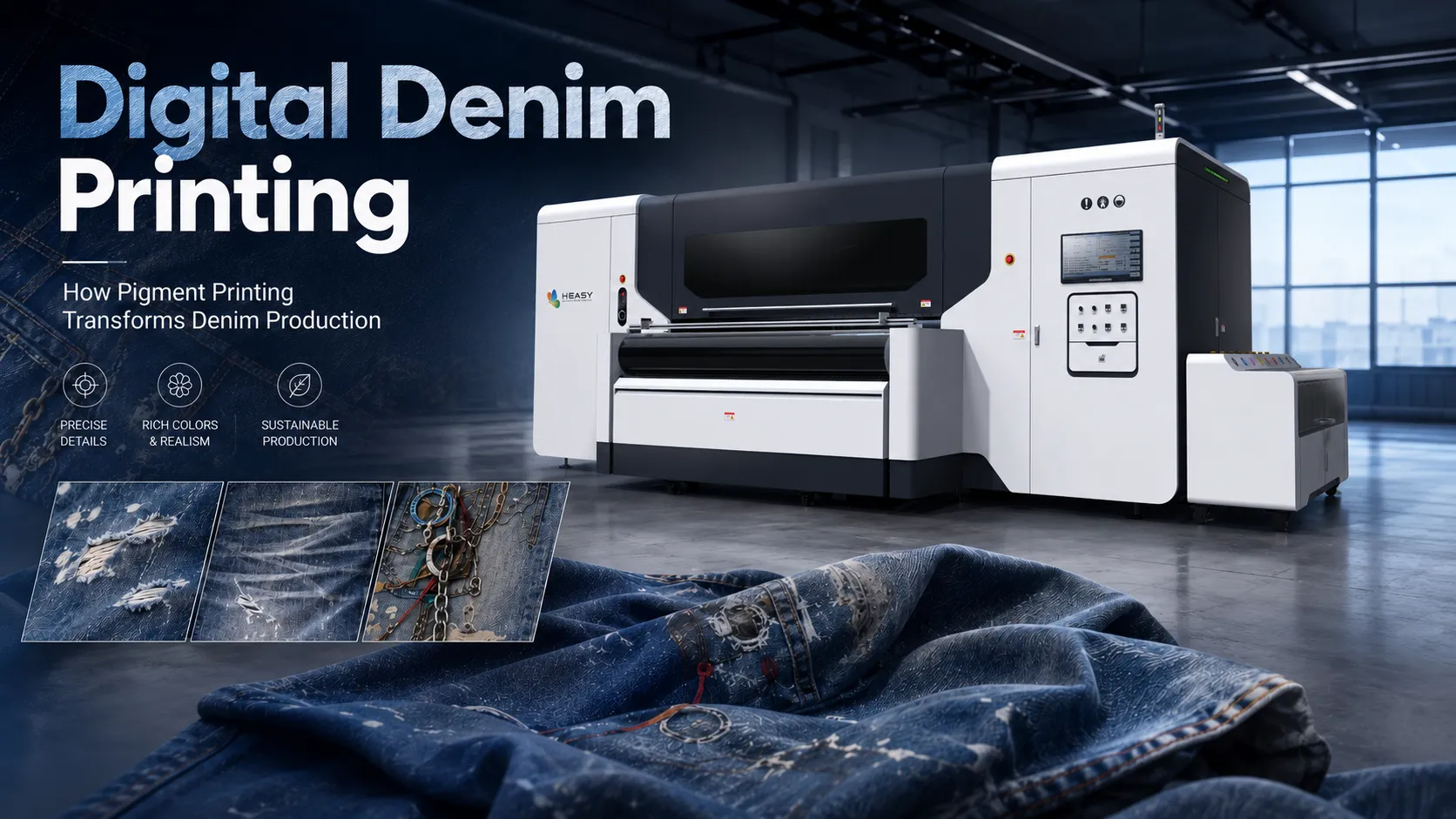
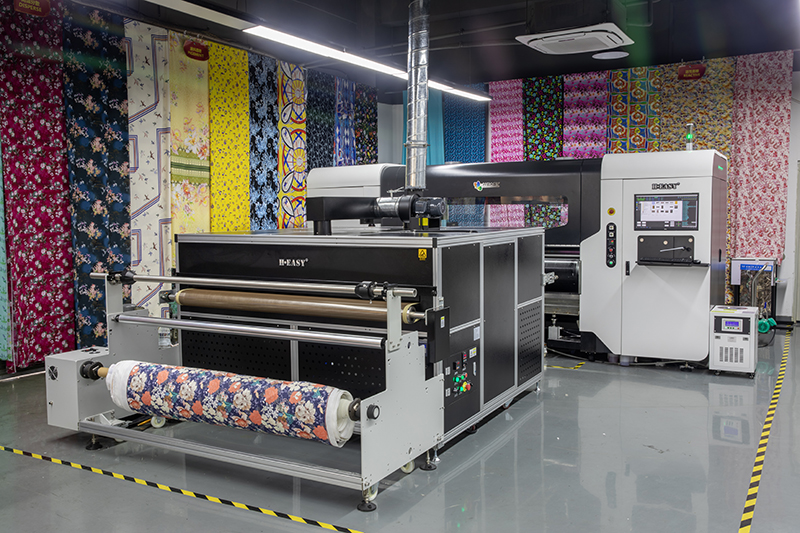
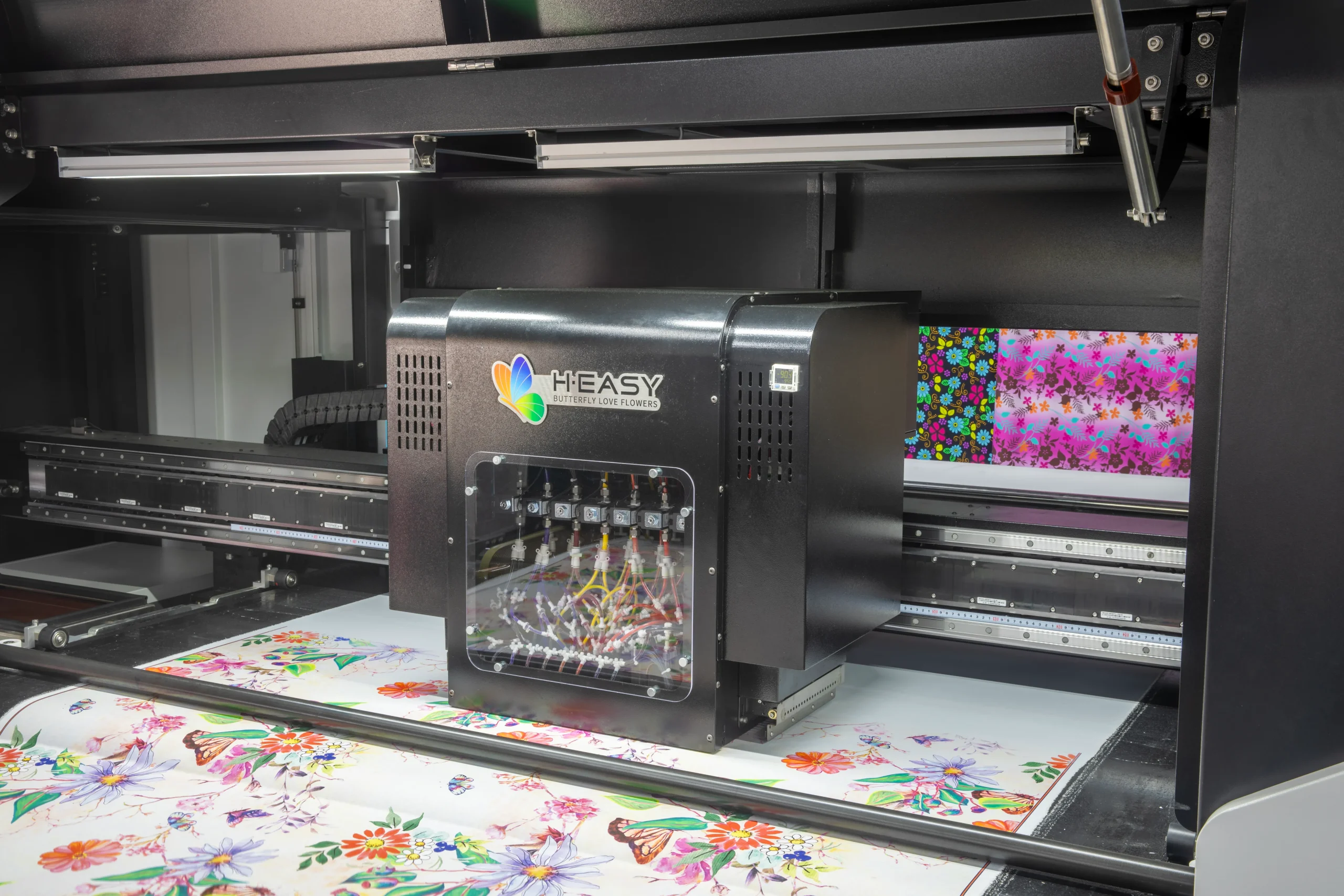
H·EASY pigment printers use a stable machine structure for industrial direct-to-fabric production, featuring a welded frame, high mechanical precision, and a one-piece printhead plate for enhanced printing stability and accuracy.
For factories that need to produce pigment print fabric every day, this kind of mechanical stability is essential.
4. Match Printer Speed with Real Production Needs
Printer speed directly affects production capacity, delivery time, and cost per meter.
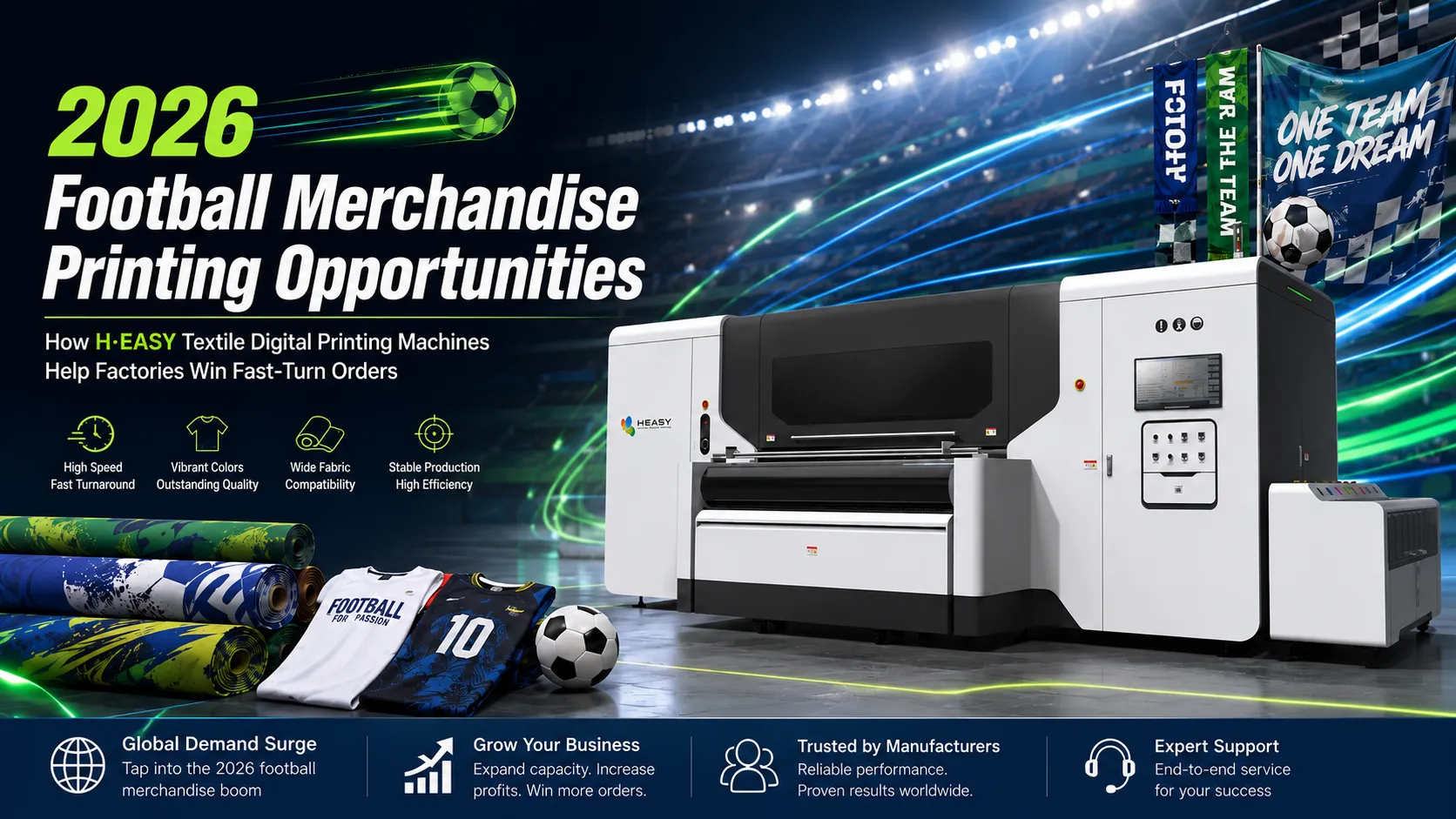
For H·EASY industrial pigment printing solutions, commonly recommended models include H1808, H1816, and H1832. Based on Ricoh Gen6 printhead configuration, the reference theoretical speeds are:
| Model | Positioning | Reference Speed |
|---|---|---|
| H1808 | Entry-to-industrial production | 1-pass 330 m²/h, 2-pass 170 m²/h, 3-pass 120 m²/h |
| H1816 | Balanced industrial production | 1-pass 660 m²/h, 2-pass 330 m²/h, 3-pass 200 m²/h |
| H1832 | High-output production | 1-pass 1300 m²/h, 2-pass 700 m²/h, 3-pass 450 m²/h |
These are reference values. In real bulk production, speed may be lower depending on feathering, fabric type, pass mode, print quality, and production requirements.
Which Model Should You Choose?
H·EASY H1808
Suitable for factories entering industrial pigment printing, sample-to-production workflows, or medium-volume orders.
H·EASY H1816
A balanced choice for garment fabric factories that need stable productivity and mature pigment printing performance.
H·EASY H1832
Recommended for high-output factories that need faster bulk production and stronger delivery capacity.
If your factory is mainly printing garment fabrics, H1816 is often a practical balance between investment, speed, and production flexibility. If you need higher daily output, H1832 is more suitable.
5. Choose the Right Printing Width
Printing width should match your main business.
For garment fabric production, 1.8m and 2.2m widths are commonly used. For home textile fabrics, 2.6m and 3.2m widths are more common.
H·EASY H1808 and H1816 are 1.8m-class machines, while H1832 has a maximum printing width of about 1.9m. Wider customized options such as 2.6m and 3.2m can also be considered depending on production needs.
| Main Business | Recommended Direction |
|---|---|
| Garment fabric | 1.8m or 2.2m width |
| Home textile fabric | 2.6m or 3.2m customized width |
| Small-batch fashion fabric | H1808 or H1816 |
| Industrial fabric production | H1816 or H1832 |
| High-output production | H1832 or customized wider machine |
6. Do Not Ignore Pretreatment and Fixation
A pigment ink printer alone cannot guarantee a good result. Pigment printing depends on the full process.
The key process includes:
Fabric inspection → Sizing / pretreatment → Printing → Drying → Fixation → Softening if needed
Pigment fastness is achieved through pretreatment, ink, binder, and heat fixation. The pigment printing generally uses ionic bonding and heat baking to form a film for better fastness.
For industrial production, factories should confirm:
- pretreatment formula;
- sizing machine compatibility;
- drying method;
- fixation temperature and time;
- softening process;
- dry and wet rubbing fastness requirements;
- odor and exhaust treatment if needed.
Pigment printing usually does not require washing. However, if the customer requires a softer hand feel, washing or softening treatment may still be added.
7. Understand the Real Cost Structure
The cost of textile pigment printing is not only the machine price.
A complete cost calculation should include:
- pigment ink consumption;
- pretreatment chemicals;
- drying and fixation energy;
- labor;
- printhead maintenance;
- cleaning waste;
- rejected fabric;
- machine depreciation;
- post-treatment if needed.
The pigment ink consumption is about 20g per square meter, which can be used as a basic reference for cost estimation.
A simple ink cost formula is:
Ink cost per m² = 0.02kg × ink price per kg
However, the real cost advantage of pigment printing often comes from process simplification. Because pigment printing usually does not require washing, factories can reduce water use, wastewater treatment, and post-processing complexity.
8. Check Ink Compatibility and Maintenance Requirements
Pigment ink contains larger particles than many dye-based inks. This means ink quality, filtration, ink circulation, nozzle maintenance, and machine compatibility are very important.
If a machine is set up for pigment printing, it is not recommended to change it to other ink processes, because pigment particles are difficult to clean completely and may cause nozzle clogging.
Before buying an inkjet printer with pigment ink, factories should ask:
- Is the machine designed for pigment ink from the beginning?
- Has the pigment ink been tested with the printhead?
- Is the ink system stable for long production shifts?
- Are spare parts and maintenance support available?
- Can the supplier provide pretreatment and post-treatment guidance?
- Can the supplier help with real production troubleshooting?
For serious industrial pigment production, a dedicated pigment solution is safer than frequently switching between ink systems.
9. Evaluate Software and Color Management
A good pigment ink printer should also have reliable RIP software and color management support.
RIP software affects:
- color accuracy;
- repeat order consistency;
- ink volume control;
- dark color output;
- fabric color matching;
- customer approval speed.
H·EASY pigment printers support RIP software such as Neostampa and Texprint. Neostampa is often preferred for producing brighter output, while Texprint can provide colors that more closely match the on-screen preview in some workflows.
For industrial pigment production, color management is directly related to production efficiency and ink cost.
10. Why Choose H·EASY Pigment Ink Printer?
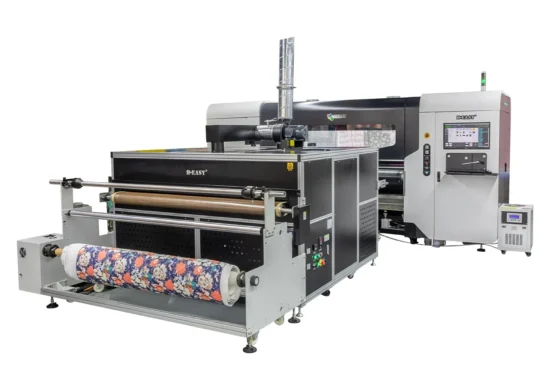
For factories looking for a practical industrial pigment ink printer, H·EASY provides complete direct-to-fabric pigment printing solutions based on industrial machine structure, Ricoh printhead application, matched ink system, and process support.
H·EASY pigment printers are suitable for customers who need:
- industrial fabric printing;
- cotton and blended fabric printing;
- no-wash pigment printing;
- medium to high production capacity;
- Ricoh Gen6 printhead options;
- stable machine structure;
- matched ink, board, and process support.
H·EASY H1808
Recommended for factories entering industrial pigment printing or handling medium-volume fabric orders. It is suitable for sample-to-production workflows and flexible fabric printing.
H·EASY H1816
Recommended for garment fabric factories that need a balance of productivity, stability, and investment control. It is a strong option for cotton, blended fabrics, fashion fabrics, and regular industrial production.
H·EASY H1832
Recommended for high-output factories that need faster bulk production, stronger delivery capacity, and higher daily output.
H·EASY also supports wider customized solutions for home textile factories that need larger fabric widths.
Final Checklist Before Buying a Pigment Ink Printer
Before choosing a pigment ink printer, confirm these points:
| Question | Why It Matters |
|---|---|
| What fabric will you print most often? | Cotton, linen, blends, polyester, and nylon need different settings |
| What is your target daily output? | Helps choose 8-head, 16-head, or 32-head models |
| What printing width do you need? | Determines machine model and investment |
| What printhead solution is used? | Affects speed, stability, and maintenance |
| Is the pigment ink tested with the machine? | Reduces clogging and color instability |
| Can the supplier provide pretreatment guidance? | Important for color yield and fastness |
| Is the fixation process matched? | Affects rubbing fastness and washing performance |
| What is the maintenance cost? | Affects long-term production cost |
| Is after-sales support available? | Critical for industrial production stability |
Conclusion
Choosing the right pigment ink printer for industrial fabric production requires more than comparing machine prices. A factory should evaluate fabric compatibility, printhead maturity, mechanical stability, production speed, printing width, ink compatibility, pretreatment, fixation, maintenance, and technical support.
Pigment printing is especially valuable for factories that print cotton, linen, rayon, blended fabrics, and mixed-material orders. It offers a simpler process, usually reduces washing requirements, and supports flexible textile production.
For factories looking for a mature industrial solution, H·EASY pigment ink printers provide Ricoh Gen6 printhead options, stable machine structure, high-speed production models, and matched pigment printing process support. Whether you need an entry industrial solution like H1808, a balanced production model like H1816, or a high-output solution like H1832, H·EASY can help build a more efficient and reliable pigment printing workflow.