In pigment printing in textile production, color fastness is one of the most important quality indicators. For fabric printing factories, customers do not only expect sharp patterns and stable colors. They also want the printed fabric to resist rubbing, washing, sunlight exposure, and daily use.
Pigment ink printing is popular because it has a simpler process, usually requires no washing, and can be used on a wide range of fabrics such as cotton, silk, polyester, nylon, rayon, blended fabric, wool, and linen. However, pigment printing also has challenges. If pretreatment, drying, fixation, ink volume, or machine stability is not controlled well, the fabric may show poor rubbing fastness, floating color, hard hand feel, or color fading.
This article explains how textile factories can improve color fastness in pigment ink printing and how a stable pigment ink printer helps achieve more reliable production results.
What Is Color Fastness in Pigment Printing?
Color fastness means how well the printed color remains on the fabric under different conditions. In textile production, the most common fastness tests include:
| Fastness Type | What It Measures |
|---|---|
| Dry rubbing fastness | Whether color transfers when dry fabric is rubbed |
| Wet rubbing fastness | Whether color transfers when wet fabric is rubbed |
| Washing fastness | Whether printed color fades or stains after washing |
| Light fastness | Whether color fades under sunlight or light exposure |
| Water fastness | Whether color bleeds or transfers in water |
| Perspiration fastness | Whether sweat affects printed color |
For pigment ink printing, dry and wet rubbing fastness are especially important because pigment particles mainly stay on the fabric surface instead of fully penetrating and reacting inside the fiber.
Why Pigment Printing Fastness Needs Special Control
Pigment ink is different from reactive, acid, or disperse ink.
Reactive ink mainly reacts with cellulose fibers such as cotton and viscose. Disperse ink is widely used for polyester. Acid ink is commonly used for nylon, wool, and silk.
Pigment ink works differently. It relies on pigment particles, pretreatment, binder, drying, and heat fixation to form a film on the fabric surface. A typical pigment printing process can be summarized as:
Fabric Inspection → Pretreatment / Sizing → Digital Printing → Drying → Fixation → Softening or Finishing if needed
In the provided materials, pigment printing is also described as a simpler process compared with reactive, disperse, or acid printing: pigment printing usually follows sizing → printing → fixation, while other dye-based processes often require steaming and washing.
Because pigment ink is fixed mainly on the surface, its fastness depends heavily on the strength of the film, the quality of fixation, the fabric surface condition, and the stability of the printing process.
How to Improve Color Fastness
To improve color fastness in pigment printing in textile production, factories should focus on these key points:
| Key Factor | Why It Matters |
|---|---|
| Proper fabric inspection | Reduces defects caused by pH, poor absorbency, skew, or dirty fabric |
| Correct pretreatment | Helps pigment particles bond better to the fabric surface |
| Controlled ink volume | Prevents excessive surface buildup and floating color |
| Complete drying | Prevents unstable fixation and color transfer |
| Sufficient heat fixation | Allows binder film formation for better durability |
| Suitable fabric selection | Helps balance fastness, softness, and cost |
| Stable printer performance | Reduces banding, clogging, reprinting, and uneven color |
1. Start with Fabric Inspection
Good color fastness starts before printing.
Before pigment printing, fabric should be checked for pH value, absorbency, weft skew, and cleanliness. The provided H·EASY pigment process materials point out that pH value has a strong influence on color fixation. If the pH is too high or too low, it may cause color difference, spots, or batch defects. Fabric absorbency also affects color depth; poor absorbency may lead to lighter colors and unstable results.
Fabric cleanliness is also important. Dust, oil, lint, and long raw edges may affect printing quality or rub against the printhead, causing nozzle clogging. For an industrial digital textile printer, stable fabric condition is directly related to stable production quality.
2. Use the Right Pretreatment Formula
Pretreatment is one of the most important steps for improving pigment printing fastness.
In pigment printing, pretreatment helps control ink spreading, improve color yield, and support pigment adhesion. Different fabrics need different formulas. The H·EASY materials mention that formulas should be adjusted according to fabric types such as cotton, linen, and silk, and that complete recipes can be provided to customers after purchasing the machine.
The Q&A materials also explain the pigment printing principle: cationic components are commonly added in the pretreatment liquid, while pigment ink carries anionic properties. After ionic bonding, heat baking helps form a film for better fastness.
A good pretreatment should improve:
- color yield;
- pattern sharpness;
- pigment adhesion;
- rubbing fastness;
- production consistency.
However, more pretreatment is not always better. Too much pretreatment or binder may improve fastness but make the fabric feel harder. The goal is to balance fastness, softness, color depth, and cost.
3. Control Ink Volume Instead of Overprinting
More ink does not always mean better fastness.
If the ink layer is too thick, pigment particles may stay heavily on the fabric surface. This can increase floating color, slow down drying, make the hand feel harder, and reduce rubbing fastness. If ink volume is too low, the color may look weak or uneven.
The practical target is:
Enough color depth + stable fixation + acceptable hand feel + controlled cost
A good pigment inkjet printer should provide stable ink output, accurate droplet control, and reliable color management. RIP software, ICC profiles, printhead condition, and ink compatibility all affect how efficiently pigment ink is used.
According to the H·EASY pigment solution materials, pigment ink consumption is roughly 20g per square meter, which can be used as a reference for cost and process planning.
4. Make Sure the Fabric Is Fully Dried
Drying is not just a step between printing and fixation. It directly affects color fastness.
If the fabric is not fully dried before fixation, the binder film may not form evenly. This can cause unstable color yield, floating color, staining, and poor rubbing fastness. The H·EASY process materials emphasize that printed fabric should be fully dried before the next process; otherwise, color rate may be unstable and floating color may increase.
One H·EASY pigment process reference mentions drying for about 5 minutes at around 140°C, while some factories combine drying and fixation into one process.
For factories using a digital fabric printer or printing on fabric machine, drying should be matched with:
- fabric weight;
- ink volume;
- print speed;
- production mode;
- dryer length;
- fixation requirement.
5. Use Proper Heat Fixation
Fixation is the key step for pigment printing fastness.
During fixation, heat helps the binder form a film and attach pigment particles to the fabric surface. Without enough fixation, the printed fabric may lose color during rubbing, washing, or daily use.
The provided materials mention different fixation references. One H·EASY pigment process document lists fixation at 130–150°C for 4–6 minutes. Another H·EASY pigment solution reference mentions fixation at 170°C for 4 minutes, with dry rubbing fastness at level 3 and wet rubbing fastness at level 2.5; adding a fixing agent can increase each by about 0.5 level.
This does not mean every fabric should use the same setting. The best fixation condition should be tested according to:
- fabric type;
- fabric weight;
- ink coverage;
- pretreatment formula;
- binder system;
- machine speed;
- required rubbing fastness;
- final product application.
For industrial production, factories should build tested fixation parameters for each main fabric category.
6. Select Suitable Fabrics for Pigment Printing
Pigment printing can be used on many fabric types, but not every fabric gives the same result.
Pigment printing works well on many cotton, linen, rayon, viscose, and blended fabrics. The H·EASY pigment solution materials list cotton, silk, polyester, nylon, rayon, blended fabric, wool, and linen as printable fabric options.
However, smooth and thin polyester or nylon fabrics can be more difficult. The Q&A materials explain that these fabrics may be hard to balance between color fastness and soft hand feel. To improve fastness, more pretreatment may be needed, but too much pretreatment can make the fabric too hard.
For bulk production, always test:
- dry rubbing fastness;
- wet rubbing fastness;
- washing performance;
- hand feel;
- color depth;
- fabric shrinkage;
- final application requirements.
7. Use Fixing Agent or Softener When Needed
A fixing agent can improve rubbing fastness, but it may also affect hand feel depending on the formula and application amount.
The provided materials mention that adding a fixing agent can improve dry and wet rubbing fastness by about 0.5 level in the referenced pigment process.
For apparel fabrics, customers often care about both softness and durability. For home textiles, light fastness, washing performance, and abrasion resistance may be more important. For decorative fabrics, color depth and surface appearance may matter more.
If the customer requires a softer hand feel, softening treatment or even washing may be needed. The materials also mention that pursuing a soft hand feel may require a washed finish.
8. Keep the Printer Stable and Well Maintained
Machine stability has a direct impact on color fastness consistency.
A stable digital textile printer helps ensure even ink output, accurate fabric feeding, and consistent drying. If the machine has nozzle clogging, unstable negative pressure, poor fabric feeding, or uneven drying, the final fabric may show color variation or weak fastness in some areas.
The H·EASY materials recommend checking whether the printer is normal before production, whether the ink is sufficient, and whether the printhead is clogged. They also point out that workshop temperature and humidity strongly affect printer status; H·EASY machines require a working environment of about 20–30°C and 50–65% humidity.
Regular maintenance should include:
- checking nozzle status before printing;
- cleaning ink lines and ink tanks regularly;
- using ink with fewer impurities and suitable pH;
- keeping temperature and humidity stable;
- ensuring fabric feeding is flat and synchronized;
- checking dryer and fixation settings;
- testing fastness before bulk production.
How H·EASY Helps Improve Pigment Printing Fastness
Improving color fastness is not only about ink or chemistry. It also depends on the whole printing system.
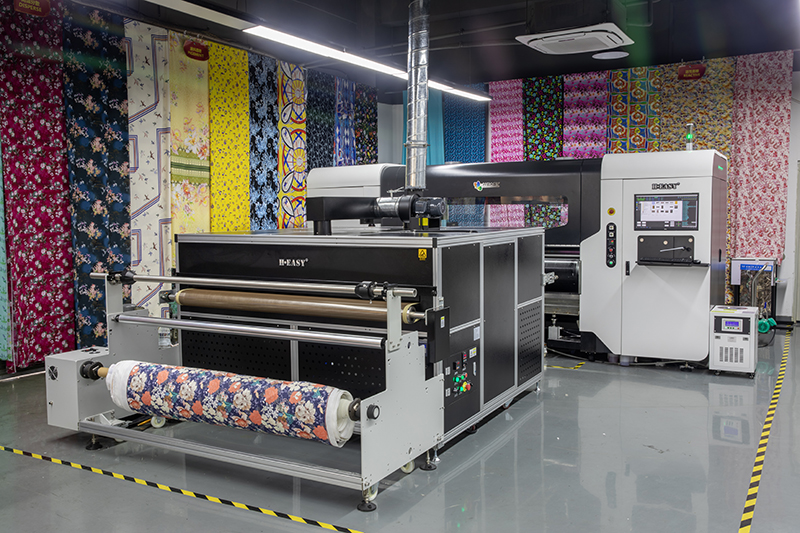
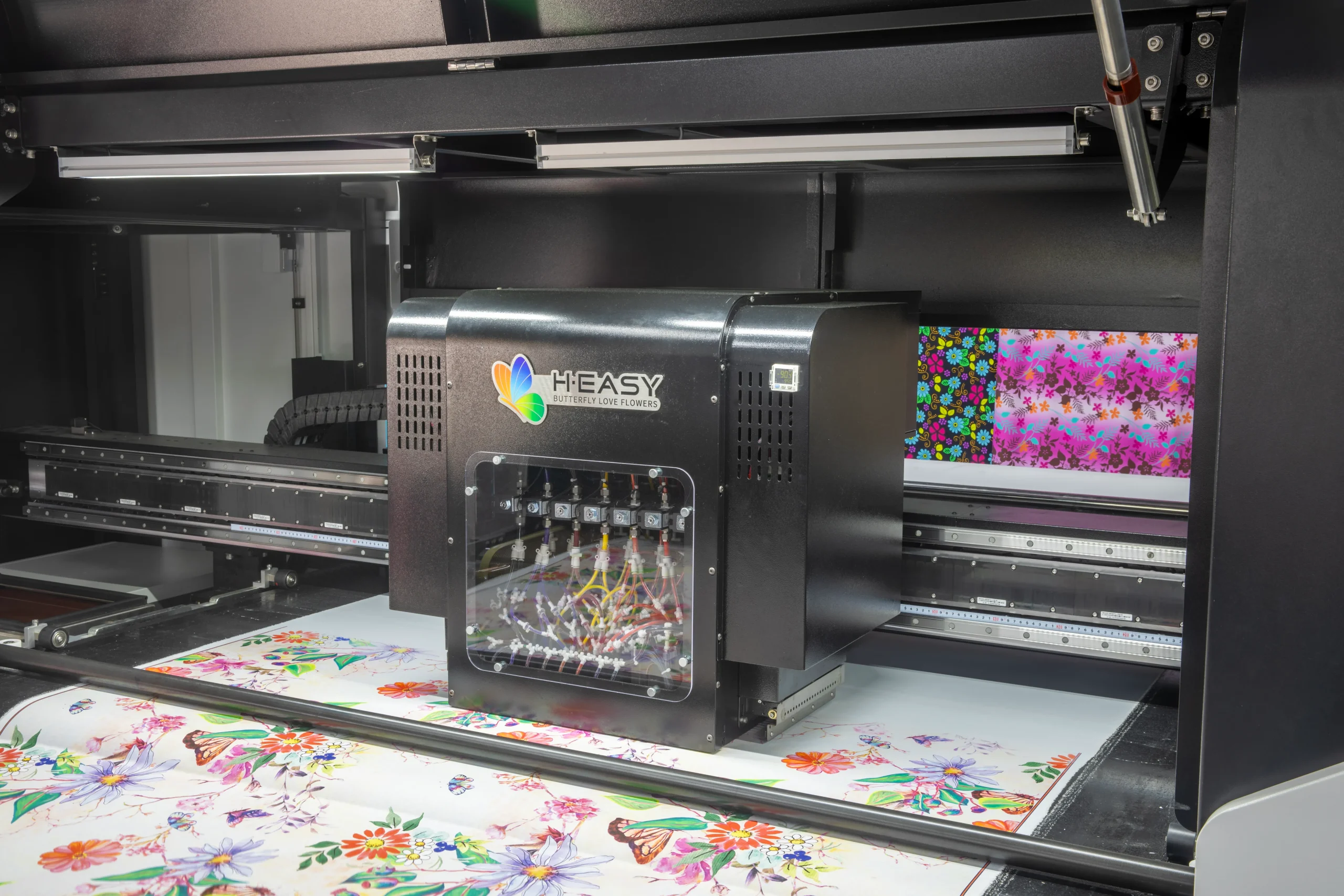
H·EASY pigment printing solutions are designed for industrial direct-to-fabric production. They combine machine structure, Ricoh printhead application, driver board adaptation, pigment ink testing, pretreatment, drying, and fixation support.
Integrated Frame for Stable Printing
H·EASY machines use an integrated frame structure to improve mechanical accuracy and production stability. The materials state that the integrated frame helps reduce traditional assembly steps, improve mechanical accuracy, and shorten the production cycle.
A stable frame helps reduce printing deviation, which supports more consistent color and fastness across long production runs.
High-Precision Head Bottom Plate
The head bottom plate uses wire-cutting processing technology, with minimum cutting size reaching about 0.01mm, helping ensure printing accuracy.
For industrial pigment printing, accurate printhead alignment helps reduce banding, ghosting, and uneven ink deposition.
Independently Developed Driver Board
H·EASY boards are independently developed and adapted to the printing machine, which allows timely upgrades and adjustments when needed.
For a pigment ink printer, board and printhead compatibility are important because stable jetting helps reduce nozzle issues and printing defects.
Matched Ink and Process Testing
The H·EASY materials mention that their ink has been tested with the machine to achieve good printing results. This is important because pigment ink contains particles and needs good compatibility with the printhead, ink system, and maintenance process.
Recommended H·EASY Models
For factories focusing on pigment printing in textile production, H·EASY models can be selected according to production scale:
| Model | Recommended For |
|---|---|
| H·EASY H1808 | Medium-volume production and sample-to-production workflows |
| H·EASY H1816 | Balanced industrial production for garment fabrics, cotton, and blended fabrics |
| H·EASY H1832 | High-output production for factories requiring faster bulk delivery |
For factories producing cotton, blended fabrics, linen, rayon, home textiles, and multi-category fabric orders, H·EASY provides a practical pigment inkjet printer solution with stable structure, tested ink compatibility, and matched process support.
Common Causes of Poor Color Fastness
| Problem | Possible Cause | Solution |
|---|---|---|
| Poor dry rubbing fastness | Ink layer too thick or fixation insufficient | Reduce ink load and improve fixation |
| Poor wet rubbing fastness | Binder film not strong enough | Adjust pretreatment or use fixing agent |
| Color fading after washing | Incomplete drying or fixation | Increase drying and fixation control |
| Floating color | Fabric not fully dried or ink layer too heavy | Improve drying and control ink volume |
| Hard hand feel | Too much pretreatment or binder | Optimize formula and add softening treatment |
| Uneven fastness | Fabric feeding, drying, or ink output inconsistency | Improve machine stability and fabric control |
| Color spots or color difference | Fabric pH, cleanliness, or absorbency issue | Strengthen fabric inspection |
Practical Checklist Before Bulk Production
Before starting bulk pigment printing, check the following:
- Fabric type and fiber composition
- Fabric pH, absorbency, skew, and cleanliness
- Pretreatment formula and pickup rate
- Ink volume and ICC profile
- Printhead condition and nozzle status
- Workshop temperature and humidity
- Drying temperature and time
- Fixation temperature and time
- Dry and wet rubbing fastness result
- Hand feel after fixation or softening treatment
This checklist helps reduce rejected fabric, improve consistency, and support stable pigment printing in textile production.
Conclusion
Color fastness in pigment ink printing depends on the complete process, not one single factor. To improve fastness, textile factories should control fabric inspection, pretreatment, ink volume, drying, fixation, finishing, printer maintenance, and production environment.
A reliable pigment ink printer or digital fabric printer should provide stable ink output, accurate fabric feeding, matched drying, and consistent long-term production performance.
For factories using pigment printing on cotton, linen, blended fabrics, rayon, and other textile materials, H·EASY pigment printing solutions can help build a more stable production workflow. With an integrated frame, high-precision head bottom plate, independently developed driver board, tested ink compatibility, and matched process support, H·EASY helps textile factories improve color fastness while maintaining production efficiency.