
Why Dark Cotton T-Shirts Put Every Printing Process to the Test
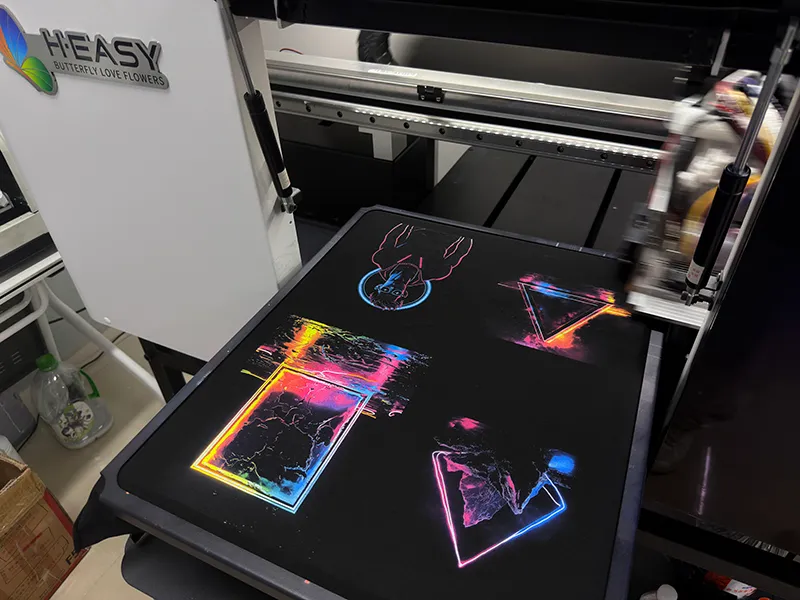
Dark cotton T-shirts are one of the clearest tests of a garment printing process.
The challenge is not simply whether a printer can put an image on the garment. A dark cotton job brings several requirements together at once: base-color coverage, white ink, CMYK color reproduction, white/color registration, hand feel, breathability, wash durability, short-run economics and production efficiency.
Screen printing, DTF, sublimation and DTG each have their own strengths and limits. DTG stands out on dark cotton because it can build a white underbase directly on the garment, print color on top, and do so without conventional screen making or a full transfer-film layer.
That makes DTG particularly relevant for small batches, multiple designs, premium cotton apparel and on-demand production.
1. Why Is Dark Cotton Harder to Print Than White Cotton?
On a white T-shirt, the fabric itself acts as a light background. CMYK inks can use that white base to reproduce color with relatively little interference from the garment color.
On black, navy, dark gray, burgundy or other dark garments, the fabric color absorbs and visually contaminates the printed color. If CMYK is printed directly onto the dark textile, reds become duller, yellows lose brightness, pale tones disappear and gradients lose contrast.
That is why dark-garment DTG normally needs a white underbase first.
Pretreatment → White Ink Base → CMYK Color → Curing
The white layer blocks the dark garment color so the CMYK image has a neutral base on which to reproduce the artwork.
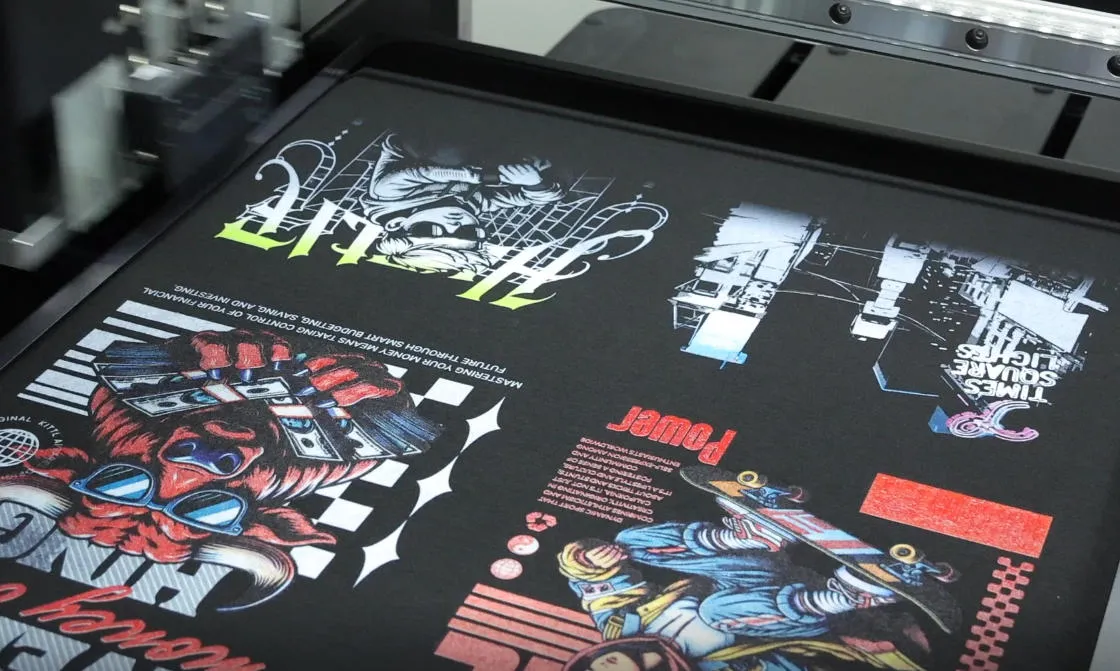
2. The Real Difficulty Is Not Having White Ink - It Is Controlling It
Challenge 1: The White Underbase Must Cover Evenly
If the white ink layer is weak or uneven, the dark fabric shows through and affects the final image. Common results include dull color, uneven solid areas, weak saturation and inconsistent appearance across the print.
For dark DTG, pretreatment, white-ink laydown and stable jetting have to work together. Simply increasing white-ink volume is not enough.
Challenge 2: White and Color Must Register Accurately
The white layer is only the foundation. CMYK color still has to land precisely on top of it. Poor registration can create white halos, color shift, soft edges, unclear fine lines and distorted small text.
This is why motion control, printhead control, software and mechanical accuracy all matter more on dark garments.
Challenge 3: Pretreatment and Curing Cannot Be Ignored
Dark cotton DTG normally relies on pretreatment to help the white ink stay near the surface, remain uniform and form a suitable base for color printing. After printing, the garment still needs thermal curing to stabilize the water-based pigment ink.
The complete production logic is therefore closer to:
Pretreatment → Printing → Curing
The exact way pretreatment is integrated into production differs by machine. This is one of the biggest workflow differences between the H·EASY HY-4050 single-station DTG and the HY 2D DTG dual-station system.
3. DTG vs. DTF vs. Screen Printing vs. Sublimation on Dark Cotton
| Process | Dark Cotton | Screen Making | Hand Feel / Surface | Typical Use |
|---|---|---|---|---|
| DTG | Yes | No | Relatively natural when process is controlled | Premium cotton apparel, POD, short runs |
| DTF | Yes | No | Transfer layer can be felt | Multi-fabric orders, rapid customization |
| Screen Printing | Yes | Yes | Depends on ink layer and artwork | Stable large-volume orders |
| Sublimation | Not a conventional solution | No | Soft on suitable polyester | Polyester sportswear and teamwear |
DTG
DTG is well suited to dark cotton when the job requires multiple designs, short runs and a relatively natural garment feel. Digital files replace traditional screen preparation, so changing artwork mainly means changing the print file.
DTF
DTF also handles dark garments effectively and generally offers broader fabric compatibility. However, the graphic is transferred with adhesive powder and heat, creating a distinct transfer layer. On large solid areas, that surface can feel different from the original garment.
Screen Printing
For one stable design in a large quantity, screen printing can still have strong unit-cost advantages. Its setup becomes less attractive when the order is divided into many designs, colorways or short replenishment runs.
Sublimation
Conventional dye-sublimation is primarily a polyester process and normally depends on a light base material. It is not the standard solution for a dark cotton T-shirt.
4. Why DTG Is Especially Relevant for Dark Cotton Garments
No Traditional Screen Making
Artwork is driven digitally. A new design does not require a new set of screens, which is useful for short runs, multiple designs, sample development, POD and repeat orders.
A job of 20 designs × 20 pieces is fundamentally different from 1 design × 400 pieces, even if the total quantity is the same.
No Full DTF Transfer-Film Layer
DTG prints water-based pigment ink directly onto the garment surface. When ink volume, pretreatment and curing are properly controlled, it can provide a more natural garment feel than a large-area transfer film.
That does not mean the print is completely undetectable by touch. Dark garments require a white underbase, so some ink-film feel can remain. The more accurate claim is that DTG can provide a more natural surface feel than a full transfer layer in suitable applications.
5. H·EASY HY-4050: A Flexible Single-Station Option for Short Runs
For businesses building their first DTG workflow, testing the market or handling mainly customized short runs, the H·EASY HY-4050 offers a compact single-station setup.
| Item | HY-4050 DTG |
|---|---|
| Print Area | Up to 400 × 500 mm |
| Printhead | 2 industrial printheads |
| Ink Type | Water-based pigment ink |
| Ink Colors | CMYK + White |
| Minimum Droplet Size | 3.5 pl |
| Print Direction | Bi-directional / uni-directional |
| Dark A4 Reference | 64 seconds/pc |
| Dark A3 Reference | 103 seconds/pc |
The HY-4050 is a practical fit for custom T-shirts, hoodies, brand samples, personalized garments and POD work where flexibility matters more than continuous industrial throughput.
6. When Order Volume Grows, Pretreatment Can Become the Bottleneck
A single-station DTG workflow can be very flexible at low to moderate volume. But as the number of dark garments rises, the bottleneck may move away from printing itself and toward pretreatment, garment handling and station idle time.
If pretreatment and printing are separate serial steps, the workflow can look like:
Pretreat → Wait / Handle → Print → Cure
The H·EASY HY 2D DTG is designed to reduce that waiting by combining dual stations, dual beams and in-line pretreatment.
7. HY 2D DTG: Dual Station Is More Than Just an Extra Platen
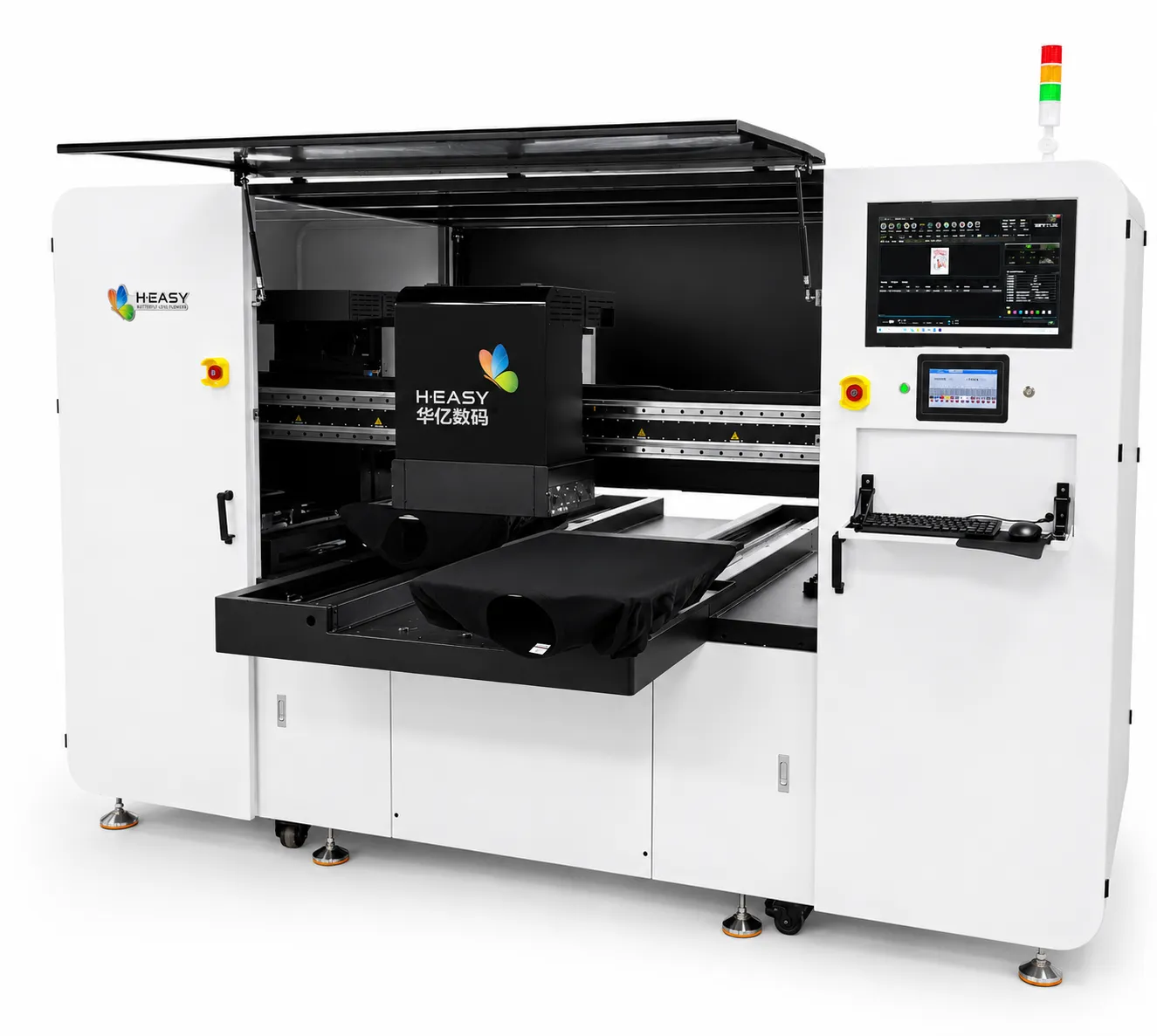
The HY 2D DTG uses a dual-station architecture with two moving systems. The rear beam applies pretreatment solution, while the front printing carriage handles white and color printing. The stations alternate so one garment can be prepared while another is being printed.
Dual Beams + Dual Stations + In-Line Pretreatment
This layout is intended to reduce waiting between preparation and printing, keep the machine occupied more consistently and support a more continuous production rhythm.
8. How the HY 2D Wet-Printing Workflow Works
- Load the garment on Station 1 and spray pretreatment solution.
- Print white plus CMYKRG color on the prepared garment.
- While Station 1 is printing, the rear beam applies pretreatment to the garment on Station 2.
- Alternate the two stations so pretreatment and printing can overlap instead of running as completely separate serial steps.
- After printing, move the finished garment to the oven or curing equipment.
The key production idea is parallel work: pretreatment on one station can occur while printing is active on the other station.
9. Why High-Lift Printing Matters for Hoodies and Heavier Garments
Flat T-shirts are relatively easy to position. Hoodies, sweatshirts, denim garments and thicker cotton items can include seams, raised areas, folds and uneven surfaces. A very low printing clearance can increase the risk of contact with the printhead area.
According to the current HY 2D DTG configuration, the pretreatment spray system can work at approximately 5 mm height and the color-printing carriage can lift to approximately 15 mm. This gives more tolerance when working with garments that are not perfectly flat.
The machine specification also lists a material-thickness range of 2.5-40 mm. Actual garment suitability should still be confirmed by sample testing, especially for textured or irregular products.
10. HY 2D DTG Industrial Production Features
- Industrial printheads: The machine is configured for continuous production, with the supplied solution positioned for long operating cycles and 24-hour production capability when the overall workflow and maintenance are managed accordingly.
- Magnetic-levitation linear motor system: Supports fast, stable carriage movement for the dual-station workflow.
- Dual workstations: Allows loading, pretreatment and printing tasks to overlap instead of leaving the print area idle.
- In-line pretreatment: Integrates pretreatment into the machine workflow rather than treating it as a fully separate manual stage.
- Automatic printhead cleaning: Simplifies routine maintenance.
- Real-time ink-level display: Shows ink status on the screen to make daily operation easier.
- No steaming or washing required: The pigment DTG workflow is completed through pretreatment, printing and curing rather than reactive-style steaming and washing.
11. How Fast Can the HY 2D DTG Run?
For an A4-size reference pattern, the supplied machine specification lists the following output:
| Print Mode | Reference Output |
|---|---|
| 3-pass | 115 pcs/h |
| 4-pass | 90 pcs/h |
| 6-pass | 60 pcs/h |
The 115 pcs/h figure is therefore a reference result for an A4-size pattern in 3-pass mode, not a guaranteed output for every garment and every artwork.
Actual throughput depends on artwork area, white-ink coverage, garment condition, pretreatment, pass count, loading and unloading speed, curing capacity and operator workflow.
12. HY-4050 or HY 2D DTG: Which Fits the Order Structure?
| Requirement | HY-4050 DTG | HY 2D DTG |
|---|---|---|
| Startup / market testing | Strong fit | Possible, but higher-capacity system |
| Small-batch orders | Strong fit | Strong fit |
| Continuous production | Moderate | Strong fit |
| Dual-station workflow | No | Yes |
| In-line pretreatment | Separate process | Integrated |
| Higher sustained output | Moderate | Strong fit |
| Industrial production focus | Entry / flexible | Higher-capacity industrial workflow |
HY-4050 is better suited to first-time DTG users, sampling, POD and lower-volume customization. HY 2D DTG is better suited to factories with stable order flow that want to reduce pretreatment waiting and keep two stations working in a coordinated cycle.
13. Which Dark-Garment Orders Are a Good Fit for DTG?
Dark Cotton T-Shirts
This is one of the clearest DTG use cases, especially when the order combines dark cotton, full color, multiple designs and small-to-medium production quantities.
Dark Hoodies and Sweatshirts
Suitable garments can also be printed when pretreatment, platen selection, height and curing are matched to the fabric and construction.
Brand Apparel
DTG is relevant when the buyer cares about detailed artwork, garment feel, design flexibility and limited-run production.
POD and Personalization
Each garment can use a different digital file for names, numbers, photographs, custom illustrations or personalized text without remaking screens.
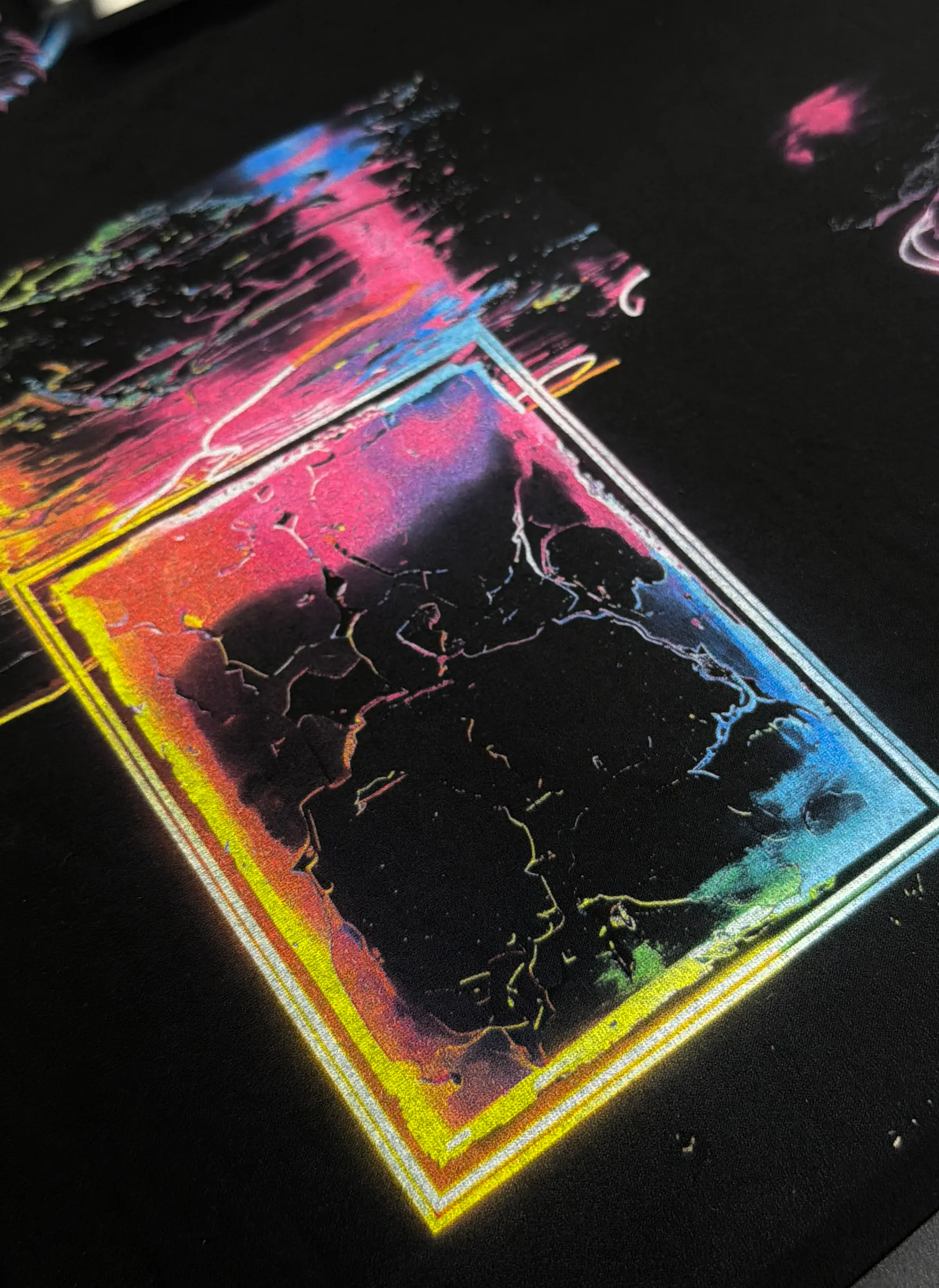
14. Which Orders May Not Be the Best First Choice for DTG?
One Very Large Order with One Stable Design
When the design is fixed and the quantity is very large, conventional screen printing may still have a lower unit-cost structure after setup is amortized.
Highly Varied Synthetic Garments
If daily production involves many polyester, nylon and mixed synthetic garments, DTF may offer broader material flexibility depending on the product requirements.
All-Over Polyester Sportswear
For full-area polyester sportswear, sublimation normally follows a more suitable production logic.
The right question is not “Which printing technology is best?” but “Which printing technology is best for this order?”
15. Dark DTG Is a Complete Process, Not Just a Printer
The final result on a dark cotton T-shirt depends on the whole chain:
Garment → Pretreatment → White Ink → Color Ink → Curing
- Pretreatment: Influences white-ink holdout and the printable surface.
- White Ink: Determines whether the dark garment color is effectively blocked.
- Color Printing: Determines color reproduction and image detail.
- Registration: Determines whether the white underbase and color image align accurately.
- Curing: Determines whether the print reaches the intended durability and production stability.
A mature DTG solution therefore needs to answer a broader production question: can the factory move a dark garment from loading to a sellable, repeatable finished print with a stable workflow?
16. Does Your Factory Need a Single-Station or Dual-Station DTG?
-
Are dark cotton T-shirts and hoodies already a stable part of your order mix?
If dark cotton garments are already a steady order type, white-ink DTG becomes much more relevant.
-
How many garments do you actually need to produce per day?
For lower volumes, HY-4050 may provide enough flexibility. As orders rise, dual-station coordination becomes more valuable.
-
Is manual pretreatment becoming a bottleneck?
If pretreatment spraying, waiting and garment handling are slowing the line, in-line pretreatment deserves serious consideration.
-
Do you frequently print thicker or less-flat garments?
Printing clearance and high-lift capability become more important when the garment surface is not perfectly flat.
-
Do customers demand color, garment feel and fast turnaround at the same time?
In that case, the decision should consider white ink, pretreatment, registration, productivity and curing together - not print speed alone.
Conclusion: Dark Cotton Tests the Entire DTG Production System
Dark cotton T-shirts are difficult because they expose several production challenges at the same time: coverage, color, registration, hand feel, durability and efficiency.
The value of DTG is not simply that it can print a black T-shirt. Its real value is that it enables digital white-underbase plus color production on dark cotton garments without conventional screen making.
For small-batch and early-stage DTG business, the HY-4050 offers a compact single-station route. When order volume becomes more stable and the bottleneck shifts toward pretreatment, loading and continuous production, the HY 2D DTG adds dual stations, in-line pretreatment, industrial printheads and higher-clearance printing to support a more continuous workflow.
**The right DTG machine is not necessarily the one with the highest specification. It is the one that matches your garments, order volume and production rhythm.