
Compare textile printing technologies
Compare each process by substrate, workflow, finish and production fit before you shortlist a printer.
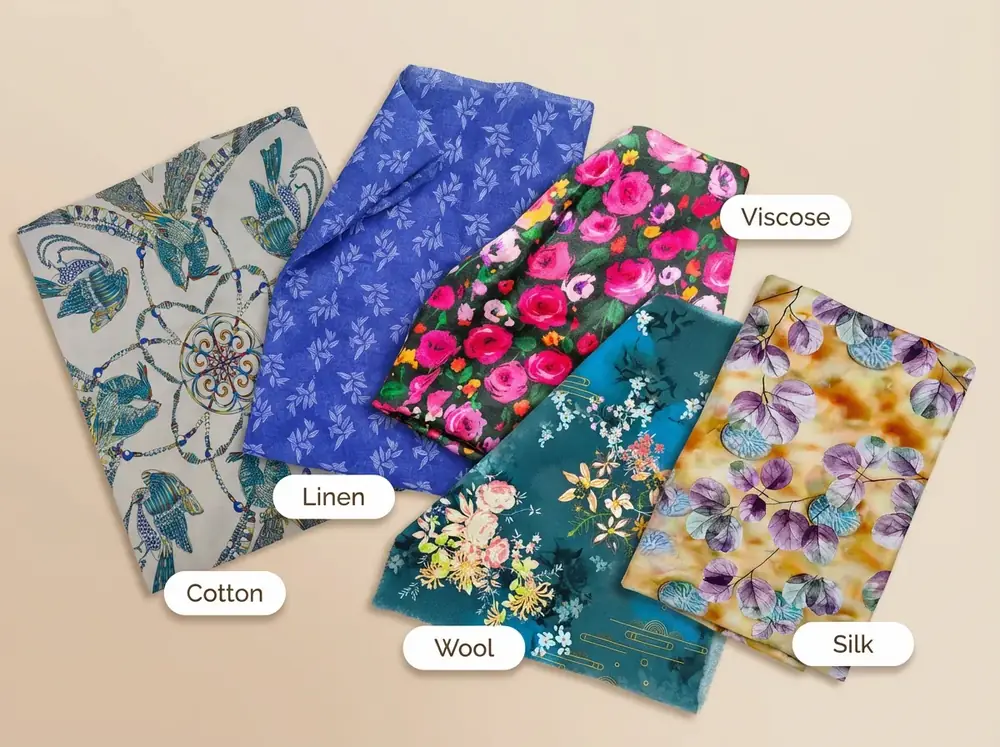
Process and material matrix
Start with what you print on, then check the production method and finishing route.
| Process | Prints onto | Best for | Method |
|---|---|---|---|
| DTF Transfer | Cotton, polyester, blends, dark and light | On-demand and mixed-fabric transfers | Print to film, heat-press |
| DTG | Cotton, cotton-rich blends and qualified polyester | Finished garments, personalization and short runs | Direct-to-garment with fabric-matched pretreatment and curing |
| Roll-to-Roll (R2R) | Silk, cotton, polyester and compatible blends | Apparel fabric, home textiles and soft signage | Direct-to-fabric roll printing; ink route and finishing matched to fibre |
| Sublimation | Polyester fabric | Polyester apparel and cut-and-sew panels | Print to transfer paper, heat-press |
| UV-DTF | Any hard surface (labels, decals) | Labels and decals on bottles, cases, signage | Print film + varnish, no heat |
| UV Flatbed | Glass, acrylic, wood, ceramics, metal | Rigid-substrate decoration | Direct-to-object, UV-cured |
| Latex | Leather, PVC, TPU, canvas | Flexible non-textile media | Direct print, LED-cured |
| Wash Label | Ribbon / care labels | Garment care and size labels | Pigment on ribbon, 6-up |
Choose the material before the machine
If the substrate is fixed, use the material selector. If the product mix is still open, review the application routes first.
Five decisions buyers compare most
Each summary is drawn from the full published guide linked on the card.
DTG vs DTF
- Material
- DTG suits premium cotton; DTF covers cotton, polyester, blends and nylon.
- Workflow
- DTG prints on pretreated fabric; DTF prints film, applies powder, cures and heat-presses.
- Finish
- DTG prioritizes a direct-to-cotton hand; DTF adds a transfer-adhesive layer.
- Production
- DTG runs garment by garment; DTF films can be batch-printed and stored.
DTF vs UV-DTF
- Substrate
- DTF is for soft fabric; UV-DTF is for hard, rigid or curved substrates.
- Ink
- DTF uses water-based pigment; UV-DTF uses UV-curable color, white and varnish.
- Transfer
- DTF uses powder, curing and heat; UV-DTF uses A/B film, UV curing and cold lamination.
- Finish
- DTF retains a textile finish; UV-DTF produces an embossed, glossy finish.
Sublimation vs DTG
- Material
- Sublimation targets polyester; DTG targets cotton and cotton-heavy garments.
- Bond
- Sublimation dye bonds inside polyester; DTG pigment sits on pretreated fibre.
- Finish
- Sublimation has no surface feel; DTG provides a soft direct-print hand on cotton.
- Production
- Sublimation suits bulk polyester work; DTG suits small-batch cotton on demand.
Pigment vs Reactive
- Bond
- Pigment uses a surface binder; reactive dye forms a covalent bond with cellulose.
- Fabric
- Pigment covers mixed fibres; reactive primarily targets cotton-class fibres.
- Finishing
- Pigment avoids the reactive route's steaming, washing and final drying stages.
- Trade-off
- Pigment simplifies production; reactive leads on premium cotton softness and deep color.
DTF vs Screen Printing
- Setup
- DTF has no screens or plates; screen printing needs a stencil and a screen for each color.
- Artwork
- DTF handles photographic detail and gradients; screen printing favors separated colors.
- Order fit
- DTF suits custom and mixed-SKU runs; screen printing suits repeated single-design production.
- Hybrid use
- DTF can cover first articles and short runs before screen printing takes repeat volume.
Technology selection questions
How should I choose between DTG and DTF?
Choose DTG for premium cotton garments when direct-print hand-feel is the priority. Choose DTF for mixed fabrics, batch transfers and orders spanning cotton, polyester, blends and nylon.
What is the practical difference between DTF and UV-DTF?
DTF heat-presses a powdered film transfer onto fabric. UV-DTF UV-cures an A-film print, laminates it to B film and cold-transfers it onto hard substrates.
Should polyester garments use sublimation or DTG?
Sublimation is the primary route for polyester because its dye bonds inside the fibre. DTG is primarily suited to cotton and cotton-heavy garments.
When should a mill choose pigment instead of reactive ink?
Choose pigment when a shorter workflow, mixed-fibre compatibility and avoiding the reactive wash line are priorities. Choose reactive for premium cotton where softness and deep color are decisive.
Are DTF and screen printing substitutes?
DTF suits custom, mixed-SKU and artwork-intensive short runs because it needs no screens. Screen printing suits repeated production of one design once setup is justified.
Bring us the substrate and target output
We will qualify the process, ink route and machine configuration against your actual job.