
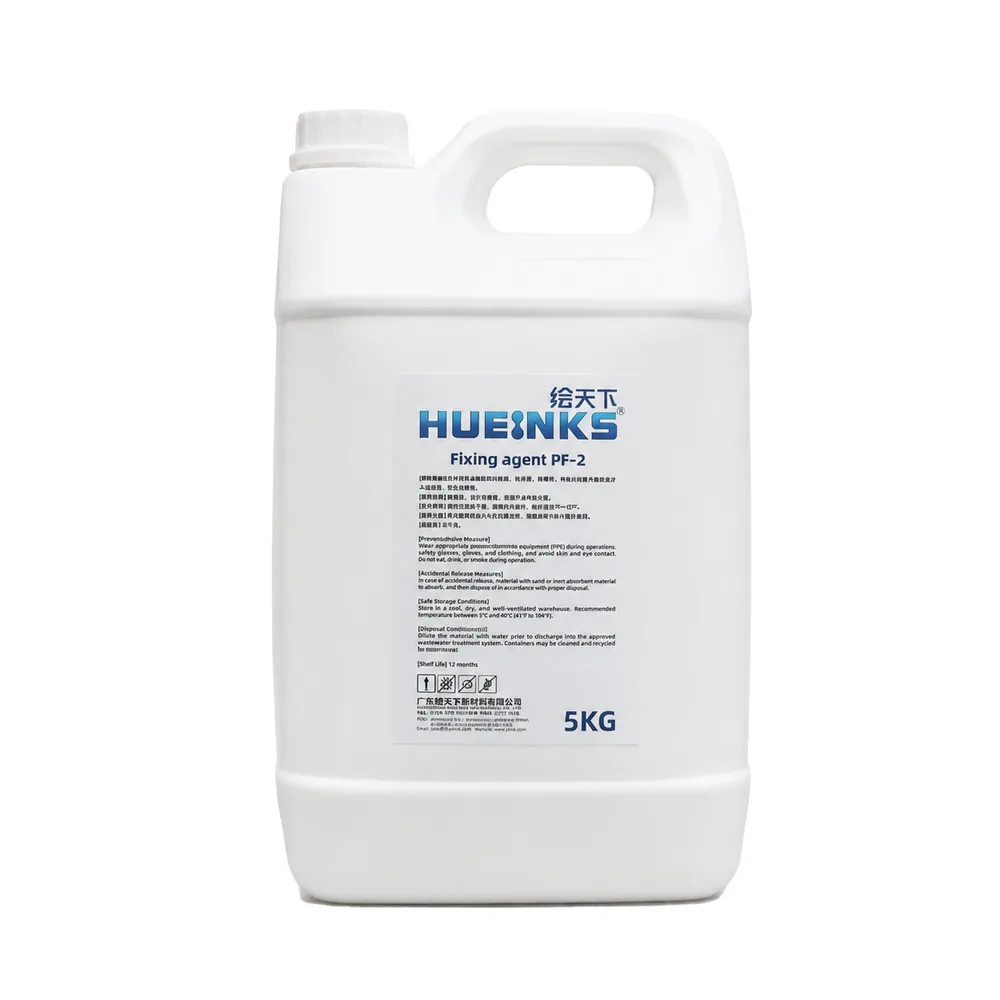
Fixing Agent PF-2, 5 kg
Applied after printing to raise fastness on finished goods. 5 kg containers.
- R2R pigment
- R2R reactive
- Container size
- 5 kg
- Model
- PF-2
Stated properties
| Purpose | Post-printing treatment to raise fastness |
|---|---|
| Net weight | 5 kg per container |
| Storage | Cool, dry, well-ventilated, 5-40 °C |
| Shelf life | 12 months |
| Handling | PPE required: safety glasses, gloves and clothing; avoid skin and eye contact; no eating, drinking or smoking during use |
| Spill | Absorb with sand or inert absorbent, then dispose appropriately |
| Disposal | Dilute with water before discharge to an approved wastewater treatment system; containers may be cleaned and recycled |
Source: Product packaging label - Transcribed from the product label, photographed 2026-08-11. Properties not listed above are not published, because we have no source for them.
What it prints
Output from this route on production fabric. Your own substrate is sampled before you commit to volume.


What a fixing agent is for
A fixing agent is a finishing step. It goes on after printing, and its job is to lift fastness on the finished goods - the property a buyer tests before they accept a delivery, and the one that decides whether a repeat order arrives.
It closes a gap. It does not create headroom that the process never had. If prints are failing rub or wash fastness badly, the cause is upstream: fabric preparation, cure temperature, or an ink route that does not suit the fibre. Those are covered on the ink routes guide and, for the pigment route specifically, on the pretreatment liquid page.
What the label states, and what it does not
Container size, storage window, shelf life, handling and disposal come from the product label and are listed above.
Composition, dosage, application method and the fastness improvement you should expect are not on the label. The last of those is the one worth being careful about: an improvement figure only means something against a stated fabric, ink, cure and test method, and quoted without them it is marketing rather than data.
We set dosage against your fabric and your target grade, and the result is tested rather than promised.
Fitting it into the line
- Establish where your current fastness actually sits, tested by a lab your buyer accepts.
- Fix anything upstream that is out - preparation and cure first.
- Then trial the fixing agent at a dosage set against your fabric.
- Re-test, and lock the dosage before volume.
Running that order matters. A fixing agent trialled on top of an unstable process produces results nobody can interpret, and the step gets blamed for whatever the process was already doing.
Handling and disposal
The label requires safety glasses, gloves and protective clothing, avoiding skin and eye contact, and no eating, drinking or smoking during use. Spills are absorbed with sand or inert absorbent and disposed of appropriately.
For disposal, the label specifies diluting with water before discharge into an approved wastewater treatment system; containers may be cleaned and recycled. Confirm your site’s discharge permit covers it before ordering in volume.
Supply
Fixing agent PF-2 is supplied under our own HUEINKS brand. Pricing, minimum order, the safety data sheet and the dangerous-goods classification for your shipping route are confirmed at quotation.
Shipping and safety documentation
Safety data sheet
Available on request
Dangerous goods
Confirmed per shipping route at quotation
Minimum order and lead time
Quoted per destination and quantity. Tell us your machine model and monthly consumption.
Frequently asked questions
When would I need a fixing agent?
When the fastness you get off the line is close to your buyer's requirement but not reliably above it. A fixing agent is a finishing step that raises fastness on printed goods; it is not a substitute for correct pre-treatment, correct curing or the right ink route, all of which move the result further.
Which routes does it suit?
It is used after printing on the routes where fastness is argued over commercially. Whether it suits your fabric, your ink and your finishing line is confirmed at quotation rather than assumed - tell us the route, the fabric and the fastness grade you have to hit.
What dosage should I use?
Set against your fabric and your target grade, not published as a single number. Under-dosing wastes the step; over-dosing costs money and can change the hand-feel, which is usually the thing the buyer notices.
Does it replace fixing the process upstream?
No. If fastness is failing badly, the cause is usually pre-treatment, cure temperature or an ink route that does not suit the fibre. A fixing agent closes a small gap; it does not rescue a process that is out.
Tell us your machine and your monthly volume
We quote consumables against a specific machine, printhead and ink set, not from a catalogue line, because that is the only way the answer is useful.