
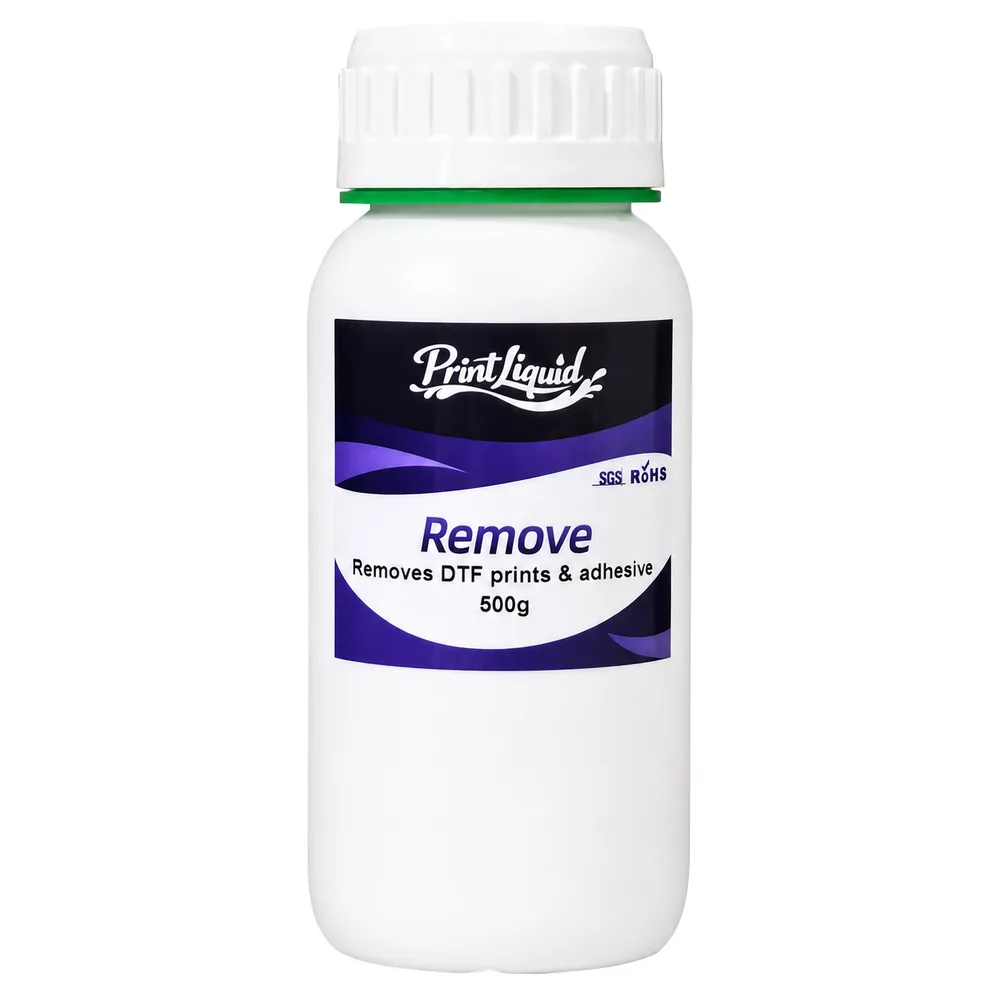
DTF Removal Liquid, 500 g
Strips DTF prints and adhesive off a garment, so a misprint costs a bottle, not a blank.
- DTF
- Bottle size
- 500 g net weight
Stated properties
| Purpose | Removes DTF prints and adhesive |
|---|---|
| Net weight | 500 g |
Source: Product packaging label - Transcribed from the current Print Liquid label, supplied 2026-08-17; the label states no further parameter. The earlier bottle with the applicator cap is no longer shipped. Properties not listed above are not published, because we have no source for them.
What it prints
Output from this route on production fabric. Your own substrate is sampled before you commit to volume.

What removal liquid is for
A DTF transfer that lands misaligned, or cures badly, normally costs you the garment. Removal liquid dissolves the printed film and the hot-melt adhesive underneath so the blank can be washed and run again. On cheap tees that is a minor saving; on branded or customer-supplied garments it is often the difference between a rework and a replacement you have to pay for.
It is a recovery tool, not a production step. A shop reaching for it regularly has a process problem upstream - most often powder coverage or an under-set curing window, both covered in DTF powder size and the curing window and DTF heat transfer adhesion: causes and solutions.
Test before you treat finished stock
How a garment reacts depends on its fibre, its dye and how long the liquid is left on. Reactive-dyed cotton and dark garments are where colour loss shows first. The routine that avoids expensive mistakes is the same one you would use for any solvent: test on a sacrificial garment from the same batch, keep the dwell time short, and work in a ventilated area with gloves.
What we can state, and what we cannot
The label states the purpose and the net weight, and that is all it states. No composition, no dwell time and no fabric compatibility list, so none of those appear here.
The bottle carries SGS and RoHS marks. We do not restate those as a bare fact, because a mark without a certificate number, its scope and its validity date is not something a buyer can check. If your tender needs certified compliance, ask and we will send the certificate itself.
Supply
Print Liquid is one of our own brands. It sits alongside the matching printhead cleaning solutions and is supplied for use with our DTF printers.
Pricing, minimum order, the safety data sheet and the dangerous-goods classification for your shipping route are confirmed at quotation.
Shipping and safety documentation
Safety data sheet
Not currently held on file
Dangerous goods
Confirmed per shipping route at quotation
Minimum order and lead time
Quoted per destination and quantity. Tell us your machine model and monthly consumption.
Frequently asked questions
What is DTF removal liquid actually for?
Recovering a garment after a bad transfer. A misaligned or under-cured DTF print normally writes off the blank; removal liquid dissolves the print and the hot-melt adhesive so the garment can be washed and re-printed. On a run of expensive blanks that is the difference between a reject and a rework.
Will it damage the garment?
That depends on the fabric, the dye and how long the liquid sits, and it is not something to assume. Test on a seam allowance or a sacrificial garment from the same batch before treating finished stock, and follow the label. Dark and reactive-dyed cotton is the usual place colour loss shows up.
Does it replace correct curing?
No. It is a recovery tool for the occasional misprint, not a process step. If transfers are failing often enough that you are buying removal liquid in volume, the fix is upstream - powder coverage, curing window or press settings.
Is a safety data sheet available?
Not currently held on file. Solvent-based removers are commonly restricted for air freight, so both the safety data sheet and the dangerous-goods classification for your shipping route are confirmed before an order ships.
Tell us your machine and your monthly volume
We quote consumables against a specific machine, printhead and ink set, not from a catalogue line, because that is the only way the answer is useful.