How Much Pigment Ink Is Used per Square Meter of Fabric?
Table of Contents

Share:

For textile factories, ink consumption is one of the key factors when calculating digital printing cost. Before choosing a pigment ink printer, many customers ask the same question:

How much pigment ink is used per square meter of fabric?

As a practical reference, pigment ink consumption is usually around 20g per square meter. This number can help factories make an initial cost estimate for pigment digital printing. However, the actual ink usage may change depending on fabric type, design coverage, color depth, pretreatment, print mode, and machine stability.

Quick Answer

A common reference for pigment ink usage is:

Pigment ink consumption: around 20g/m²

A simple ink cost formula is:

Ink cost per m² = 0.02kg × ink price per kg

For example, if pigment ink costs USD 15/kg:

0.02kg × USD 15 = USD 0.30/m²

This is only the ink cost. The final printing cost should also include pretreatment, drying, fixation, labor, electricity, maintenance, and fabric loss.

Why 20g/m² Is Only a Reference

The ink usage of pigment digital printing is not fixed. Two fabrics with the same size may require different amounts of ink.

A light pattern with more white space usually uses less ink. A dark, full-coverage design uses more ink. Designs with large black, navy, red, or high-saturation areas often need higher ink output to achieve the required color depth.

Before quoting a printing job, factories should check:

  • whether the pattern is full coverage;
  • how many dark color areas are included;
  • whether the customer requires high color saturation;
  • whether the fabric absorbs ink easily;
  • whether the final product needs higher rubbing fastness.

So, 20g/m² is a useful starting point, but the real number should be confirmed through sampling and production testing.

digital-textile-printing-machine

Fabric Type Affects Pigment Ink Consumption

Different fabrics absorb and hold ink in different ways.

Natural fibers such as cotton, linen, rayon, and wool usually have better absorbency. Synthetic fibers such as polyester and nylon have smoother surfaces and different ink acceptance. Blended fabrics combine different fiber types, so they may need adjusted pretreatment and ink settings.

The H·EASY pigment ink solution can be used for many fabric types, including cotton, silk, polyester, nylon, rayon, blended fabric, wool, and linen. This makes it suitable for factories that handle multiple fabric categories and mixed orders.

However, every fabric still needs testing. The best ink amount should balance:

color depth + hand feel + fastness + production cost

Using too little ink may make the color look weak. Using too much ink may increase cost, affect drying, reduce softness, or create unnecessary surface buildup.

Pretreatment Helps Improve Ink Efficiency

Pigment digital printing usually includes:

Fabric inspection → Pretreatment / sizing → Digital printing → Drying → Fixation → Finishing

Pretreatment helps control ink spreading, improve color yield, and make the printed pattern sharper. It also helps pigment particles stay better on the fabric surface during fixation.

Good pretreatment can improve ink efficiency. If pretreatment is not suitable, the color may look light or uneven, and operators may try to increase ink volume to compensate. This can raise ink cost and affect fabric hand feel.

That is why pigment printing should not rely only on “more ink.” A stable process uses the right combination of:

  • fabric pretreatment;
  • ICC color profile;
  • ink volume control;
  • drying temperature;
  • fixation time;
  • machine stability.

How H·EASY Pigment Ink Printers Help Control Ink Usage

Ink consumption is not only about the ink itself. It is also affected by the printer’s mechanical precision, printhead stability, ink system, and production consistency.

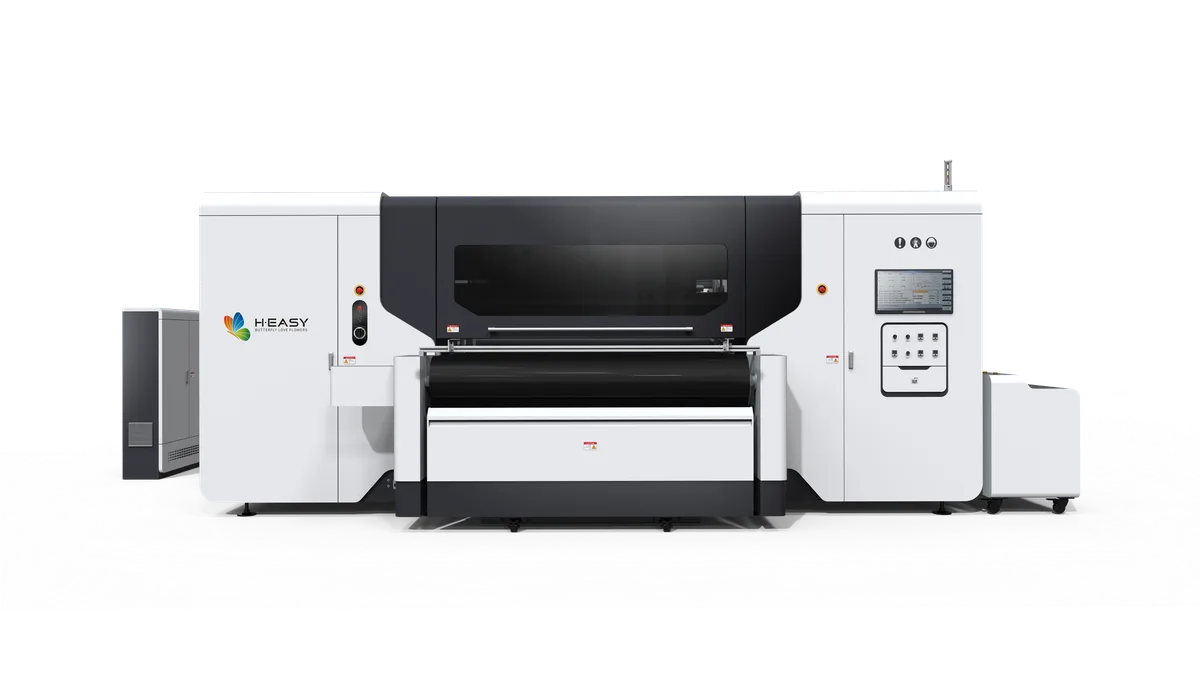
The H·EASY pigment ink printer is designed for industrial direct-to-fabric printing. It helps factories achieve stable output and reduce unnecessary waste during production.

1. Integrated Frame for Stable Production

H·EASY machines use an integrated frame structure. This helps improve mechanical accuracy and production stability, especially during long-time continuous printing.

A stable machine structure helps reduce printing deviation, misalignment, and rework. For factories, fewer printing defects mean less wasted ink and less wasted fabric.

2. High-Precision Printhead Bottom Plate

In industrial textile printing, printhead alignment is very important. If the printhead position is not accurate, the printed pattern may show banding, ghosting, or color inconsistency.

The H·EASY machine uses a high-precision printhead bottom plate, with processing accuracy reaching around 0.01mm according to the provided technical materials.

Better printhead alignment helps improve image clarity and reduce production loss.

Pigment ink

3. Ricoh Gen5 / Gen6 Printhead Options

H·EASY pigment ink printers can be configured with Ricoh Gen5 or Ricoh Gen6 printheads.

Ricoh Gen5 is known for good penetration and mature application in pigment printing. Ricoh Gen6 offers higher efficiency and a smaller minimum droplet size, making it suitable for factories that need better productivity.

A stable printhead system helps control ink output more accurately and reduces waste caused by clogging, cleaning, and unstable jetting.

4. Matched Ink, Board, and Process

For pigment printing, ink compatibility is critical. Ink, printhead, driver board, waveform, pretreatment, and fixation must work together.

H·EASY has experience in Ricoh printhead applications and independently developed driver boards for better machine adaptation. This helps improve printing stability and makes it easier to optimize the pigment printing process for different fabrics.

Key Factors That Change Pigment Ink Usage

FactorImpact on Ink Consumption
Design coverageFull-coverage designs use more ink
Color depthDark colors usually need more ink
Fabric typeAbsorbent fabrics may require adjusted ink volume
PretreatmentGood pretreatment improves color yield
Print modeHigher quality modes may affect ink and speed
Printhead conditionClogging and cleaning increase waste
Fixation qualityPoor fixation may cause rework
Customer requirementHigher fastness or deeper color may increase ink use

How to Reduce Real Ink Cost per Square Meter

To reduce pigment ink cost, factories should not only focus on ink price. They should also improve the qualified output rate.

Practical ways to control cost include:

  • use the right pretreatment for each fabric;
  • build suitable ICC profiles for different designs;
  • avoid excessive ink volume on dark patterns;
  • keep printheads in good condition;
  • control workshop temperature and humidity;
  • ensure proper drying and fixation;
  • use pigment ink tested with the machine;
  • reduce reprinting, cleaning waste, and fabric rejection.

With a stable printer and optimized process, factories can achieve better cost control per square meter.

Conclusion

Pigment ink consumption is usually around 20g per square meter of fabric, but the actual usage depends on the design, fabric type, pretreatment, print mode, and quality requirements.

For cost calculation, factories can use this simple formula:

Ink cost per m² = 0.02kg × ink price per kg

However, real production cost is not only about ink usage. It also includes pretreatment, drying, fixation, labor, maintenance, waste rate, and machine stability.

With an integrated frame, high-precision printhead bottom plate, Ricoh Gen5 / Gen6 printhead options, and matched pigment ink printing process, the H·EASY pigment ink printer helps textile factories achieve more stable output, better ink control, and more efficient direct-to-fabric production.

For cotton, linen, blended fabrics, knitted fabrics, home textiles, and multi-category orders, H·EASY provides a practical pigment digital printing solution for factories looking to manage cost and improve production flexibility.

About the Author: Heasy Team

Technical Support and Content Team

The Heasy Team consists of seasoned printing engineers and color management specialists dedicated to providing stable, efficient digital printing solutions for customers worldwide.

Talk to our experts today!

Chat with us 👋