How Much Pigment Ink Is Used per Square Meter of Fabric?
There is no universal pigment-ink consumption figure per square meter. Coverage, color target, fabric, pretreatment, profile, print mode and saleable yield all affect the result. For a quote, measure a representative production sample and divide its net ink use by the accepted printed area.
How to establish a usable number
Use the same conditions planned for production:
- Load the intended fabric, pretreatment, artwork, ICC profile and print mode.
- Record ink by channel before and after a representative run, or use a calibrated machine record that your factory has checked against actual use.
- Divide net ink used by the saleable printed area, not merely the loaded area.
- Decide separately whether startup, cleaning, purging and rejected output belong in the job estimate or in factory overhead.
Repeat the measurement when the fabric, artwork coverage, color target or print mode changes materially. A number from another mill or design is a comparison point, not a quotation baseline.
What drives consumption variance
- Design coverage - full-bleed patterns use far more ink than small-graphic prints on a mostly-blank substrate.
- Color depth - dark colors (navy, red, full black) and high-saturation areas need increased ink output to read properly.
- Fabric and pretreatment - construction and surface preparation change how a given laydown looks and performs after fixation.
- Profile and print mode - channel limits, passes and resolution can change the commanded laydown; verify the selected production preset.
- Saleable yield - setup waste, cleaning and rejected output increase ink used per accepted square meter even when the print file is unchanged.
Cost formula
For a quick ink-only estimate:
ink cost per m² = measured ink use in kg/m² × current ink price per kgUse the ink supplier’s current quote and the measured consumption from the actual fabric and artwork; do not substitute a generic market-price baseline.
All-in cost is larger
Ink is one cost line. A realistic per-m² total for pigment printing includes:
| Cost line | Measurement basis |
|---|---|
| Ink | Measured kg/m² × supplier price/kg |
| Pretreatment | Measured solution use × chemistry cost |
| Drying / fixation | Metered energy use × local tariff |
| Labor / machine | Operator and machine cost ÷ saleable m² |
| Maintenance / waste | Period cost and scrap ÷ saleable m² |
See how much does pigment ink printing cost per square meter for the full breakdown.
Fabric compatibility
Fabric compatibility depends on the ink, pretreatment, fixation and acceptance standard. The published pigment route focuses on cotton and blends, but every construction still needs a representative sample before production pricing or performance claims.
Production-grade hardware
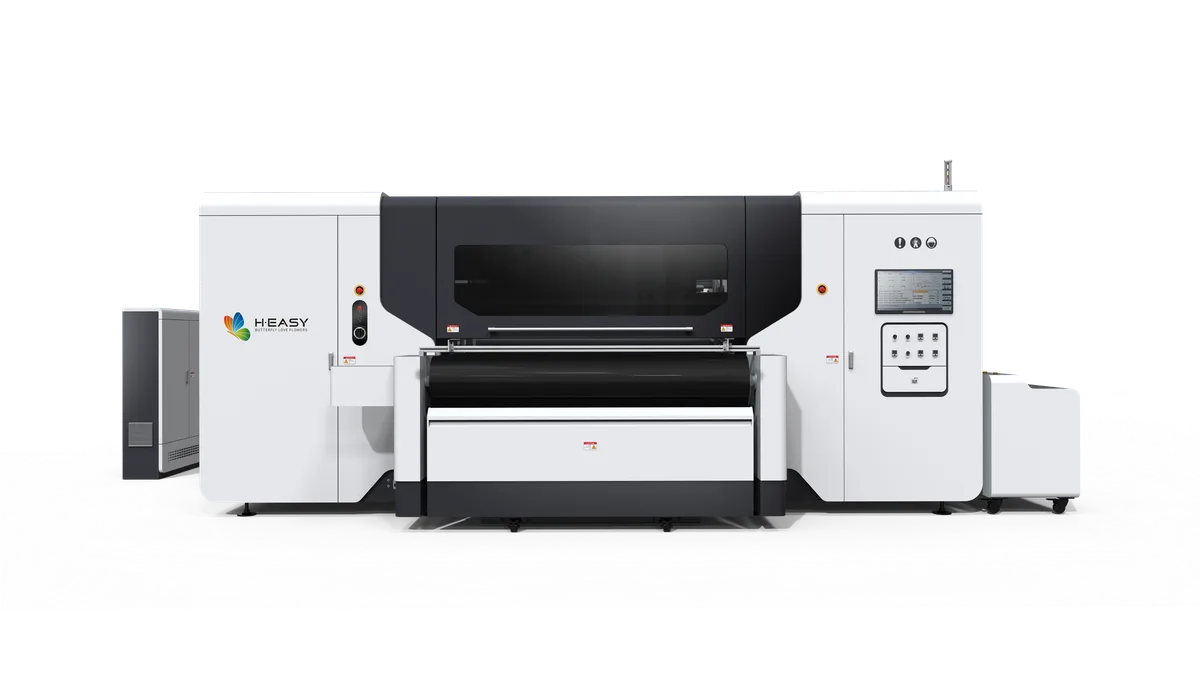
For industrial-scale pigment textile printing, see the HY-Series R2R printers - 1.8–2.6 m direct-to-fabric Ricoh Gen6 platforms supporting reactive, disperse, acid and pigment ink workflows.