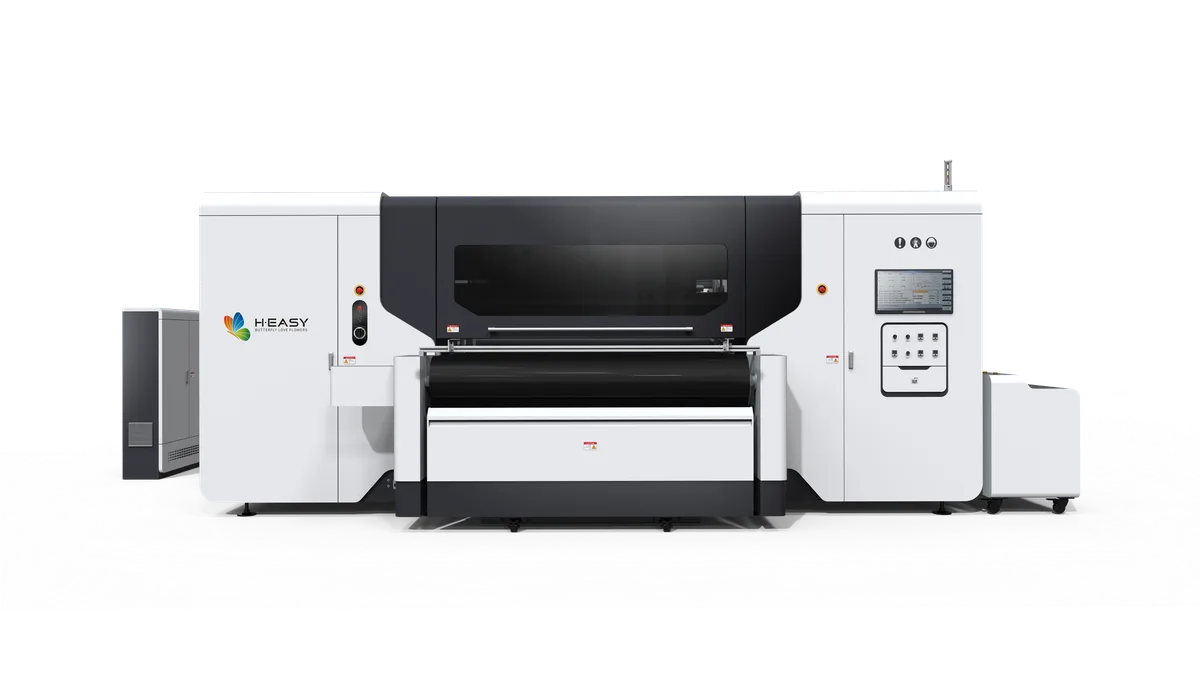
Digital Fabric Printing Transformation: A Mill Roadmap
A fabric-printing transformation succeeds when the mill routes the right orders to digital, qualifies the complete ink and finishing chain, measures sellable output, and scales with traceable controls. Buying a faster print engine is only one part of the program. Artwork preparation, fabric handling, pretreatment, fixation, washing or curing, inspection, staffing, utilities, service, and order planning determine whether the new route works in bulk.
Digital printing should not be framed as an automatic replacement for every existing process. It is a second manufacturing route with different strengths and constraints. The business case becomes credible only when it is tied to real orders and approved finished fabric.
Start with the order portfolio, not a technology slogan
Review a representative period of actual quotations, samples, production orders, changeovers, rework, and late deliveries. Classify each order by:
- fibre, construction, width, surface, stretch, and incoming finish;
- artwork type, repeat, number of colorways, coverage, and change frequency;
- order length, reorder pattern, sampling demand, and delivery window;
- required color, hand, penetration, registration, care, and defect limits;
- pretreatment, transfer, steaming, washing, curing, drying, and finishing;
- approved process, buyer restrictions, and evidence required for release.
This exposes where digital may remove screen preparation, shorten an artwork change, or support more variants. It also exposes jobs that should remain on a qualified screen or transfer route. Do not convert a job simply because its order length is lower than another job; substrate, image character, chemistry, special effect, and finishing capacity still matter.
Use the site’s technology comparison to identify candidate routes, then validate them on the mill’s materials rather than treating a comparison table as a purchase decision.
Build a routing matrix for real jobs
A routing matrix gives sales, planning, color, and production teams the same decision logic. It should state when a job is a digital candidate, when it stays on the current route, and what evidence is needed before moving it.
| Order characteristic | Digital route may be worth qualifying when | Keep or compare another route when |
|---|---|---|
| Artwork | Designs or colorways change frequently; fine detail or gradients matter | A stable repeat and established screen set already meet the requirement |
| Product mix | Sampling, replenishment, or multiple variants create frequent setups | One repeat runs predictably with few changes |
| Fabric | Transport and ink chemistry can be qualified on the actual construction | Surface, stretch, pile, seam, or finish cannot be controlled on the candidate line |
| Finish | The mill has a compatible pretreatment and fixation or curing route | Required deposition, texture, effect, or approved chemistry belongs to another process |
| Delivery | Decoupled sampling or rapid artwork changes solve a measured bottleneck | Printing is not the bottleneck and downstream finishing remains constrained |
The matrix is a starting hypothesis. Production trials must confirm it. A demonstration on supplier-selected fabric cannot prove that the mill’s hardest construction, darkest ground, longest repeat, or strictest finished-product requirement will pass.
Lock the fibre, ink, and finishing route first
Digital fabric printers deliver ink; they do not make every chemistry interchangeable. Match the substrate to the complete process:
- direct reactive, acid, disperse, or pigment routes each require their own qualified preparation, printing, fixation, cleaning, and finishing logic;
- sublimation transfer adds paper handling and heat transfer rather than a direct-to-fabric wet route;
- frequent ink switching can create contamination, cleaning, profile, storage, and downtime risks;
- a printer exit condition is not automatically a finished-fabric condition.
Map every upstream and downstream asset, its usable width, roll direction, speed range, material-handling interface, utilities, and environmental controls. The slowest qualified stage limits the line. Adding printer capacity does not increase shipments if coating, steaming, washing, curing, drying, inspection, or packing remains the constraint.
The fabric-process selection guide and R2R ink-workflow guide help define this boundary before a machine trial.
Convert artwork and color into controlled production data
Digital artwork is easy to duplicate; a repeatable production result is not. Define ownership and revision control for:
- source artwork, repeat construction, separations, and approved colorways;
- RIP file, rendering intent, ink limit, profile, print mode, and queue settings;
- substrate, pretreatment, ink, and finishing recipe linked to that profile;
- monitor, viewing, measurement, and physical-sample approval conditions;
- archived production file and the rule for any later substitution.
Do not use one generic profile across visibly different fabrics simply because they share a fibre name. Construction, surface, whiteness, absorbency, coating, and finishing can change the printed and measured result. Retain the approved physical sample and every critical stage sample with the digital job record.
Run a pilot designed to expose weak points
The pilot should use the mill’s materials and failure-prone jobs. Include fabric that wrinkles, stretches, skews, sheds lint, has difficult edges, or challenges drying. Use artwork with solids, fine positive and reversed lines, small text, gradients, repeat joins, high-coverage areas, and control features across the usable width.
Agree before the trial:
- exact printer configuration, ink, fabric, and preparation;
- profile, mode, artwork coverage, and usable width;
- fixation, washing or curing, drying, and final finishing;
- inspection conditions, test methods, and pass/fail criteria;
- what counts as sellable output and which planned losses are included;
- response to a nozzle event, fabric fault, stoppage, and restart;
- records, samples, training, and acceptance documents the supplier returns.
Inspect the finished product, not only the fresh print. Record defects by roll position and process stage so that the team can separate artwork, profile, nozzle, feed, coating, fixation, wash-off, drying, and finishing causes.
Measure sellable flow instead of headline speed
Advertised print speed is a mode label, not a production result. Build a flow model from the same acceptance standard used in the trial. Include:
- loading, roll changes, alignment, splices, and edge preparation;
- nozzle checks, routine cleaning, artwork changes, and profile setup;
- qualified print mode and actual artwork coverage;
- pretreatment or paper, fixation, wash, cure, dry, and finish capacity;
- inspection, rejected intervals, rework, conditioning, and packing;
- shift pattern, operators, planned maintenance, and service response.
Compare approved output at the line exit. A dual-feed or multi-lane feature may help when two paths can be controlled and downstream equipment can accept the flow, but the label alone does not prove doubled sellable output. Require a configured trial and acceptance criteria for the intended fabrics.
Test environmental claims with a line boundary
Avoid “green,” “waterless,” or “zero wastewater” claims without a defined boundary. Digital removes physical screen preparation, but the full route can still use pretreatment chemistry, transfer paper, cleaning fluid, heat, steaming, washing, water treatment, ventilation, and waste handling.
For the candidate job, record:
- water and chemistry used in fabric preparation, production washing, cleaning, and utilities;
- energy used by printing, transfer, steam, cure, dry, ventilation, and climate control;
- ink, paper, coating, cleaning material, rejected fabric, and packaging;
- wastewater and solid-waste treatment required by the actual process;
- sellable yield under the same quality requirement.
Compare routes per approved unit of output and state which stages are inside the calculation. A qualified pigment route may avoid the production wash stage used by a reactive route, for example, but that does not erase pretreatment, cleaning, energy, or rejected material.
Make traceability useful before adding more software
Remote dashboards, scheduling software, and factory integration can help only when the underlying records have stable definitions. Begin with a job traveler that links:
- customer order and artwork revision;
- fabric, ink, pretreatment, and other consumable lots;
- profile, mode, recipe, machine, operator, and time;
- environment and machine events relevant to quality;
- each finishing stage, inspection result, defect map, and disposition;
- retained samples and authorization for deviations.
Assign ownership for each field and test whether it helps answer a real production question. Once the records are reliable, integrate them with ERP, scheduling, color, maintenance, or MES systems. Buying a dashboard before the team agrees on job identity and recipe control digitizes ambiguity.
Scale in controlled phases
Move through gates rather than switching the whole order book at once:
- Route proof: qualify fibre, chemistry, and finished-product result.
- Job proof: pass difficult artwork and representative fabric lots.
- Repeatability proof: reproduce the approved result after normal stops, changes, and maintenance.
- Flow proof: demonstrate sellable line output with downstream stages.
- Limited release: route a bounded order family with enhanced inspection.
- Expansion: add jobs only when the control plan and capacity evidence support them.
At every gate, define who can approve progression and what happens when the result misses. Keep the current production route available until the digital route has passed the required evidence, training, service, and recovery tests.
Use an evidence-based investment brief
The final brief should contain the order-routing matrix, qualified fabric and ink routes, site and utility survey, sample and acceptance plan, flow model, staffing and training plan, service and spare-parts boundary, operating-cost inputs, traceability design, and phased release criteria.
Score supplier proposals against that brief. Unsupported promises such as “every fabric,” “maximum speed and quality,” “automatic operation,” or “zero waste” are not acceptance evidence.
The current R2R textile printer family is an equipment path to evaluate after the process boundary is defined. Use the contact form to send the candidate fabrics, ink routes, usable width, artwork mix, finishing equipment, site utilities, and pilot acceptance criteria for a configuration review.