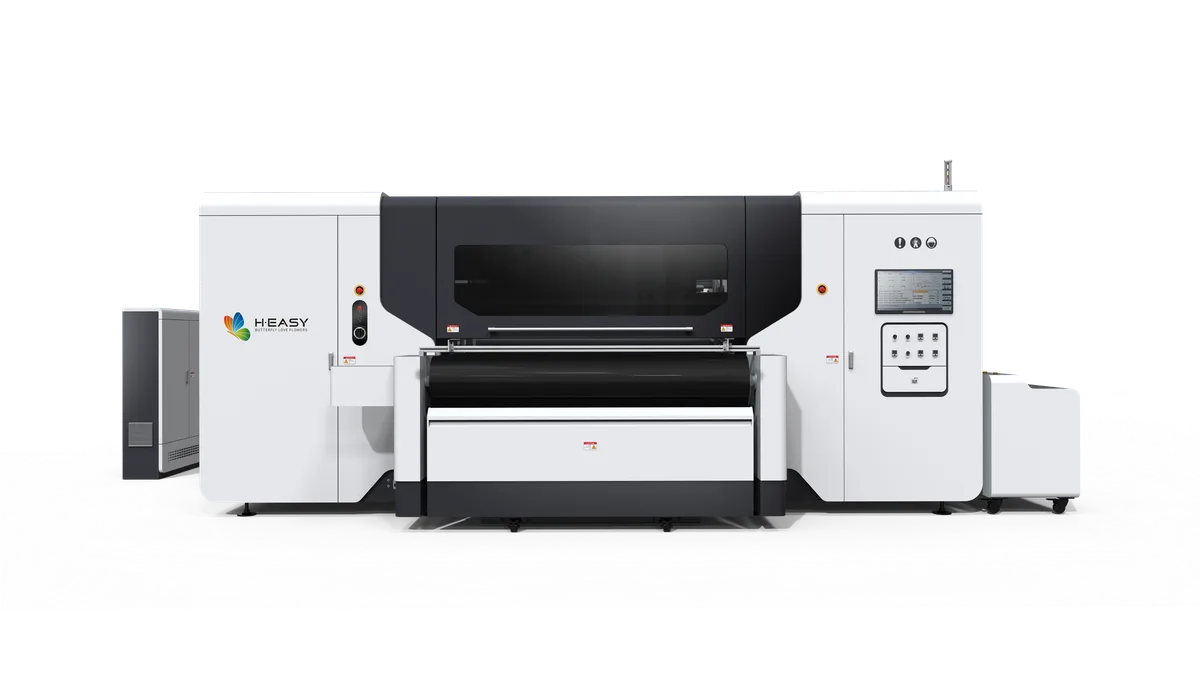
HY-2208 Digital Textile Printer: A Cost-Effective Choice for Small-Batch Custom Fabric Printing

The textile digital printing industry is entering a new stage of competition.
In the past, many printing factories relied on large-volume orders to generate profit. Today, rising material costs, higher labor expenses, expensive consumables, fewer bulk orders, and growing demand for small-batch fast-response production are changing the market.
For small and medium printing businesses, the real question is no longer simply: Can we print fabric?
The more important question is: How can we enter the market with lower investment, control ink and maintenance costs, and handle small-batch custom orders profitably?
This is exactly why we developed the HY-2208 high-speed textile digital printing machine.
Designed for small-batch customization, startup printing businesses, e-commerce fabric orders, garment sampling, home textile small orders, and fashion fabric development, the HY-2208 helps customers build a more flexible and cost-controlled production workflow through stable machine structure, self-developed core hardware, matched ink solutions, and technical service support.

Quick Answer: What Problems Does HY-2208 Help Solve?
| Customer Pain Point | HY-2208 Solution Direction |
|---|---|
| High investment in large machines | Better suited to startup and small-to-medium printing businesses |
| More small-batch orders | Supports flexible, multi-design, small-volume production |
| Slow design changeover with old equipment | Digital files can be processed and printed without traditional screen-making |
| High third-party ink cost | Matched ink solution helps control long-term consumable cost |
| Printhead clogging and maintenance pressure | Machine, ink, and ink supply system are designed to work together |
| Labor and material waste | Stable feeding, ink supply, and drying support smoother production |
| Lack of production experience | We provide installation, training, and after-sales support |
For customers entering the textile digital printing business, HY-2208 is not only a machine. It is a small-batch custom production solution built around equipment, ink, process, and service.
1. Small-Batch Customization Is Changing Textile Printing
Textile printing orders are changing quickly.
Traditional printing is more suitable for large-volume, fewer-style, longer-cycle production. But e-commerce platforms, fast fashion brands, independent designers, home textile customization, and streetwear fabric development are driving a new production model:
- small batches;
- multiple designs;
- frequent orders;
- fast sampling;
- quick reorders;
- personalized customization.
Customers are less willing to hold large inventory. Instead, many brands prefer to test the market with small quantities first, then reorder quickly based on sales feedback.
This creates new requirements for printing factories: Machines must be flexible. Design switching must be fast. Cost must be controllable. Quality must remain stable.
Large machines can create investment pressure when orders are unstable. Old machines may have lower initial cost, but slow changeover, high failure rate, and maintenance problems can reduce profit.
A digital textile printer for small-batch customization must therefore offer stronger production flexibility.
2. Why HY-2208 Is Suitable for Textile Printing Startups
For startup printing factories and small processing businesses, machine selection should not only be based on whether the specifications look powerful. The machine must match the real order structure.
HY-2208 is designed to help customers enter textile digital printing with a more controllable investment.
It is suitable for:
| Application | Typical Orders |
|---|---|
| E-commerce fabric customization | Small batches, multiple designs, quick reorders |
| Garment sampling | Brand samples and designer fabric development |
| Home textile small orders | Cushions, curtains, decorative fabric, sample collections |
| Fashion fabric development | Multiple patterns, short cycles, personalized styles |
| Small printing workshops | Multi-customer, multi-style, flexible scheduling |

Compared with traditional printing, digital printing does not require traditional screen-making. Artwork can be processed digitally and sent directly to production.
This makes HY-2208 suitable for multiple-design, small-volume orders and helps reduce sampling and changeover costs within a digital textile sampling workflow.
For new business owners, the value of HY-2208 is clear: You do not need to start with a heavy investment in large-scale equipment to enter the small-batch custom fabric printing market.
3. Cost Reduction from the Machine Side: Stable Structure Reduces Long-Term Loss
A textile digital printing machine is not a short-term consumable. It is a long-term production asset.
If the structure is unstable, even a low-cost machine may create long-term problems such as:
- reduced printing accuracy;
- unstable fabric feeding;
- pattern shifting;
- color inconsistency;
- frequent after-sales issues;
- production downtime.
The HY-2208 is designed to reduce long-term production risks through stable hardware structure.
Integrated Frame for Stable Operation
An integrated frame improves overall machine stability and reduces mechanical attenuation during long-term operation.
For small-batch custom production, orders change frequently. The machine must remain stable under different designs, fabrics, and production schedules.
The integrated frame helps reduce printing fluctuation caused by vibration, mechanical loosening, or structural deviation.
For customers, this means:
- more stable print quality;
- longer machine service value;
- lower maintenance pressure;
- more controllable long-term operating cost.
For startup customers, machine stability directly affects whether they can keep accepting orders consistently.
High-Precision Printhead Bottom Plate
The printhead bottom plate affects printhead installation accuracy, pattern sharpness, color registration, and production consistency.

HY-2208 uses an integrated stainless-steel printhead bottom plate design, helping to:
- shorten installation time;
- reduce after-sales workload;
- make printhead replacement easier;
- improve printing accuracy stability;
- reduce accuracy changes caused by time and environment.
For multi-design, small-batch orders, one common problem is that samples look good but bulk production becomes unstable. A stable printhead bottom plate helps reduce that risk.
Self-Developed Driver Board and Control System
Stable printing is not only about mechanical structure. It also depends on the control system.

HY-2208 is equipped with our self-developed inkjet control system and driver board.
The driver board affects:
- jetting stability;
- droplet control;
- machine response;
- long-term operation reliability;
- maintenance and upgrade flexibility.
For customers, a self-developed control system means that machine issues can be identified and handled more efficiently by the original manufacturer, reducing dependence on external technical support.
4. Cost Reduction from the Consumable Side: Machine and Ink Matching Matters
In textile digital printing, ink is one of the most important long-term costs.
Many small and medium customers focus heavily on machine purchase price at the beginning, but later find that ink cost, ink compatibility, printhead clogging, cleaning waste, and color instability continue to consume profit.
One major advantage of HY-2208 is that we provide textile digital printing ink solutions matched with the machine.
Machine and Ink Are Designed to Work Together
Ink is not stable simply because it can be loaded into the machine.
For real production, ink must match:
- printheads;
- ink supply system;
- negative pressure system;
- driver board waveform;
- drying system;
- fabric process.
Better matching between machine and ink helps reduce clogging, missing nozzles, color difference, and frequent cleaning.
Lower Long-Term Consumable Pressure
For small-batch custom printing businesses, every order margin matters.
If ink cost is too high, or if production losses are caused by clogging, cleaning, or reprinting, small orders can quickly become unprofitable.
With matched ink solutions, we help customers control long-term consumable pressure and make operating costs more predictable after production starts.
More Stable Color and Fastness Performance
Stable ink affects both cost and product quality.
Good ink matching helps improve:
- smooth ink output;
- color reproduction;
- pattern sharpness;
- batch consistency;
- color fastness performance.
For apparel, home textiles, and custom fabric customers, stable quality is more important than simply choosing the lowest-cost ink.
5. Production Efficiency: Built for Multi-Style, Small-Batch, Fast Delivery
HY-2208 is designed for small-batch customization and flexible production.
This type of order usually has one major feature: Each order may not be large, but there are many styles, high frequency, and short delivery cycles.
HY-2208 helps improve production efficiency in several ways.
Fast Design Changeover
In traditional printing, changing a design often requires screen-making, paste adjustment, trial printing, and approval.
Digital printing allows patterns to be changed through digital files.
This is suitable for:
- multi-customer orders;
- multi-SKU production;
- small-batch mixed orders;
- e-commerce reorders;
- fast sampling.
Lower Inventory Risk
Brands are less willing to produce large inventory in advance.
HY-2208 supports a production model of: sample first -> small-batch test -> quick reorder.
This helps factories serve e-commerce brands and fast-response customers more effectively.
Higher Machine Utilization
Large machines may face idle capacity if orders are insufficient. HY-2208 is more suitable for small and medium customers entering the market through multi-category, multi-customer, and multi-batch production.
This can help improve machine utilization and reduce the pressure of relying on only one large customer.
6. Who Is HY-2208 Suitable For?
| Customer Type | Why HY-2208 Fits |
|---|---|
| Textile printing startups | More controllable investment for small-batch entry |
| Small printing workshops | Suitable for multi-customer and multi-design orders |
| E-commerce apparel suppliers | Supports testing, sampling, and quick reorders |
| Home textile studios | Suitable for cushions, curtains, and decorative fabric samples |
| Garment sampling centers | Supports brand sampling and designer artwork development |
| Streetwear supply chains | Suitable for short-cycle, personalized fabric production |
| Traditional printing factories | A practical entry point into flexible digital printing |
7. What Should Customers Confirm Before Buying HY-2208?
Before choosing HY-2208 or any other textile digital printing machine, customers should use a textile printer buying checklist and confirm:
- Are the main orders apparel, home textiles, denim, or blended fabrics?
- What is the usual order quantity per batch?
- Do customers frequently change designs?
- Should sampling and small-batch production be done on the same machine?
- What are the requirements for hand feel, fastness, and color reproduction?
- Are pretreatment, drying, or finishing processes required?
- Are the target customers e-commerce sellers, brands, wholesalers, or processing clients?
- Does the factory need ink, process, and after-sales support from the supplier?
These questions determine the right machine configuration, ink solution, and production workflow.
8. Why Choose Us?
Choosing a textile digital printing machine is not only choosing equipment. It is choosing a long-term production support system.
We have been deeply engaged in textile digital printing equipment development and provide support from machine to ink, installation to training, and debugging to after-sales service.
Our advantages include:
- self-developed equipment technology;
- stable mechanical structure;
- self-developed control system;
- matched ink solutions;
- process testing support;
- installation and debugging service;
- operator training;
- after-sales maintenance support.
For customers entering textile digital printing for the first time, this one-stop support can reduce trial-and-error costs and help production become stable faster.
Conclusion: HY-2208 Is a Practical Choice for Small-Batch Custom Printing Startups
The textile digital printing market has entered a more refined stage of competition.
In the past, factories competed through large orders, high capacity, and low unit prices. Today, more customers compete through response speed, small-batch delivery, cost control, and stable production.
The HY-2208 high-speed textile digital printing machine is designed around this market change.
With controllable investment, stable machine structure, self-developed core hardware, matched ink solutions, and complete after-sales support, HY-2208 helps small and medium printing businesses lower the entry barrier, reduce long-term consumable pressure, and improve small-batch custom production efficiency.
For customers planning to enter textile customization, small-batch fast-response production, home textile small orders, garment sampling, or e-commerce fabric printing, HY-2208 is a digital textile printing machine worth considering.