Digital Textile Printing Market Size: An Evidence Guide
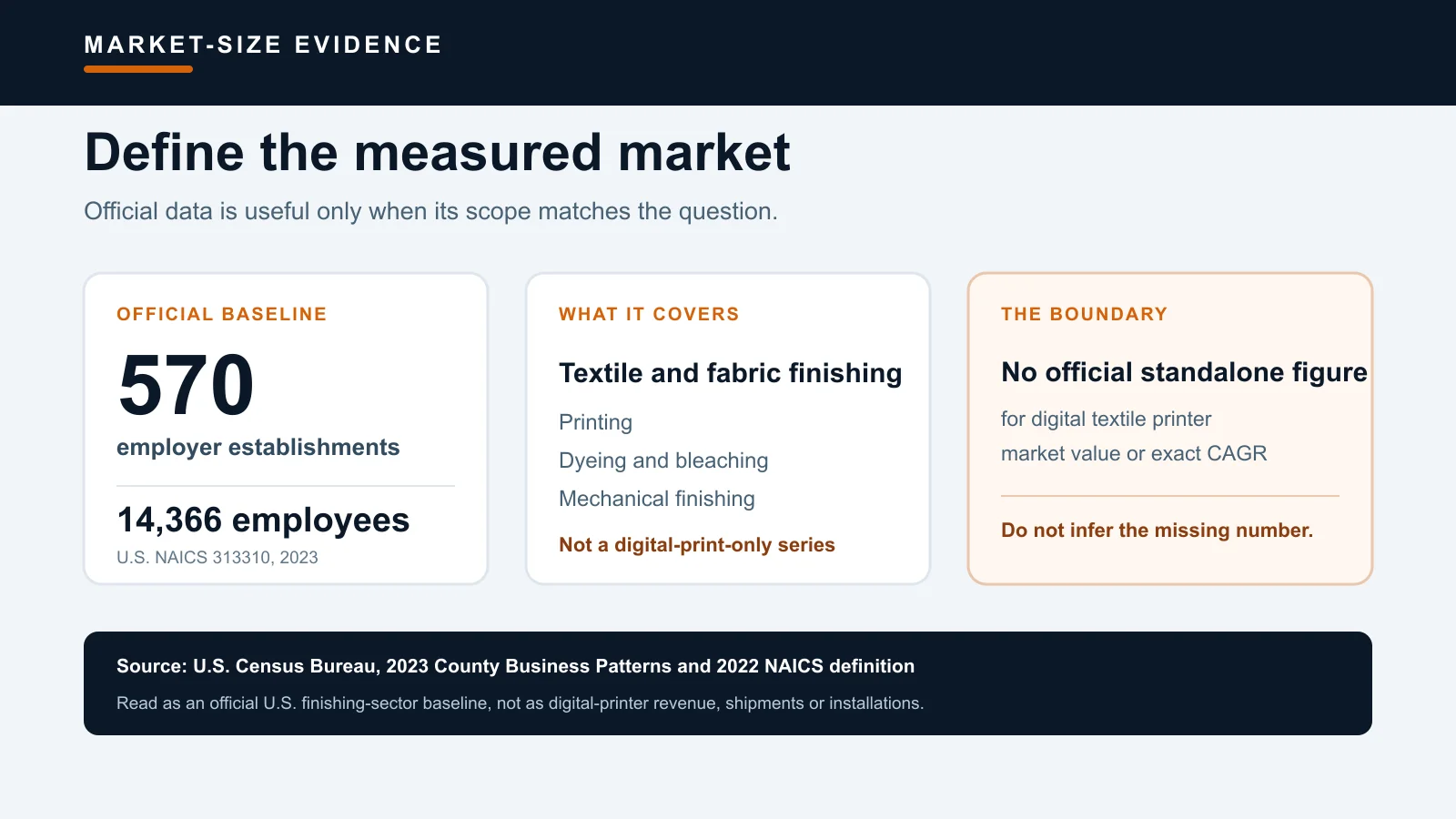
No official public series cited here independently reports the global or U.S. market value of digital textile printers or an exact growth rate for that category. That is the central finding, not a missing paragraph. The legacy articles used commercial market figures whose definitions and underlying data could not be verified, so those figures are not republished.
Public data can still support a useful market view. The responsible approach is to define the market, identify what each source actually measures and keep the unmeasured digital-printer segment separate from broader textile activity. This guide shows how a buyer or planner can do that without turning adjacent data into a false market-size claim.
Define the market before looking for a value
“Digital textile printing market” can refer to very different things:
- printer-manufacturer revenue;
- machines shipped or installed;
- ink, software and service revenue around those machines;
- the value or volume of digitally printed textile output;
- print-service businesses rather than equipment; or
- an entire textile-finishing sector that also uses analogue processes.
Those are not interchangeable denominators. A report that includes print services and consumables will produce a different value from a report limited to printer hardware. A global estimate cannot be applied to one country without a documented geographic method. A growth rate for printed output does not automatically describe machine sales.
Before accepting a market number, require its product boundary, geography, reference period, currency treatment, source population and calculation method. If those elements are unavailable, the number cannot be audited and should not be used to justify equipment capacity or return assumptions.
What the U.S. Census baseline measures
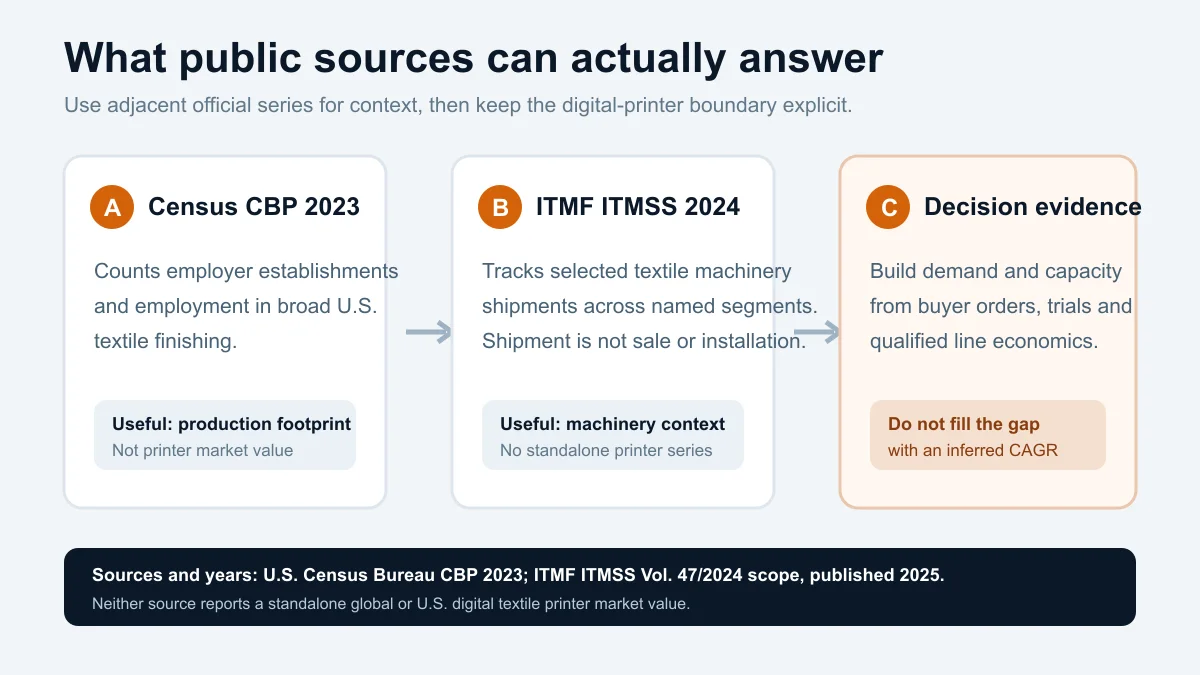
The U.S. Census Bureau’s 2023 County Business Patterns file reports 570 employer establishments and 14,366 employees under NAICS 313310, Textile and Fabric Finishing Mills. This is a useful official baseline for the scale of an adjacent U.S. production sector.
It is not a count of digital printing companies. The 2022 NAICS definition says the industry includes printing together with dyeing, bleaching, stonewashing, cleaning and other mechanical or preparatory finishing operations. It also describes printing examples that are not limited to digital methods. The data therefore cannot reveal how many of the reported establishments operate a digital textile printer, their installed capacity or their equipment spending.
That boundary is as important as the headline counts. Read the Census result as evidence that a defined textile-finishing employer base exists. Do not relabel the entire category as a digital-print market.
What textile machinery shipment data measures
The ITMF International Textile Machinery Shipment Statistics scope covers named segments in spinning, drawtexturing, weaving, knitting and finishing machinery. Its published scope does not provide a standalone digital textile printer series. It also defines a shipment as machinery physically shipped during the review year and warns that shipments should not be confused with sales or installations.
This makes ITMF valuable when the question matches a segment in the survey. It does not create an official digital-printer market value by association. A planner should never take movement in a broad textile machinery category and apply the same direction or rate to digital printers without a source that actually measures that subset.
What the sources can support
Used within their limits, the official sources answer practical questions:
| Question | What the evidence can support | What it cannot support |
|---|---|---|
| Is there a defined U.S. textile-finishing employer base? | Census establishment and employment counts for the published NAICS category | The digital share of those establishments |
| Which activities sit inside that category? | The official NAICS definition of printing, dyeing, bleaching and other finishing | A claim that every listed establishment prints textiles |
| What does the cited machinery survey mean by shipment? | Machinery physically shipped within its named survey segments | Revenue, installation count or a digital-printer subset not reported by the survey |
| How large is a factory’s addressable opportunity? | A model built from qualified customers, applications, order mix and capacity | A universal answer copied from a market headline |
This evidence hierarchy is deliberately conservative. It produces fewer headline figures, but every conclusion can be traced to the source that supports it.
Why the archived size and growth claims were removed
The archived market articles stated precise global, regional and forecast figures. Their cited material was either absent, commercially branded or did not expose enough of the method to verify the product boundary. Some images were third-party market graphics carrying another publisher’s branding. Those graphics are on the migration blacklist and are not used, edited or recreated.
Replacing an unsupported estimate with a new estimate would repeat the same failure in a cleaner layout. The correct editorial result is to say that no independent public official statistic in the reviewed source set isolates the digital textile printer market. That statement leaves room for a properly defined paid dataset later without presenting a guess as fact today.
Build a decision-grade market view instead
A factory investment needs evidence closer to the purchase decision than a global market total. Start with the demand the line could actually serve:
- identify target fabrics and the compatible ink and finishing routes;
- separate current orders from unqualified sales interest;
- group jobs by artwork, coverage, width, quality and delivery requirements;
- test representative material and record sellable output rather than nominal engine speed;
- model utilization around changeovers, maintenance, finishing and inspection;
- include pretreatment, drying, fixation, washing or curing where the selected chemistry requires them; and
- test the result against conservative demand and downtime assumptions.
The textile printer buying checklist turns those inputs into supplier questions. The digital printing transformation roadmap helps separate the process qualification from the equipment purchase.
Use market context without turning it into ROI
Sector data can inform where to investigate. It can show that a production ecosystem exists, define which activities a statistical category includes and reveal the scale of an adjacent employer base. It cannot establish a factory’s sale price, margin, utilization, ink coverage, labor requirement or payback.
For equipment planning, the best evidence comes from the intended textile and workflow. Choose the fabric printing process, run a controlled digital textile sample and document the line conditions that produced an acceptable result. Only then should capacity and economics enter the decision model.
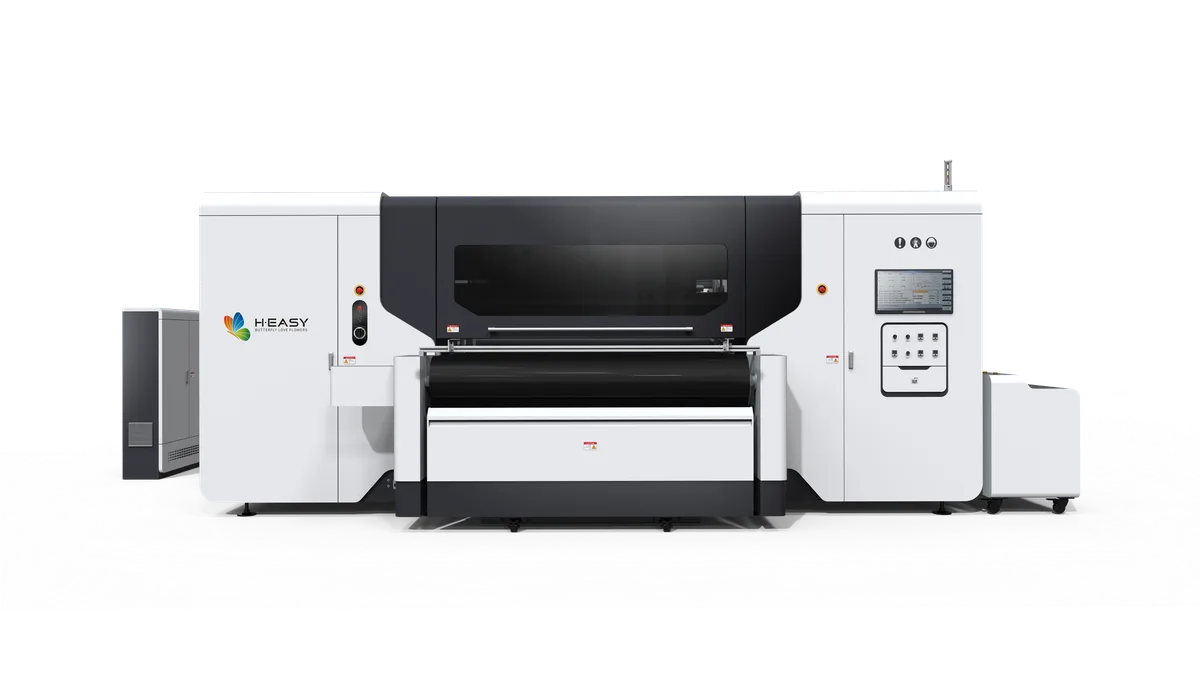
The roll-to-roll textile printer family provides current equipment context, but no product page can supply a universal market return. A credible proposal connects the model to verified demand, qualified fabric and complete process costs.
A source test for future market reports
When a new market report appears, review it in this order:
- Category: Does it isolate printer hardware, or combine equipment with inks, software and services?
- Technology: Does it separate digital textile printing from analogue printing and broad textile finishing?
- Geography: Are global and country figures independently measured or allocated by an unexplained model?
- Time basis: Are the observations shipments, sales, installations, production output or forecast values?
- Method: Are sample, assumptions, currency conversion and revisions documented?
- Traceability: Can a reviewer reach the original dataset rather than a screenshot of a chart?
If the report passes those tests, its figures can be cited with the stated scope. If it does not, use it as a research lead rather than a published fact. The absence of an auditable figure is a valid finding and a safer basis for an industrial buying decision than unsupported precision.
Sources and references
- County Business Patterns: 2023 U.S. fileThe U.S. employer-establishment and employment counts reported for NAICS 313310 in the market-baseline section and chart.
- 2022 NAICS definition for Textile and Fabric Finishing MillsThe scope boundary showing that NAICS 313310 includes printing, dyeing, bleaching and other textile-finishing activity rather than digital printing alone.
- International Textile Machinery Shipment Statistics Vol. 47/2024: Scope and CoverageThe machinery-survey coverage and the warning that shipment means physically shipped machinery, not sales or installations.