Digital Textile Printing Trends: An Evidence Guide
The strongest verified textile-printing trends are not a single growth rate or an automatic equipment upgrade. Official evidence points to mixed capital investment across adjacent textile-machinery categories, a large but diverse textile production ecosystem, and rising attention to digital records and product lifecycle information. For a print factory, the practical response is to improve qualification, process visibility and changeover discipline before assuming that a broad industry signal predicts local demand.
This guide replaces a legacy trend summary that repeated unsourced forecasts and generic claims. It uses current official sources within their stated scope. Where those sources do not isolate digital textile printers, the article says so rather than extending the data beyond what was measured.
Trend evidence needs a category boundary
An industry trend can describe different things: machinery shipments, factory output, textile sales, production technology, regulation or buyer behaviour. Those signals may interact, but they are not interchangeable.
For example, higher shipments in one textile-machinery category do not prove that digital printer revenue rose by the same rate. A broad textile turnover figure does not measure the value of printed output. A policy direction can change information requirements without proving that a particular print method will gain market share.
Before using a trend in a purchase decision, ask four questions:
- What product or activity does the source actually count?
- Is the signal global, regional or specific to a supply chain?
- Does it report shipments, installations, output, revenue or an intention?
- Can the proposed factory action be tested with its own fabrics and orders?
That boundary turns a trend from a headline into a decision input.
Signal one: capital investment is moving in different directions
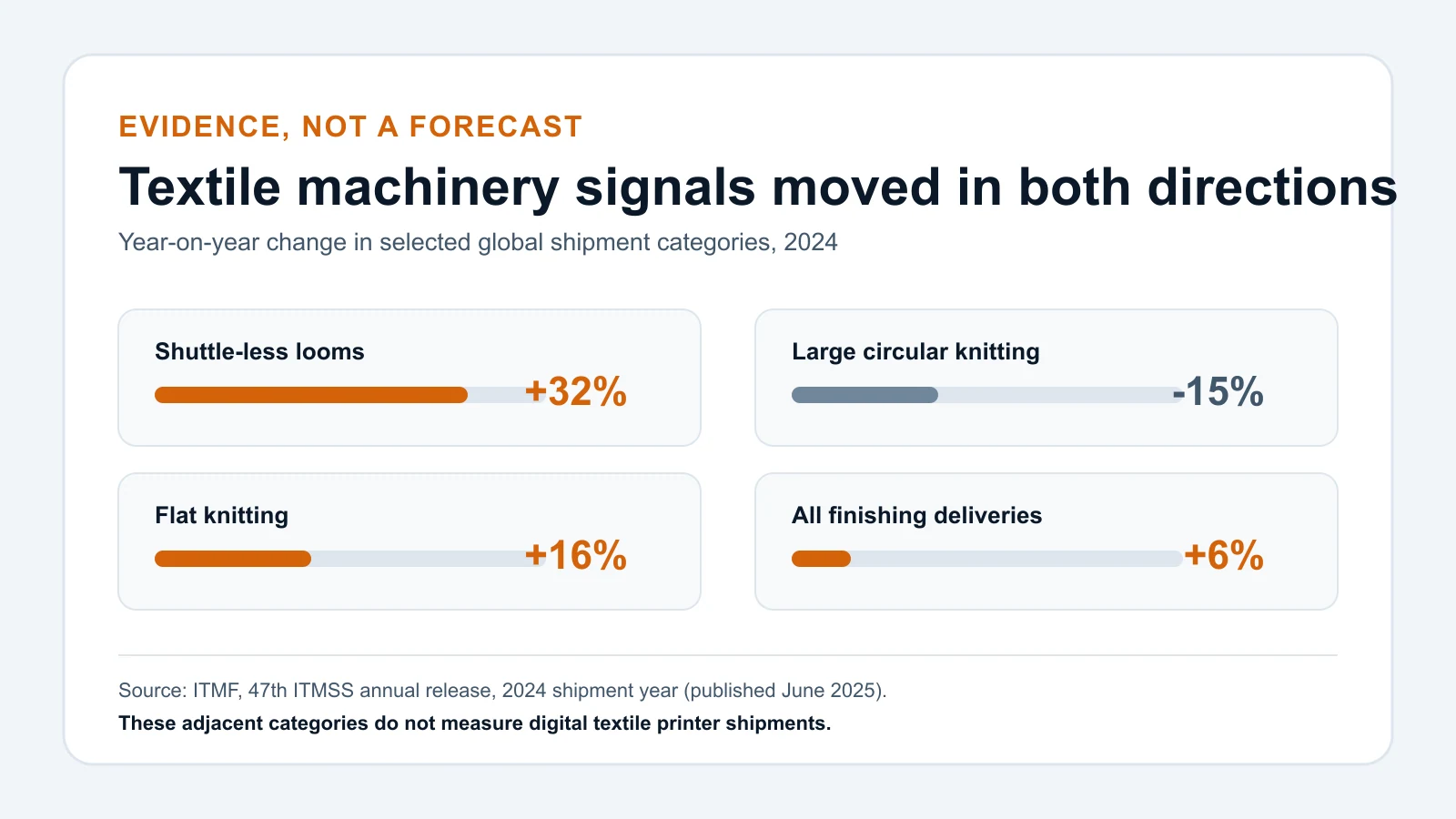
The ITMF release for the 2024 shipment year reports mixed movement among the machinery categories it covers. Global shipments of shuttle-less looms rose 32%, while large circular knitting-machine shipments fell 15%. Flat knitting machine shipments increased 16%, and the sum of finishing-machinery deliveries rose 6%.
These figures do not form a digital textile printer index. ITMF identifies six survey segments covering spinning, drawtexturing, weaving, large circular knitting, flat knitting and finishing. The release does not report a standalone digital textile printer series.
The useful conclusion is therefore limited but important: equipment demand can move in opposite directions across the same production ecosystem. A factory should not convert a positive number in an adjacent category into a sales forecast for its own print line. It should qualify the applications, fabric routes and customer commitments that could feed that line.
Signal two: the textile ecosystem is large and heterogeneous
The European Commission’s 2024 industrial-ecosystem factsheet reports EUR 167 billion in textiles and clothing turnover, labelled for 2023, together with 192,000 enterprises and 1,300,000 employees. Those numbers establish the scale of a broad European production ecosystem. They do not describe digital printing alone.
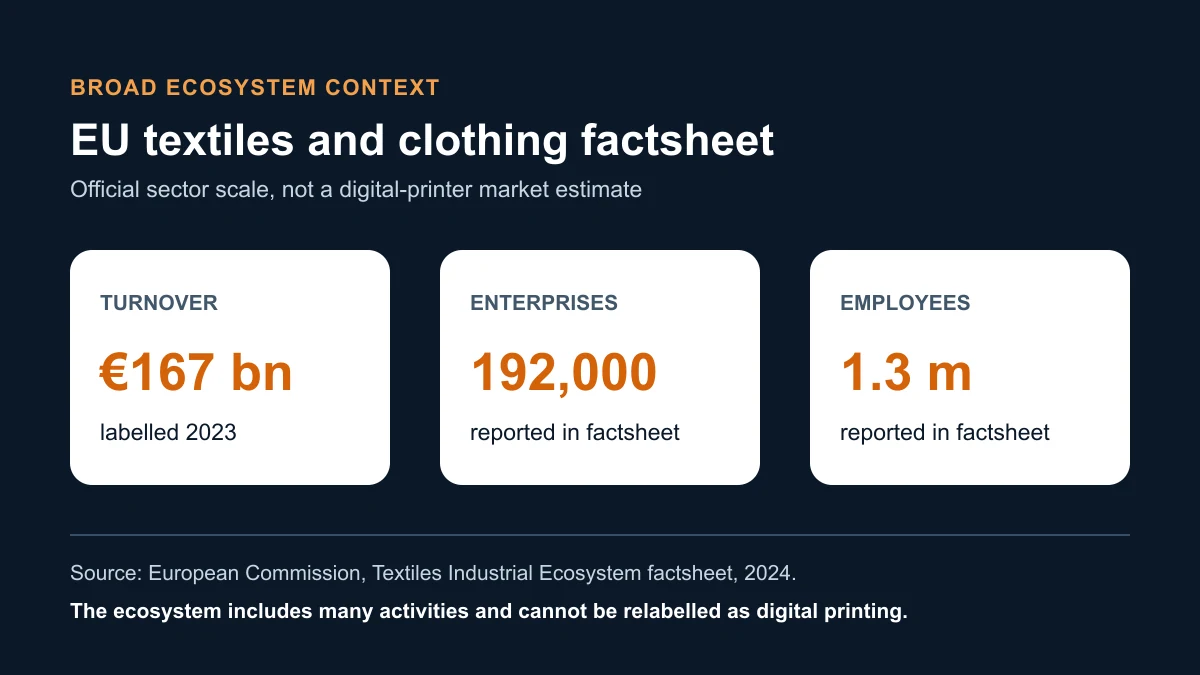
The same factsheet defines the ecosystem broadly, from fibres and yarns through fabrics and finished products, including clothing, carpets, home textiles, industrial filters and medical textiles. A printer may serve some of those applications, but the aggregate cannot be presented as a digital-print market size.
For planning, diversity matters more than the headline total. Apparel sampling, home-textile repeats and technical-fabric marking can require different ink chemistry, pretreatment, fixation, washing, inspection and finishing. A line that is flexible in one workflow may be unsuitable for another. Market context should lead to a narrower application brief, not a wider assumption.
The fabric printing process guide helps translate end use and fibre content into a process route. The textile printer buying checklist then turns that route into questions for equipment and process suppliers.
Signal three: production data is becoming part of product readiness
The European Commission’s Sustainable and Circular Textiles Strategy covers the lifecycle of textile products and lists the introduction of a Digital Product Passport among its actions. The cited strategy page does not provide a universal data template for every printer, so it would be wrong to invent one. It does provide a clear direction: product information and traceability should be treated as operational capabilities rather than paperwork added after production.
For a textile printer, sensible preparation starts with records the process already needs:
- substrate identity and incoming-lot reference;
- ink and pretreatment route used for the job;
- artwork, profile and approved sample reference;
- production settings that affect repeatability;
- fixation, curing, washing or other finishing route; and
- inspection result and disposition of nonconforming output.
This list is an operational inference, not a claim that each field is mandated by the cited EU page. Its value is practical: when product information is requested by a customer or supply-chain system, the factory can retrieve a traceable production record instead of reconstructing one from memory.
Signal four: digitalisation must improve control, not just add dashboards
The Commission factsheet describes a transition toward a greener, more digital and more resilient textile ecosystem. In a print room, digitalisation earns its place when it improves a production decision.
A useful workflow connects the approved artwork and sample to the actual run. Operators should be able to see which substrate lot, profile, ink route and finishing conditions produced the accepted result. When output changes, the record should help separate artwork changes from material, environment, maintenance and post-treatment causes.
Simply collecting more screen data does not guarantee repeatability. The data must use consistent names, be captured at the relevant process point and lead to a defined response. A warning that nobody owns, or a setting that cannot be linked to an approved sample, adds complexity without control.
The digital textile sampling workflow shows how to create a reference that production can reproduce. The print-quality inspection checklist explains why profiling, material condition and process control belong to one system rather than separate software tasks.
Signal five: flexibility depends on a qualified process envelope
Digital workflows can reduce the setup burden associated with changing artwork, but artwork flexibility is not the same as unlimited material flexibility. Changing fibre type, fabric construction, ink chemistry or finishing route can change the whole process.
A factory should define the envelope it can reproduce:
- target applications and acceptable substrates;
- compatible ink and pretreatment combinations;
- approved colour and appearance criteria;
- changeover and cleaning responsibilities;
- finishing and inspection capacity; and
- conditions that require a new sample approval.
This creates a controlled form of flexibility. Sales can offer variation within a known process, while production can identify requests that need qualification before a delivery promise is made. That is more credible than treating every short run as automatically economical or every fabric as printable on one line.
A practical trend review for equipment planning
Use external evidence to form questions, then close the decision with internal tests:
- Define the application and fabric route before naming a machine category.
- Separate broad sector evidence from a digital-printer claim.
- Ask whether a reported number measures shipments, output, revenue or another denominator.
- Identify which production records would be needed to reproduce and trace an accepted sample.
- Trial representative fabrics through the complete pretreatment, printing, fixation and finishing route.
- Base capacity and cost work on sellable output and qualified demand, not an industry headline.
The digital printing transformation roadmap can help sequence that work. Current roll-to-roll textile printer options provide equipment context only after the process route is clear.
The defensible outlook
The official sources support a measured conclusion. Textile manufacturing is a large, diverse ecosystem. Its machinery categories are not moving uniformly, and European policy direction is increasing the importance of lifecycle and product information. None of that proves a universal growth rate for digital textile printers.
For factories, the durable trend is better decision discipline: qualify demand, record the process, control changeovers and connect equipment selection to a verified application. Those capabilities remain useful whether the next market headline points up or down.
Sources and references
- Global Textile Machinery Shipments Show Mixed Performance in 2024The reported 2024 year-on-year movement in shuttle-less loom, large circular knitting, flat knitting and finishing-machinery shipments, plus the survey-category boundary.
- Textiles Industrial Ecosystem factsheetThe broad EU textiles and clothing turnover, enterprise and employee figures and the Commission's description of digital and green transition pressures.
- Sustainable and Circular Textiles StrategyThe lifecycle scope of the EU strategy and its stated action to introduce a Digital Product Passport.