DTF White Ink Transfer Printing: Why Process Integration Matters More Than Ink Alone

Introduction
In the DTF (Direct-to-Film) printing industry, ink has always been one of the most discussed factors affecting print quality. White ink, in particular, plays an important role in opacity, color reproduction, image appearance, and overall transfer performance.
However, as DTF printing technology continues to mature, relying solely on ink improvements is no longer enough to achieve stable and efficient production.
A DTF transfer is not produced by ink alone. It is the result of a complete production chain:
RIP Color Separation → PET Film → White Ink Printing → Powder Application → Drying & Curing → Storage → Heat Transfer
Every stage can affect the final result. A high-quality DTF ink may improve the appearance of an individual sample, but a well-controlled production process determines whether that quality can be reproduced consistently during continuous manufacturing.
This is why the DTF industry is gradually moving from single-material competition toward complete process optimization and system integration.
1. DTF Ink Is the Foundation, but the Process Determines Production Stability
There is no doubt that ink remains a critical component of DTF printing.
White ink directly affects:
- Opacity and whiteness
- Color reproduction
- Color gamut
- Fine-detail performance
- Print consistency
- Transfer layer structure
However, many DTF manufacturers eventually encounter the same problem:
The sample looks perfect, while mass production becomes unstable.
During continuous production, issues such as film sticking, incomplete transfer, edge defects, poor adhesion, cracking, inconsistent hand feel, and unstable wash durability may appear.
In many cases, simply changing the ink does not completely solve these problems.
DTF printing is a complete process rather than a single-consumable application. The interaction between DTF ink, printhead, ink delivery system, RIP settings, transfer film, hot-melt powder, curing process, and heat-press parameters ultimately determines the finished transfer.
Ink helps determine print quality. Process integration determines whether that quality can be reproduced consistently.
2. Why Ink-Only Optimization Cannot Solve Every DTF Problem
2.1 DTF Film and Hot-Melt Powder Affect Hand Feel and Adhesion
The relationship between PET transfer film, ink, and hot-melt adhesive powder is fundamental to DTF transfer performance.
Even with high-quality DTF ink, an incompatible film or adhesive powder can lead to:
- Ink remaining on the film after peeling
- Incomplete image transfer
- Poor adhesion
- Edge defects
- Cracking during stretching
- Poor wash resistance
- Excessively hard hand feel
The release characteristics of the PET film need to be compatible with the ink and adhesive system. At the same time, the hot-melt powder needs to provide appropriate adhesion and elasticity for the target fabric and application.
A high-quality DTF transfer typically aims to provide:
Soft Hand Feel + Strong Adhesion + Good Elasticity + Consistent Wash Performance
Achieving these characteristics requires coordinated optimization of film, ink, powder, and curing conditions.
Emerging powderless and reduced-powder DTF processes further demonstrate this trend. Their development involves changes to film coating, bonding systems, printing processes, and curing technology - not simply the development of a new ink.
2.2 The Ink Delivery System Determines White Ink Stability
White ink is one of the most demanding components in DTF printing because its pigment particles can be more prone to settling.

Common production problems include:
- Printhead clogging
- White ink sedimentation
- Ink starvation
- Uneven white density
- Nozzle dropout
- Interrupted ink flow
It is tempting to attribute these problems entirely to ink quality. In reality, the printer’s white ink delivery system also plays an important role.
A stable DTF white-ink system may require coordinated control of:
- Continuous or active white-ink circulation
- Secondary filtration
- Ink pressure
- Negative-pressure control
- Temperature
- Moisture management
- Ink agitation
- Tubing and ink-path design
- Printhead maintenance
If the ink delivery system cannot maintain stable conditions, even a well-formulated white ink may struggle during continuous high-speed production.
White-ink management should be considered a system-level engineering problem rather than simply an ink-selection problem.
3. RIP Configuration Affects DTF Image Quality and Transfer Thickness
The RIP software determines how digital artwork is converted into printable data.
For DTF applications, factors such as white-ink density, white underbase generation, color-to-white relationships, ink limits, layering, feathering, choke, and fine-detail processing can significantly affect the final transfer.
A common mistake is to increase white-ink volume simply to obtain stronger coverage. However, excessive white ink can increase transfer thickness and create a heavier or stiffer hand feel.
A well-optimized DTF printing workflow should instead aim for:
High Opacity with Controlled Ink Volume
Fine details and small gaps also require appropriate white-layer processing. Without proper RIP configuration, the final transfer may develop oversized white borders, blocked details, or unnecessarily thick areas.
Therefore, differences in DTF print quality are not always caused by different inks. RIP configuration and process tuning can be equally important.
4. DTF Printer and White Ink Management: Why Equipment Design Matters
A DTF printer must provide more than basic image output. It needs to maintain stable ink delivery and printing conditions throughout continuous production.
This is particularly important for white ink. A stable DTF printer should consider white-ink circulation, filtration, ink pressure, negative-pressure control, temperature, ink-path design, printhead maintenance, and continuous white-ink supply.
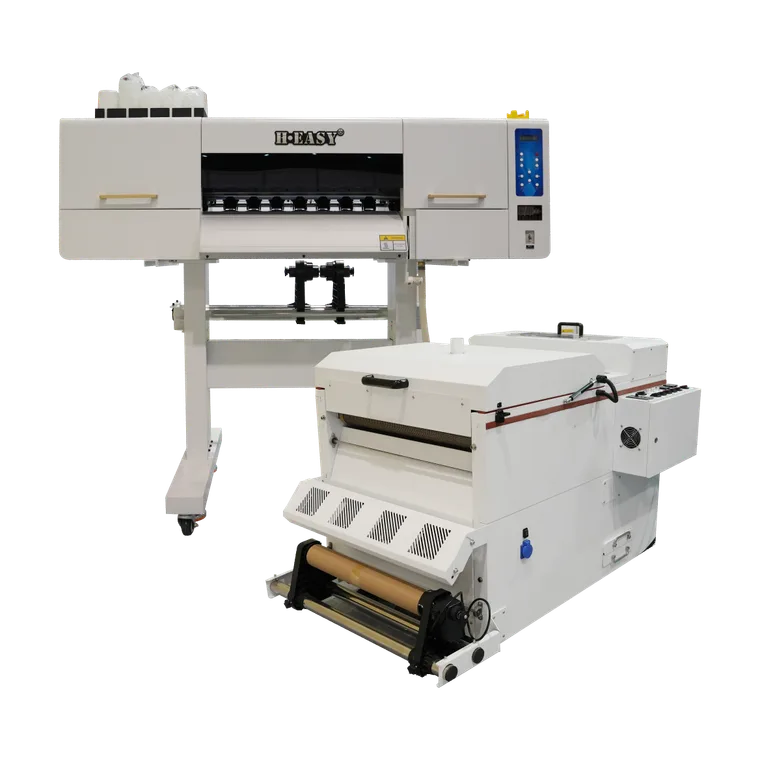
H·EASY HY-702/704: Designed Around Stable DTF Production
The H·EASY HY-702/704 illustrates how DTF equipment can support a more integrated production approach.
The HY-702/704 uses two Epson i3200-A1 printheads in a CMYK+W configuration, providing a dedicated white-ink printing solution for DTF transfer production.

Its ink supply configuration combines a large-capacity continuous ink supply system with white-ink circulation, helping support a more stable white-ink supply during continuous operation.
The machine features a 600 mm print width and an auto-lift cleaning station, providing a configuration designed for continuous DTF transfer production.
The purpose of these configurations is not simply to increase printing speed. More importantly, they are designed to support an integrated workflow in which printing performance, white-ink management, and production stability work together.
5. Powder Application and Curing Directly Affect DTF Transfer Reliability
After printing, the ink must interact correctly with the hot-melt adhesive powder. The powdering and curing stages therefore have a direct impact on adhesion, elasticity, surface texture, wash resistance, edge quality, and transfer consistency.
Uneven powder distribution can create weak or excessively thick areas. Insufficient curing may result in poor bonding, while excessive heat can negatively affect the film, ink layer, or adhesive properties.
For continuous DTF production, the curing system should maintain stable process conditions rather than relying on frequent manual adjustments.
Important variables include heating temperature, heating time, conveyor speed, powder quantity, powder recovery, and powder distribution uniformity.
H·EASY Powder Shaking and Drying System
The HY-702/704 can be combined with a dedicated powder-shaking and drying system to create a more continuous DTF production workflow.

Key configuration features include:
- Mesh-belt conveyor
- Automatic take-up and feeding
- High-frequency powder shaking
- Powder distribution control
- Front heat-conduction plate preheating
- Upper drying and curing
- Air-cooling function
- Optional smoke filtration
- Heating-belt adjustment
The system is rated at 4.5 kW, 220 V / 16 A.
The powdering and curing process should be controlled as carefully as the printing process.
6. Heat Transfer Is the Final Test of the DTF Process
The quality of a DTF transfer cannot be judged only by the printed film. The final heat-transfer process determines whether the printed image successfully bonds to the garment.
Even with the same printer, film, ink, and powder, different combinations of temperature, pressure, pressing time, fabric type, and peeling method can produce different results.
Improper heat-transfer conditions may cause poor adhesion, peeling, bubbling, excessive pressure marks, and inconsistent wash durability.
Professional DTF production should therefore establish standardized heat-press parameters for different fabrics and transfer applications.
Printing → Powder Shaking → Drying & Curing → Heat Press → Finished Garment
7. From Individual Equipment to a Complete DTF Workflow
A professional DTF production line is not simply a printer placed next to a powder shaker. The equipment needs to work together as a complete process.
H·EASY HY-702/704 DTF Printer
↓
Powder Shaking & Drying System
↓
Heat Press
↓
Finished Transfer Product
This workflow reflects a broader shift in DTF production. The competitive advantage is moving away from individual components and toward the stability and efficiency of the complete production chain.
When printing, powder application, curing, and heat transfer are properly coordinated, manufacturers can achieve more predictable production results while reducing the risks associated with manual process variations.
8. The Future of DTF Printing: From Material Competition to Process Integration
8.1 Full-Process Standardization
A standardized DTF workflow should connect every production stage: Artwork → RIP → Printing → Powder Application → Curing → Storage → Heat Transfer → Quality Inspection.
Each stage should have defined operating parameters and quality-control standards.
- More consistent color
- Stable white coverage
- Consistent hand feel
- Repeatable transfer performance
- Lower rejection rates
- More predictable production costs
8.2 Automation and Production Efficiency
Labor costs, powder waste, rework, and defective transfers all affect DTF production margins. As a result, automation is becoming an increasingly important direction for the industry.
- Automated powder application
- Powder recovery
- Automatic temperature control
- Stable web tension
- Automatic film alignment
- Continuous curing
- Automated white-ink circulation
- Production monitoring
The goal is not simply to increase printing speed. The real goal is to increase usable output while reducing waste, rework, and manual intervention.
8.3 More Sustainable and Controlled Production
Environmental considerations are also influencing how DTF production systems are designed. Sustainable DTF production involves more than selecting low-odor or low-VOC inks.
- Powder and dust management
- Exhaust and ventilation
- Energy consumption
- Waste-film handling
- Powder recovery
- Equipment efficiency
- Workplace safety
The optional smoke filtration and powder-management functions of a supporting powder-shaking system can contribute to a more controlled production environment.
9. How to Build a More Stable DTF White-Ink Production System
For DTF manufacturers looking to improve production stability, it is more useful to evaluate the entire workflow than to focus on a single consumable.
- Ink System - Check white-ink circulation, filtration, pressure stability, ink-path design, and printhead maintenance.
- RIP Configuration - Optimize white-ink density, ink limits, underbase generation, choke, feathering, and fine-detail processing.
- Film and Powder - Verify compatibility between PET transfer film, DTF ink, and hot-melt adhesive powder.
- Printing, Powdering and Curing - Maintain stable printing parameters, powder distribution, heating temperature, curing time, and conveyor speed.
- Heat Transfer - Establish standardized temperature, pressure, and pressing time for different fabrics and transfer applications.
When these five areas are properly coordinated, manufacturers can improve not only visual quality but also production consistency, transfer durability, workflow efficiency, and overall cost control.
Conclusion
The DTF industry is moving beyond the stage where simply choosing a better ink can create a sustainable competitive advantage.
Ink remains important, but it is only one component of the production system.
Film, ink, printhead, ink delivery, RIP software, hot-melt powder, curing, and heat transfer must work together to create a stable DTF printing process.
The H·EASY HY-702/704 demonstrates this approach by combining dual Epson i3200-A1 printheads, CMYK+W printing, large-capacity continuous ink supply, white-ink circulation, auto-lift cleaning, and 600 mm print width with a supporting powder-shaking and drying system.
For low-volume production, changing consumables may produce visible improvements. For high-volume manufacturing, however, process optimization is what determines consistency, productivity, durability, and production cost efficiency.
The future of DTF printing will therefore be less about “Which ink is better?” and more about “Which complete process can deliver better quality, higher stability, and lower production costs?”
That is where the real competitive advantage of DTF printing will come from.
| Parameter | HY-702/704 |
|---|---|
| Print Width | 600 mm |
| Printheads | 2 × Epson i3200-A1 |
| Print Mode | CMYK + W |
| Ink Supply | Large-capacity continuous ink supply + white-ink circulation |
| Media | PET transfer film |
| 4-Pass Speed | Up to 22 m²/h |
| 6-Pass Speed | Up to 15 m²/h |
| RIP Software | PhotoPrint / RIIN |
| Control System | Hosonsoft |
| Cleaning | Auto-lift cleaning station |
Printers matched to this guide