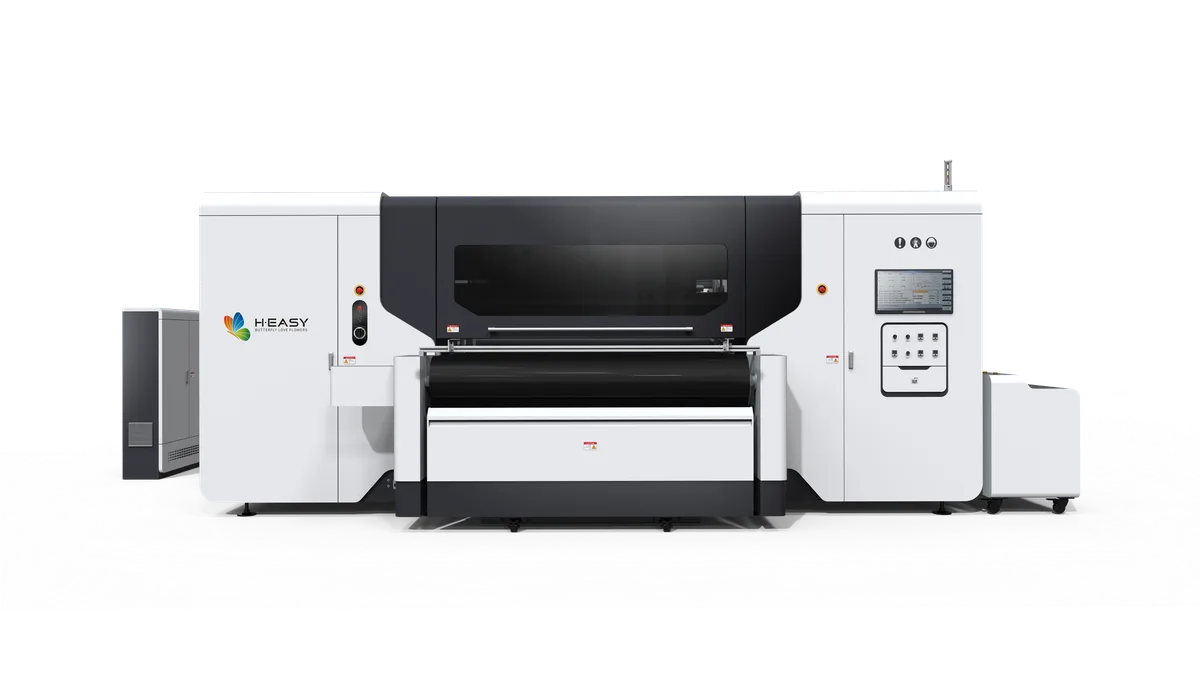
Pigment Digital Printing Machine: Why It May Become a Key Technology for Flexible Textile Manufacturing

Introduction
Over the past decade, digital textile printing has solved one major question:
How can textile manufacturers move beyond the limitations of rotary screen and flat screen printing for small-batch, multi-design production?
Reactive digital printing has entered the cotton, linen and viscose market. Acid digital printing has served silk, wool and nylon applications. Disperse sublimation and disperse direct printing have become important solutions for polyester fashion, sportswear and synthetic fabrics.
But as the textile industry enters a new production cycle, a different question is becoming more important:
How can textile and apparel manufacturing respond as fast as internet-driven demand?
The answer may point to a technology that was once considered not mature enough: pigment digital printing.
As pigment ink, printhead control, machine structure, pretreatment and fixation processes continue to improve, the pigment digital printing machine is moving from niche applications toward industrial-scale production. It is becoming an important equipment choice for fast fashion, e-commerce apparel, digital denim, children’s wear, home textiles and customized fabric printing.
Why Is a Pigment Digital Printing Machine Worth Attention?
The value of a pigment digital printing machine is not only that it can print on fabric. More importantly, it fits the future logic of textile manufacturing.
| Industry Change | Value of Pigment Digital Printing Machine |
|---|---|
| Orders are becoming smaller | Suitable for small batches, multiple styles and fast sampling |
| Fashion cycles are becoming faster | Digital files can be printed directly with less reliance on screen-making |
| Fabric types are becoming more complex | Supports cotton, linen, rayon, blends and selected synthetic fabrics |
| Environmental requirements are increasing | Usually reduces dependence on traditional washing processes |
| E-commerce reorders are growing | Suitable for small test orders and quick repeat production |
| Factories need transformation | Helps traditional printing factories build flexible production capability |
What Is a Pigment Digital Printing Machine?
A pigment digital printing machine is a type of digital textile printing machine that uses pigment ink to print directly onto fabric. The machine controls inkjet printing through digital image files. After printing, pretreatment, drying and heat fixation help pigment particles form a stable color layer on the fabric surface.
Unlike reactive, acid or disperse dye-based printing, pigment printing does not mainly depend on chemical reaction with one specific fiber type. Instead, it relies on:
- pigment particles;
- pretreatment solution;
- binder system;
- drying;
- heat fixation;
- finishing when needed.
A typical pigment digital printing workflow is:
Fabric Inspection → Pretreatment → Digital Printing → Color Fixation
In production, it is often simplified as:
Sizing → Printing → Fixation
Compared with reactive, disperse and acid printing processes that usually require sizing, printing, steaming, washing and finishing, pigment printing has a shorter workflow. This is one of the main reasons why pigment digital printing machines are gaining more attention.
1. Traditional Textile Printing Is Facing New Industry Challenges
Traditional textile printing has long been built around the logic of large volume, fewer patterns and lower unit cost.
Rotary screen and flat screen printing are still competitive for large-volume orders. The larger the order, the easier it is to spread the cost of screens, paste preparation, trial printing and setup.
But today’s apparel and textile market is changing. E-commerce platforms, fast fashion brands, designer labels and cross-border apparel supply chains are pushing a new order model:
- small batches;
- multiple styles;
- frequent reorders;
- fast product launches;
- rapid replenishment;
- personalized designs.
Brands no longer want to produce massive inventory at one time. Instead, they prefer to test the market with small quantities first, then reorder quickly based on sales feedback.
This is where digital textile printing creates value - and where pigment digital printing machines become especially relevant.
2. Why Is Pigment Ink Getting More Attention?
Pigment ink is gaining attention not because it replaces every other printing process, but because it is closer to the future needs of apparel and textile manufacturing: shorter workflow, wider fabric compatibility, lower water dependence and faster response.
2.1 Better for Short-Process Manufacturing
Many dye-based textile printing processes require longer post-treatment, including steaming, washing, drying and finishing.
Pigment digital printing usually focuses on:
Pretreatment → Printing → Fixation
A shorter workflow allows factories to handle:
- fast-response orders;
- small-batch production;
- multi-design orders;
- e-commerce test styles;
- brand sampling.
For apparel supply chains, faster production requires fewer waiting steps and less process complexity.
2.2 Better for Multi-Fiber Applications
Modern textile products are no longer limited to one fiber type. A printing factory may need to work with:
- cotton;
- linen;
- rayon;
- cotton-polyester blends;
- cotton-linen blends;
- knitted blends;
- white denim base fabric;
- decorative home textile fabrics.

Pigment digital printing can be applied to a wide range of fabrics, including cotton, silk, polyester, nylon, rayon, blended fabrics, wool and linen. This gives pigment digital printing machines strong flexibility in blended-fabric and multi-material production.

2.3 Better Aligned with Sustainable Manufacturing
Textile dyeing and printing have long faced pressure from water consumption, wastewater treatment and chemical usage.
One advantage of pigment digital printing is that many standard workflows reduce dependence on traditional washing processes. This helps lower water use and wastewater pressure in certain applications.
For factories upgrading toward greener production, a pigment digital printing machine is not only printing equipment. It can also be an entry point into a more sustainable textile production model.
3. Why Did Pigment Digital Printing Not Break Out Earlier?
Pigment digital printing is not a new concept. The reason it did not fully break out in earlier years was mainly technical difficulty.
3.1 Hand Feel and Fastness Were Hard to Balance
Pigment ink mainly stays on the fabric surface. If pretreatment and binder systems are not controlled properly, common problems may include:
- stiff hand feel;
- heavy surface texture;
- poor dry or wet rubbing fastness;
- color change after washing;
- dull appearance in dark areas.
Therefore, for pigment digital printing machines to achieve industrial production, factories need more than printing capability. They need stable pretreatment, fixation, fixing agent and softening processes.
3.2 Deep Colors Are More Challenging
Black, navy, dark brown and dark gray patterns usually require higher ink volume and stronger fixation control.
If ink volume is increased blindly, it may cause:
- heavier drying load;
- harder hand feel;
- more floating color;
- lower rubbing fastness;
- higher production cost.
Deep-color performance in pigment printing depends not only on ink density, but also on:
- ICC profile;
- ink limit control;
- pretreatment uniformity;
- drying completeness;
- fixation temperature and time.
3.3 Printhead, Ink and Waveform Must Be Highly Matched
Pigment ink contains solid color particles, which makes it more demanding on printheads and ink supply systems.
If ink stability, printhead control, driver board, waveform or negative pressure is not well matched, factories may face:
- nozzle clogging;
- missing nozzles;
- unstable jetting;
- color variation;
- frequent cleaning downtime.
This means the competition in pigment digital printing machines is not only about hardware. It is about complete system capability.
4. The Competition Has Changed: From Machine Speed to System Capability
The future competition of pigment digital printing machines will not only be about who prints faster. What really affects long-term profitability is system capability.
A mature pigment digital printing solution must solve several problems at the same time:
| System Area | Key Requirement |
|---|---|
| Printhead system | Stable jetting, fewer missing nozzles, easier maintenance |
| Ink system | Stable dispersion, printhead compatibility, batch consistency |
| Driver board and waveform | Matching between printhead, ink and production speed |
| Machine structure | Stable high-speed running and accurate positioning |
| Belt feeding | Flat fabric feeding without skewing or wrinkling |
| Pretreatment | Controls color yield, sharpness, fastness and hand feel |
| Drying and fixation | Ensures film formation and rubbing fastness |
| Color management | Controls batch difference and repeat-order consistency |
| Technical service | Helps factories reduce trial-and-error cost |
Many factories do not fail because the machine cannot print. They fail because the system cannot support long-term stable production, low rework, fewer nozzle issues, consistent color and controllable cost.
5. What Signals Are Textile Exhibitions Sending?
In recent years, textile machinery exhibitions have sent a clear signal: digital textile printing is moving from single-machine display to complete production solution competition.
In the past, buyers mainly focused on:
- machine speed;
- number of printheads;
- printing width;
- resolution.
Now, more buyers are asking:
- Is the ink stable?
- Is the pretreatment process mature?
- Is the finishing process matched?
- Can bulk production remain consistent?
- Can small orders be profitable?
- Is the machine suitable for long-term industrial production?
This shows that the market is becoming more mature.
For pigment digital printing machines, exhibition attention reflects a larger market trend: lower water dependence, shorter processes, personalization and flexible manufacturing.
6. Market Applications Are Pushing Pigment Digital Printing Machines Forward
6.1 Fast Fashion and E-Commerce Apparel
Fast fashion and e-commerce orders usually require:
- many styles;
- smaller quantities;
- short delivery time;
- quick reorders;
- frequent artwork updates.
Pigment digital printing machines help factories handle these orders more flexibly, especially for cotton, rayon, blended apparel fabrics and custom textile products.
6.2 Digital Denim
Digital denim is one of the important growth applications for pigment digital printing.
Traditional denim effects such as washing, whiskers, fading and distressing usually rely on water washing, sanding, chemical treatment and manual finishing.
Digital denim can reproduce these effects through image-based printing on white or light-colored denim base fabric, including:
- whiskers;
- washed textures;
- vintage effects;
- distressed visuals;
- retro graphics;
- personalized designs.
This makes it suitable for e-commerce sellers, streetwear brands, small batches and fast-response orders.
6.3 Children’s Wear and Personalized Apparel
Children’s wear often requires multiple patterns, faster design changes and higher attention to production safety and environmental performance.
Pigment digital printing machines can quickly switch among different designs, making them suitable for children’s wear, parent-child apparel, school clothing and event apparel.
6.4 Home Textiles and Decorative Fabrics
The home textile market is moving from standard bulk production toward personalized and collection-based development.
Pigment digital printing can be used for:
- curtains;
- sofa fabrics;
- cushions;
- bedding;
- decorative fabrics.
For home textile customers, machine stability, printing width, long-roll production and color consistency are especially important.
7. Behind Ink Demand Growth, Factories Must Focus on Total Cost
Growing pigment ink demand shows that the market is expanding. But for printing factories, ink volume and ink price are not the only factors.
The real question is: What is the total production cost per square meter?
Total production cost includes:
- ink consumption;
- pretreatment solution;
- fixing agent;
- softening treatment;
- cleaning ink loss;
- rejected fabric and rework;
- machine depreciation;
- labor and energy;
- machine utilization.
A practical reference for pigment ink consumption is around 20g/m², but actual production should be tested according to artwork coverage, fabric type, color depth and fastness requirements.
8. What Kind of Pigment Digital Printing Machine Is Suitable for Industrial Production?
In the next few years, pigment digital printing machines will need to do more than produce samples. A machine suitable for industrial production should have the following capabilities.
8.1 Stable Integrated Frame
Pigment digital printing requires long-time continuous production. If the machine frame is not stable, factories may face:
- image shifting;
- color variation;
- unstable fabric feeding;
- printhead alignment error;
- poor bulk consistency.
A stable integrated frame helps improve mechanical accuracy and long-term production stability.
8.2 High-Precision Printhead Bottom Plate
In multi-head machines, printhead bottom plate accuracy directly affects:
- color registration;
- image sharpness;
- batch consistency;
- long-term stability.
A high-precision head bottom plate helps maintain accurate printhead positioning and stable output.
8.3 Stable Ink and Machine Compatibility
Because pigment ink contains particles, it must be matched with printheads, ink supply, waveform and maintenance systems.
Ink compatibility helps reduce:
- nozzle clogging;
- color variation;
- downtime;
- production uncertainty.
8.4 Mature Pretreatment and Fixation Support
The final result of pigment printing is not decided by the printer alone.
Pretreatment affects:
- color yield;
- edge sharpness;
- dry and wet rubbing fastness;
- hand feel;
- bulk production stability.
Fixation also needs to be tested according to fabric, ink, pattern coverage and customer requirements. A pigment digital printing machine should be part of a full workflow including pretreatment, drying, fixation and finishing.
9. Pigment Digital Printing Machine Solutions
For factories planning to enter pigment digital printing, machine selection should match order structure, fabric type and production target.

We provide different pigment digital printing solutions according to customer needs.
| Factory Requirement | Recommended Direction |
|---|---|
| Sampling, small-batch and e-commerce orders | HY-1808 |
| Apparel fabrics and medium-volume fast-response production | HY-1816 |
| Multi-style mixed production | HY-1816 |
| High-capacity continuous production | HY-2232 |
| Home textiles or wide-format fabrics | Customized solution based on width requirements |
Our value is not only supplying a pigment digital printing machine. We support factories with:
- stable machine structure;
- ink compatibility;
- pretreatment guidance;
- fixation process support;
- color management;
- production application experience;
- technical service.
For investors entering digital textile printing for the first time, this complete solution is more important than simply comparing machine prices.
10. What Will Pigment Digital Printing Machines Solve in the Next Decade?
Over the past decade, digital textile printing solved the question: How can textile printing move beyond rotary screen and flat screen limitations?
In the next decade, the question will become: How can textile production respond as quickly as digital commerce?
This is where pigment digital printing machines have strong potential.
They will not completely replace reactive, acid or disperse printing systems. However, they will continue expanding in:
- fast fashion;
- small-batch fast-response orders;
- e-commerce apparel;
- digital denim;
- children’s wear;
- personalized apparel;
- customized home textiles;
- blended fabrics;
- sustainable supply chains.
Future competition will focus on three battles.
10.1 Technology Improvement
The industry needs to improve:
- hand feel;
- deep-color performance;
- rubbing fastness;
- printhead stability;
- bulk consistency.
10.2 Cost Optimization
Factories need to reduce:
- ink waste;
- cleaning loss;
- rework rate;
- machine downtime;
- total cost per square meter.
10.3 Application Expansion
Pigment digital printing will continue expanding from apparel and home textiles into:
- digital denim;
- home décor;
- personalized consumer products;
- industrial textiles.
Conclusion: Pigment Digital Printing Machines Are Becoming an Entry Point to Flexible Manufacturing
The value of pigment digital printing is not only water saving or no screen-making.
Its real value lies in how it matches the transformation of textile manufacturing: from large-volume inventory production to small-batch, multi-style and fast-response flexible manufacturing.
As pigment ink, printhead control, machine structure, pretreatment and fixation processes continue to mature, the pigment digital printing machine is becoming an important equipment choice for printing factories entering the next stage of digital production.
But successful pigment digital printing requires more than purchasing a machine. Factories need a complete system: stable equipment + suitable ink + standardized pretreatment + precise fixation + color management + process support.
We will continue to focus on pigment digital printing applications and provide more stable, efficient and industrial-ready textile digital printing solutions for apparel, home textiles, digital denim and small-batch fast-response markets.