How to Choose Ink for Digital Textile Printing
Choose digital textile printing ink by matching the fibre, print route, machine fluid path, finishing process and finished-product requirement as one system. An ink label that names the right fabric or printhead does not prove that the installed line will produce stable, sellable output. Qualification must cover everything from the container to the finished and tested textile.
This is why ink selection should happen before a production machine is ordered or an existing line is converted. The decision affects pretreatment, drying, fixation, washing, color management, maintenance supplies and the type of work the factory can accept.
Define the product and print route first
Begin with what receives the image. Roll fabric, a finished garment and a transfer film enter different production routes even when all of them are described as digital textile printing.
Record the fibre composition, fabric construction, base color, surface finish, stretch, heat sensitivity and intended use. Then state whether the image will be printed directly onto fabric, directly onto a garment or onto a transfer that is applied later. The right ink is tied to that route; it cannot be chosen from the artwork alone.
The garment printing methods guide helps separate direct garment printing, film transfer, sublimation and other garment workflows. For roll fabric, use the fabric process selection guide to map the material before comparing ink suppliers.
Match ink chemistry to the fibre and finishing process
Different textile ink families use different ways to remain on or in a fibre. That mechanism determines the suitable materials and the finishing equipment the factory must support.
- Reactive ink is used in qualified routes for cellulose-rich materials. The complete process normally includes preparation, fixation and washing.
- Disperse ink is used for polyester routes. The job may be printed onto transfer paper or directly onto suitable fabric, followed by the specified heat process.
- Acid ink is used in qualified routes for protein fibres and selected synthetic materials. Preparation, fixation and washing remain part of the process decision.
- Pigment ink places pigment at the textile surface with a binder system. It can be qualified across a broad material range, but hand, crocking and curing performance depend on the complete recipe.
- Garment and transfer inks must be selected for their specific DTG, DTF or sublimation workflow rather than treated as interchangeable textile fluids.
No chemistry is automatically best for every job. A factory that cannot steam or wash should not select a route that depends on those stages. A factory that needs a particular hand, stretch response or care result should test that finished requirement instead of relying on a generic statement about color. The R2R ink workflow guide explains how the main direct-to-fabric routes differ.
Treat the printer and ink path as a qualified system
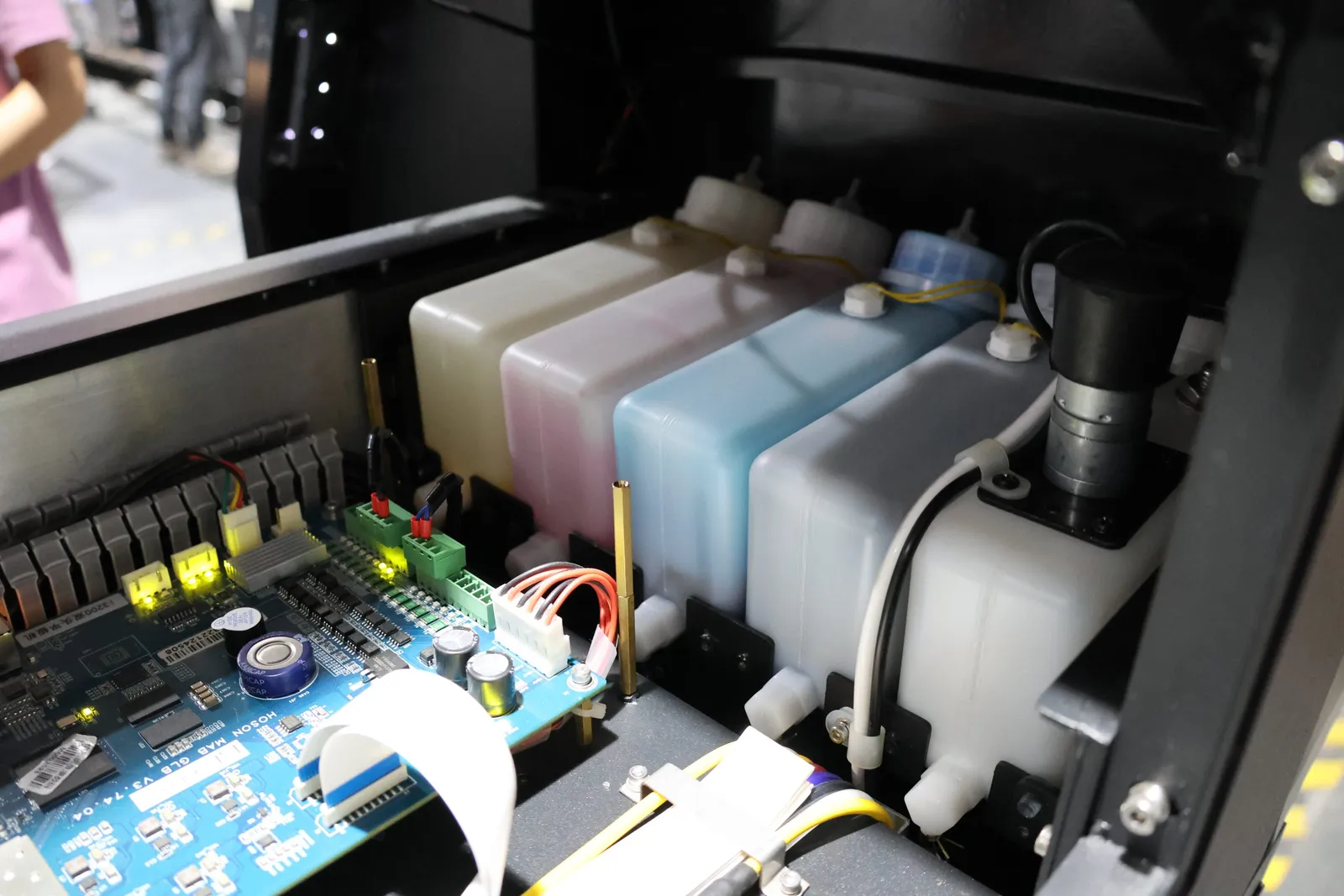
Printhead compatibility is necessary, but it is not enough. Ink moves through containers, filters, pumps, tubing, valves, dampers and pressure-control parts before it reaches the nozzle. It must also work with the machine’s waveform, recirculation behavior, capping station and approved cleaning fluid.
Ask the machine supplier to identify the approved ink set for the installed configuration in writing. The answer should also identify the matched cleaning and storage fluids, maintenance consumables and any configuration-specific handling procedure. A supplier saying that an ink is “for” a head family does not confirm compatibility with every machine built around that head.
Do not mix ink, cleaner or replacement parts merely because the connectors fit. Chemical incompatibility can create deposits, swelling, separation or unstable jetting elsewhere in the path. Follow the controlled documents for the machine and ink rather than improvising a flush.
Translate buyer requirements into an acceptance plan
“Good color” is not a usable qualification target. Write down the properties that decide whether the finished product can ship, such as:
- approved color under the agreed viewing condition;
- edge detail, gradients, solids and repeat appearance;
- hand, surface feel and penetration where relevant;
- stretch and recovery for the intended product construction;
- resistance to the care, rubbing, light or exposure conditions specified by the buyer;
- staining, migration or transfer behavior after the required finishing;
- repeatability between ink lots and production runs.
Use the buyer’s actual test method when one is specified. A supplier’s sample on a different fabric, with a different finish, cannot replace qualification on the intended product. Certification paperwork also does not prove color, fastness or hand on a factory’s own route; treat compliance evidence and production performance as separate checks.
Run the ink trial through the complete route
Use representative production fabric and artwork, including difficult coverage, fine detail, gradients and the colors the factory must control. Record the ink identity and lot, fabric lot, pretreatment, machine configuration, print mode, profile, room condition and every finishing step. Without that record, a good sample cannot be reproduced reliably.
Inspect the print before and after finishing. Some faults appear only after heat, washing, pressing or curing, while an unstable pretreatment can make a sound ink look defective. Keep an approved physical sample and the production record together so a later lot or supplier change can be compared against the same reference.
The trial should also include a controlled production run, startup after an idle period and the approved cleaning routine. Watch for nozzle loss, density drift, separation, air movement, filter restriction, excessive maintenance or unusual residue. These observations test operating stability rather than only the first attractive print.
Evaluate the supplier beyond the container
A production ink supplier should provide controlled product identification, handling documents, lot traceability and a clear process for reporting a quality issue. Confirm how the supplier communicates formulation or production changes and how replacement stock is matched to an approved lot.
Review storage and handling requirements against the factory’s real receiving, warehouse and production conditions. Follow the current supplier data sheet for temperature, shelf life, agitation and conditioning rather than copying values from another ink. Make sure the recommended cleaning fluid and maintenance consumables can be supplied with the ink, not discovered only after a stoppage.
Technical support should be able to distinguish an ink fault from a profile, pretreatment, finishing, environment or hardware fault. Preserve nozzle checks, job records and samples so that support receives evidence instead of a vague report that the color has changed.
Compare the cost of approved output
Container price is only one input. Compare how each qualified option affects ink consumption on representative artwork, cleaning and startup waste, pretreatment and finishing, labor, rejected output, inventory, maintenance and supplier support. Use the factory’s own trial records rather than a promised return or a universal cost claim.
An inexpensive ink that changes color between lots, needs repeated recovery or fails after finishing may increase the cost of every approved metre or garment. The textile printer buying checklist shows how to connect consumables with the rest of a line-level purchasing decision.
Control any ink change as a conversion project
Changing ink supplier or chemistry is not a routine refill. First obtain a written conversion procedure for the installed machine. It should define which fluids and ink-path parts are compatible, how old material is removed, how waste is handled, how the new ink is introduced and how the machine is verified before production resumes.
A successful conversion also requires new color qualification and finished- product testing. Keep the previous approved sample and process record so the change can be evaluated honestly. If the supplier cannot document the conversion boundary, do not use production equipment as the experiment.
Make the final selection reproducible
Approve an ink only when the production record connects the material, machine, fluid path, pretreatment, print mode, profile, finishing route and acceptance result. Keep the approved ink identity, support contact, maintenance supplies, physical sample and change-control rule with that record.
This approach turns ink selection from a marketing comparison into a controlled factory decision. It also makes future troubleshooting faster: the team knows which variables were qualified and which change must be investigated.
Printers matched to this guide