Ricoh MH5421F vs Kyocera KJ4B-EX600-RC
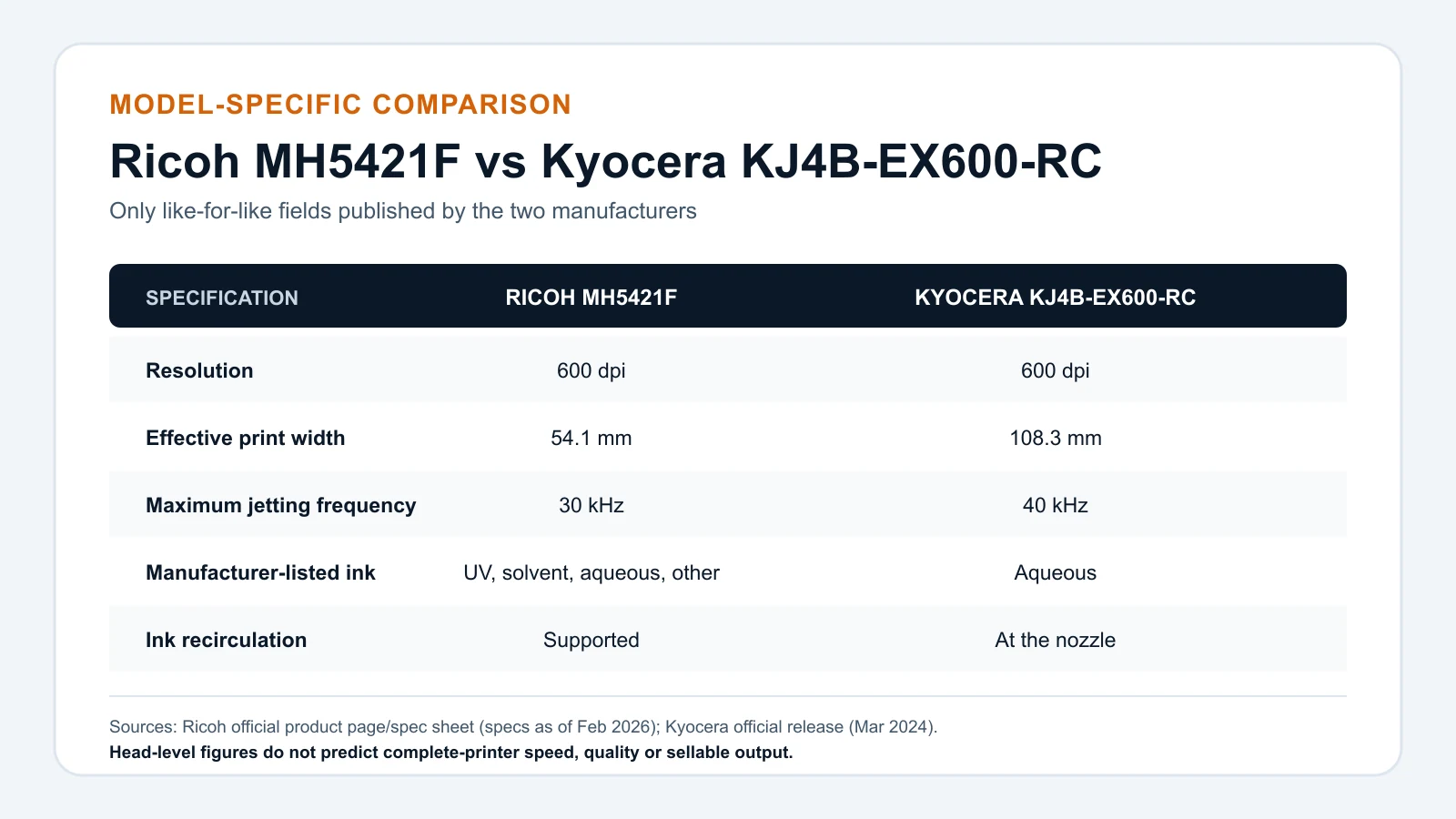
The Ricoh MH5421F and Kyocera KJ4B-EX600-RC are industrial inkjet printheads with published 600 dpi resolution and ink recirculation, but they are not interchangeable specifications. Their effective widths, listed ink scope, maximum jetting frequencies, drop-volume schedules and physical sizes differ. A defensible comparison starts with the exact model datasheets and ends with a complete-system trial using the intended ink and textile route.
This article replaces a legacy brand-level comparison that made unsupported claims about cost, colour, speed and print quality. The rewrite compares only the two named models and only fields available from their manufacturers. A blank field stays “not published” rather than becoming an assumption.
Like-for-like published specifications
| Published field | Ricoh MH5421F | Kyocera KJ4B-EX600-RC |
|---|---|---|
| Resolution | 600 dpi | 600 dpi |
| Effective print width | 54.1 mm | 108.3 mm |
| Ink recirculation | Supported | Recirculation at the nozzle |
| Manufacturer-listed compatible ink | UV, solvent, aqueous, others | Aqueous |
| Maximum jetting frequency | 30 kHz | 40 kHz |
| Published drop volumes | 7 / 14 / 21 pL, depending on ink | 14 pL at 40 kHz, 18 pL at 30 kHz, 24 pL at 20 kHz |
| Body dimensions | 89 × 24.5 × 66.3 mm | 200.0 × 30.0 × 68.2 mm |
| Published viscosity value | 11 mPa·s for the MH5421F | Not published in the cited Kyocera release |
| Weight | 147 g | Not published in the cited Kyocera release |
| Maximum print speed | Not published on the cited Ricoh product page or sheet | 101.6 m/min |
Every value in the table is model-specific. The manufacturers do not provide a like-for-like nozzle-count field across the cited pages, so this guide does not compare nozzle counts. It also does not convert print width into a recommended number of heads or a complete printer width.
What the shared 600 dpi figure does and does not mean
Both manufacturers publish 600 dpi, which provides one comparable addressability field. It does not prove that the two heads will create the same textile image.
Perceived detail and colour depend on the nozzle condition, drop behaviour, waveform, ink, substrate, pretreatment, head gap, media control, screening, profile and finishing route. Ink spread on a woven or knitted surface can change an edge even when the head specification is unchanged. A factory should therefore compare an approved print target on the intended fabric rather than select a head from dpi alone.
Effective width changes the integration problem
Ricoh publishes a 54.1 mm print width for the MH5421F. Kyocera publishes a 108.3 mm effective print width for the KJ4B-EX600-RC. The second number is larger, but that fact alone does not establish a faster or better printer.
Head layout also has to account for mounting tolerances, stitching between heads, usable carriage or bar geometry, service access, cable and ink routing, media width and the control system. A wider head can change the number and arrangement of components in a design, while a narrower head can support a different layout strategy. Only an engineered configuration can show the resulting printable width and uniformity.
Recirculation descriptions are not proof of identical architecture
Ricoh lists an ink-circulation structure as supported and describes continuous flow through the head. Kyocera describes recirculation at the nozzle for the KJ4B-EX600-RC. Both disclosures are relevant to fluid management, especially where sedimentation, entrained air or drying near the nozzle can affect jetting.
The wording is not enough to declare the internal paths or maintenance behaviour equivalent. An integrator still needs the current plumbing diagram, pressure requirements, filtration, degassing approach, temperature-control method, startup and shutdown procedure, and recovery sequence for the selected fluid.
Ink labels define a starting point, not an approval
Ricoh lists UV, solvent, aqueous and other ink categories for the MH5421F family. Kyocera lists aqueous ink for the KJ4B-EX600-RC and identifies textiles as one application. Those are manufacturer statements about broad compatibility scope.
They do not approve every formulation inside a category. Two aqueous textile inks can differ in viscosity, surface tension, pigment or dye system, particle behaviour, additives and drying response. The waveform, temperature and fluid path must be qualified with the exact ink. The Ricoh sheet publishes 11 mPa·s for the MH5421F, while the cited Kyocera release does not publish a viscosity value. That missing field should be requested from Kyocera or the system integrator, not inferred from the word “aqueous.”
The digital textile ink selection guide shows how fibre, ink chemistry and finishing route fit together before a head or printer configuration is approved.
Frequency and drop volume must be read together
Ricoh publishes a 30 kHz jetting frequency and 7, 14 or 21 pL drop volumes, depending on ink. Kyocera publishes a maximum 40 kHz frequency with 14 pL at 40 kHz, 18 pL at 30 kHz and 24 pL at 20 kHz.
These values describe manufacturer test points, not a ranking. A higher frequency does not guarantee more sellable fabric per hour, and a larger drop does not guarantee stronger colour. The available operating point depends on the qualified ink, waveform, desired coverage and stability. The printer then adds head count and arrangement, motion, pass strategy, data delivery, drying and process stops.
Kyocera also publishes 101.6 m/min as a maximum print speed for its head. The cited Ricoh page and sheet do not publish a corresponding MH5421F speed, so no head-speed comparison is possible. More importantly, the Kyocera value must not be presented as a textile printer’s production speed. Printer output has to be measured under stated line conditions and reduced to sellable output after the complete process.
Physical size, cooling and service access matter
The published body dimensions are 89 × 24.5 × 66.3 mm for the Ricoh model and 200.0 × 30.0 × 68.2 mm for the Kyocera model. Ricoh publishes a weight of 147 g. The cited Kyocera release does not publish weight.
Those differences affect mechanical and service design. The head must fit with manifolds, cables, drive boards, cooling hardware, guards and access for inspection or replacement. Ricoh identifies an integrated heater and thermistor. Kyocera identifies a water-cooling system in its launch release. Those statements describe different published thermal features; they are not a complete cooling specification or evidence that one method is superior.
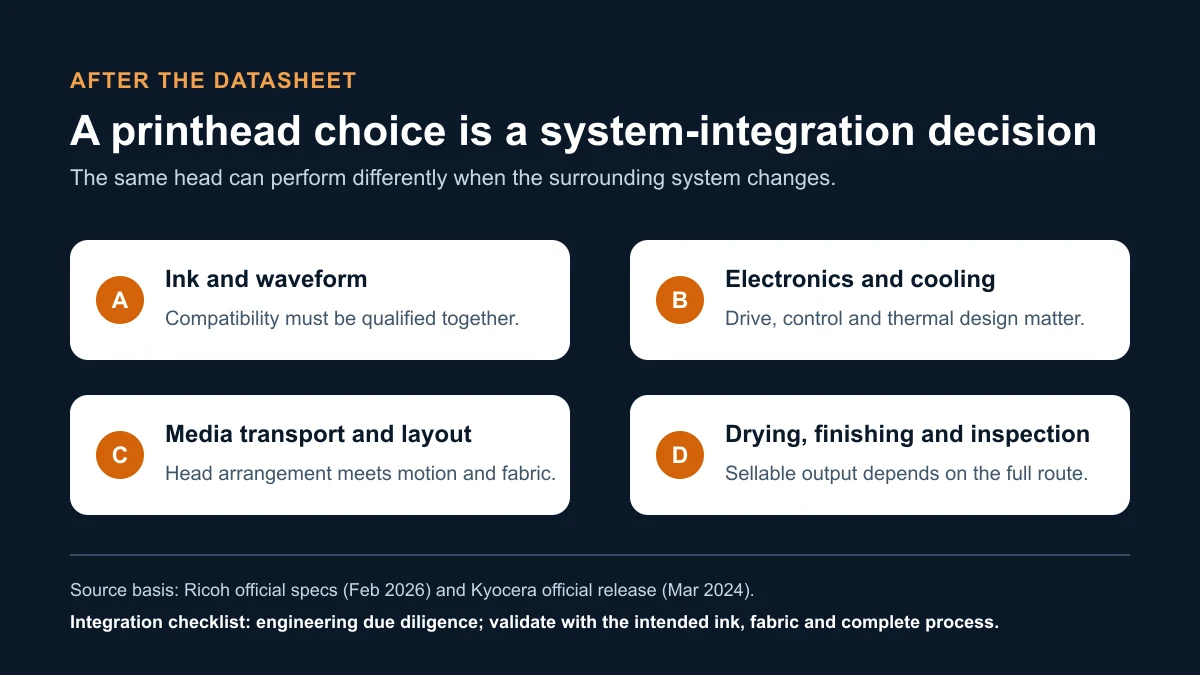
What a factory should compare beyond the head
A printhead decision belongs inside a system review:
- Confirm the exact model, revision and current manufacturer document.
- Obtain written fluid limits and qualify the intended ink formulation.
- Review waveform, drive electronics, data path and thermal control as one package.
- Check head arrangement, stitching, print gap, media transport and service access in the proposed machine.
- Run the intended fabric through pretreatment, printing, drying or fixation, washing where required, finishing and inspection.
- Record nozzle condition, settings, environment, material lot and accepted result so the trial can be reproduced.
- Confirm cleaning materials, replacement process, spares, warranty limits and local technical support.
The digital textile sampling workflow provides a structure for that trial. The R2R maintenance checklist helps expose access and recovery questions that a specification table cannot answer.
How to read a printer proposal that names either head
Ask the supplier to identify the exact printhead model rather than a manufacturer name or generation label alone. The proposal should state the head arrangement, intended ink, qualified operating point, printable width, test mode, fabric, coverage, complete process route and basis for any output claim.
If a proposal quotes the Kyocera maximum head speed as machine output, request the machine-level test conditions. If it assigns a speed to the Ricoh MH5421F, request the source because the cited Ricoh documents do not publish that field. If either proposal claims compatibility from a broad ink label, request the exact ink qualification record.
Current roll-to-roll textile printer configurations show how a complete platform adds width, head arrangement, ink route and process support around its specified head family. That product context is not evidence that the two heads in this article are interchangeable or installed in the same machine.
Bottom line
The official specifications support a neutral conclusion. Both named models publish 600 dpi and recirculation, but they disclose different widths, ink categories, frequency and drop-volume points, physical envelopes and supporting features. Some fields are missing on one side, so a complete numerical ranking would be invented.
Choose the system that can document compatibility with the intended ink, integrate the head safely, move the target textile consistently and reproduce an approved result through finishing. The printhead datasheet is the start of that decision, not the factory outcome.
Sources and references
- RICOH MH5421F/5421MF industrial inkjet printheadsRicoh MH5421F resolution, print width, recirculation, ink compatibility, frequency, drop-volume, viscosity, dimensions, weight and application statements.
- RICOH MH5421F/MH5421MF specification sheetThe Ricoh specification table and its statement that the specifications are current as of February 2026.
- Kyocera launches KJ4B-EX600-RC with ink recirculationKyocera KJ4B-EX600-RC dimensions, maximum print speed, resolution, effective width, frequency, drop volumes, aqueous-ink compatibility, recirculation and textile suitability.
- Kyocera inkjet printhead product lineupKyocera's description of the KJ4B series as a water-based-ink series used in single-pass and multi-pass applications including textile printing.